Showing posts with label faith. Show all posts

Sunday, August 03, 2014

What Humility Has to Do with Autism

Power tends to corrupt, and absolute power corrupts absolutely. ~ Lord Acton
Some friends and I were commenting on an article which states that people in power are less sensitive to social cues. "Studies have repeatedly shown that participants who are in high positions of power (or who are temporarily induced to feel powerful) are less able to adopt the visual, cognitive or emotional perspective of other people, compared to participants who are powerless (or are made to feel so)."

People in power are less able to mirror the emotions of others. It explains why politicians seem out of touch the longer they stay in Washington. Why the people who suffered at the hands of the monarchy and the czars committed cruel acts after they won revolutions. "When people experience power, their brains fundamentally change how sensitive they are to the actions of others." It causes me to appreciate people like George Washington: the people would have given him honors, titles, rank, and lavishness worthy of a king, but he remained humble. He went back to farming after his eight years in office ended.

If you have a special needs child in your life, this article becomes personal! The world views our children as weak — less than human. Their vulnerability makes others feel powerful. A friend's husband is in a wheelchair due to a recent accident. Although she works with special needs students, she didn't understand what it's like until now. People don't look her husband in the eye: he's beneath them. He communicates well, yet one waitress didn't leave a bill until my friend had returned from the bathroom.

Even in fleeting encounters, power lowers resonance with social cues. "For those participants who were induced to experience feelings of power, their brains showed virtually no resonance with the actions of others; conversely, for those participants who were induced to experience feelings of powerlessness, their brains resonated quite a bit. In short, the brains of powerful people didn't mirror the actions of other people."

Whether we are parent, teacher, or therapist, power can go to our head, especially when a task is vital. For me, that hot button was potty training because diapers shut down many opportunities. Pamela was six years old and still in pull-ups. No matter how often we headed her to the bathroom, she never realized it was time to go. Fortunately, I had read that a benefit of a gfcf diet was improved bladder control. I quit potty training until we started homeschooling Pamela and took her off certain foods. Fortunately, I had never pushed Pamela to the point of causing me to regret my actions. Had I not known about food connection, it could have happened.

Certain kinds of therapy puts the adult into a powerful role. Think about what a person might do to a child, even a well-intentioned adult who only wants the best for that child, might do because of the power differential. Even an intelligent, loving adult might overstep boundaries because power has shut down the mirror neurons that promote empathy. We know what can happen when a low-verbal or non-verbal child is put in the hands of someone with too much power. We see the awful stories on the news all the time!

I prefer Relationship Development Intervention and Charlotte Mason because adults are viewed as encouragers and guides. Children are valued for who they are, whether they are brilliant or a bit delayed or far, far "behind." In this "must-see" video on being the father of someone with autism and apraxia, Matt Oakes put our roles as parents and teachers very well.

"I don't think it's my job to force Liam to be the kind of kid, the kind of person that I want him to be. It's our job as parents, it's my job as his dad, to help him find who he is."

"Is." Not "will be."

"A child is a born person." ~ Charlotte Mason

The view of ourselves as persons in authority must be accurate as well. Matt appreciates the importance of humility.

"Instead of being this sort of superhero for their kids, I think that a good dad is someone who just humbles himself in front of their kids and finds ways to reach to their kid where they are and say I see you and I love you."

"I think to help kids unlock who they are you have to realize as a dad, as a parent, that it's really not about you. But, to make it about the kid, you have to be vulnerable and you have to be humble. You have to let that stuff go."


Mason cautioned us about our view of ourselves in this way, "Our deadly error is to suppose that we are his showman to the universe; and, not only so, but that there is no community at all between child and universe unless such as we choose to set up." She kicks this view of humility up a notch by recognizing authority properly.
"When we learn to realise that––God is, Self is, the World is, with all that these existences imply, quite untouched by any thinking of ours, unprovable, and self-proven,––why, we are at once put into a more humble attitude of mind. We recognise that above us, about us, within us, there are "more things . . . than are dreamt of in our philosophy." We realise ourselves as persons, we have a local habitation, and we live and move and have our being in and under a supreme authority." ~ Charlotte Mason
Humbling ourselves forces us to trust in the Teacher, the Holy Spirit, to work in our children what we cannot do. Like Matt said, our role is not to force our children to be what we want them to be. Only the Holy Spirit knows who they are. In our humility, we can help them find out. Since God already knows, the more we trust Him, the less we get in the way.
"When we recognise that God does not make over the bringing up of children absolutely even to their parents, but that He works Himself, in ways which it must be our care not to hinder, in the training of every child, then we shall learn passiveness, humble and wise. We shall give children space to develop on the lines of their own characters in all right ways, and shall know how to intervene effectually to prevent those errors which, also, are proper to their individual characters." ~ Charlotte Mason
I attended two Charlotte Mason retreats in the past two weeks. Clockwise invited me to assume a humble posture, that of a child, where we immersed ourselves in a typical school day. Living Education Retreat gave me three verses on humility:

"Likewise, you who are younger, be subject to the elders. Clothe yourselves, all of you, with humility toward one another, for 'God opposes the proud but gives grace to the humble.'" 1 Peter 5:5

"Rather, let the greatest among you become as the youngest, and the leader as one who serves." Luke 22:26

"At that time the disciples came to Jesus, saying, 'Who is the greatest in the kingdom of heaven?' And calling to him a child, he put him in the midst of them and said, 'Truly, I say to you, unless you turn and become like children, you will never enter the kingdom of heaven. Whoever humbles himself like this child is the greatest in the kingdom of heaven.'" Matthew 18:1-4

Monday, April 21, 2014

Beautiful in Its Time

I promised to share Mason's ideas about habits of faith in light of families dealing with autism becoming unchurched. Everything has a season. There is a time for every matter under heaven. God makes everything beautiful in its time. Since we cannot fathom His ways, we can wait and see what He has assigned for us and cling to Him during this dry season.

Some parents tag team (take turns on Sunday or attend different services). Some arrive in two cars. Some simply cannot make it. God is with us in all places and times: He knows when we rise and sit. He lays His hands on us to guide us and to hold us. Since He knows our thoughts, He knows when we long to worship Him with His people in His house but cannot because of our unique situation. We're always in His presence, even when we're changing a six-year-old's diaper.

I see His omnipresence as good news! The Father who sent His Son to meet the woman at the well, heal the sick, and be God in the flesh meets us where we are. We can draw great comfort that He's with us when we're stuck at home. Mason sees God as tender, compassionate, caring, and wise — better than any human father that has ever lived. We're with Him all the time! Our lives should have no separation between the secular and sacred, especially on Sundays! G. K. Chesterton paints the image beautifully in this poem:

You say grace before meals. All right.
But I say grace before the play and the opera,
And before the concert and the pantomime,
And grace before I open a book,
And grace before sketching, painting,
Swimming, fencing, boxing, walking, playing, dancing;
And grace before I dip the pen in the ink.


These habits are only a start. We shouldn't launch them all at once nor check them off like IEP goals. What little, daily things draw you to God? Take your time. Savor whatever moments come your way and leave checking off to the behaviorists.

Thought of God - God intends our spiritual life and earthly life to be one, so we can train faith habits anywhere, anytime. One habit is thought of God: "Happy-making, joyous thoughts, restful and dutiful thoughts, thoughts of loving and giving and serving, the wealth of beautiful thoughts with which every child's heart overflows." Since we're to be humble as children, we can hope for a heart full of beautiful thoughts. Relationship Development Intervention showed me how: slow down and focus on God's nonverbals. Something as mundane as dung beetles can make us rich toward God.

Dung beetles? Yes! I read a tidbit about dung beetles and their life cycle the weekend before last. Gross, but interesting stuff. What did we see on the nature walk at the wildlife refuge the following Friday? Dung beetles! I shared what I knew with two of our groups (we usually break up into four or five groups when we walk). It wasn't a coincidence because, two days later, my Sunday school class was taking turns reading Ezra 6. I read aloud the passage which included these words from the ESV: "Also I make a decree that if anyone alters this edict, a beam shall be pulled out of his house, and he shall be impaled on it, and his house shall be made a dunghill." On Monday morning, one student told me she heard a story about dung beetles on the radio on the way to school!

I think God weaves these threads into our lives to see if we are paying attention to His little pokes. While God may give us a booming call to do something big (such as opening a small, private school based on Mason's ideas in less than three months), He may also share delightful, little moments with us.

Bible Reading — Another habit on Mason's list is one we can cultivate at home. During my unchurched season, I wasn't regular in my Bible reading. I'm still not as regular as I'd like to be. If you're not well-versed in the Bible, why not pick something exciting like Daniel, Jonah, or Esther? Mason believed, "The narrative teaching of the Scriptures is far more helpful to children, anyway, than the stimulating moral and spiritual texts picked out for them in little devotional books." Tap into your inner child and read the Bible with a humble heart.

Read and narrate little bit at a time. Look at beautiful paintings or sculpture from that time in history. Look up places on the map and make your own Bible timeline. Daniel comes to life when you see the palace of Darius, the Ishtar gate, paintings like Blake's Nebuchadnezzar or Tanner's Daniel in the Lion's Den, or maps of Alexander's empire (wondering if he is the great horn or the mighty king). The Illustrated Bible Story by Story illuminates Bible reading beautifully.

Keep in mind that the idea isn't to become SUPER BIBLE READER with AMAZING LEGALISTIC POWERS! It's to feed on God's Word, meet with Him, and grow in grace and truth. Jesus promised that the Holy Spirit would instruct us in all things: surely, that includes the Bible. By opening the Word, we're inviting the Holy Spirit to be our teacher!

Regularity in Devotions — By devotions, Mason meant prayers and she thought it "a great thing for all of us to get the habit of 'saying our prayers' at a given time and in a given place." Devoting a set place and time for prayers is hard for parents of autistic children. Life is unpredictable and we never know when the timer is counting down to a meltdown. We can pray anywhere, anytime because God is everywhere. Jesus recommended finding a secret spot in your home and, when on the go, He did seek quiet places to pray, even late at night. Because some of our children have insomnia, praying in the wee hours of the night may be a good fit. Don't worry if you are too frustrated or too exhausted or too sad to say the "right" words. God has given us the Holy Spirit to speak on our behalf when we're speechless. Just as we long for our children to come to us, God longs for us to come to Him.

Habit of Praise — Music delights us and makes worship feel natural. Mason wrote, "Praise and thanksgiving come freely from the young heart; gladness is natural and holy, and music is a delight. The singing of hymns at home and of the hymns and canticles in church should be a special delight." God must value worship songs since the longest book of the Bible is pure music. David, a man after God's heart, wrote many psalms. Why not sing thoughts of God at home?

We focus on one hymn for a time and then learn another. I prefer sheet music to plain words to let Pamela see notes moving on a page and harmonies working together. While I prefer hymns and choral pieces like Handel's Messiah, Beethoven's Ninth, Mozart's Requiem, and Bruckner's motets, you might prefer something else. What kind of music draws you closer to God? The side benefit is that a spectrum child might enjoy worship services more if the music is familiar.

It amazes me how God works through the person choosing music for a service to touch your heart. Last year, not long after we'd adopted "Great Is Thy Faithfulness" as our school song, we sang it in church. I felt blessed. The other day a family from our school attended my church's worship service. Two of the three hymns were ones we've learned at school this year ("Come Thou Fount of Every Blessing" and "Amazing Grace"). The student had specifically asked for the school to learn the former and the first piece she asked to learn on the guitar is the latter. She felt loved that morning!

Habit of Sunday-keeping — God didn't need a day of rest after creating the world, but He knows that humans do. Parents of special needs children struggle to juggle everything, much less rest for a full day. When my two children were little, Steve worked long hours and traveled. We didn't get much rest. We didn't have family nearby. We had just moved and didn't even have friends. So, we tag teamed rest. Steve stayed with the kids while I got my coffee and book fix. Steve grabbed a smoothie and went to the video store by himself. We all headed to a nature trail and walked. I was always amazed at how well just a few hours of relaxation cured crankiness. As Mason said more eloquently, "How healing to the jaded brain is the change of thought and occupation the seventh day brings with it."

If anyone knows how jaded a brain can get, it's families raising spectrum children! Keeping Sunday means quiet, glad, serene, instead of the rigid and dull ruled by frowning naysayers. She recommended "Sunday stories, Sunday hymns, Sunday walks, Sunday talks, Sunday painting, Sunday knitting even, Sunday card-games." It doesn't even really need to be Sunday, much less an entire day. After a long week of school, Saturdays work better for me. I'm tired and not ready to think about what needs to be done by Monday. I read books for my own enrichment, keep my diverse notebooks, practice my hobbies (I have many), go out for pizza with Pamela, etc. I still have chores, but I only do what I feel like doing.

Right now, an hour, much less a full day may seem out of reach. I pray a day will come when you can come closer to Sunday-keeping. In the mean time, grab fifteen minutes here and there or an hour of respite. If all you can manage is to kick up your feet and sip a cup of coffee, give yourself the gift of Sabbath in the best sense of the word.

Rest. Calm. Peace.

Monday, April 07, 2014

Where Are They?

The CDC recently announced the latest rate of autism: 1:68. Back in 1991 when we first suspected Pamela of having autism, the literature said it was 2-5 in 10,000. I had to drive to another county to find a family like ours. The numbers are so high that even small churches should have at least one family with autism attending regularly. Unfortunately, some families stay home. Here are some reasons why:

Traditional, orderly services often work well for our children. They are predictable, quiet, etc.

However, parents feel embarrassed if their autistic kids — who look old enough to "know better" — wiggle or make auditory self-stims. People stare at us when this happen. Or, our kids makes loud remarks about that fat guy or that old woman or the boring sermon or the bald preacher. Or, getting everyone dressed in their Sunday best to church on time is impossible. Or, someone has a meltdown in the car on the way over because of a detour. Or, the preacher who gets exuberant during a sermon preaches too loud. Or, there is some anomalous noise in the sound system that only our children hear and it drives them bonkers. Or, our gluten-free, casein-free child runs straight to the donut table, which we will regret the next day. Or, some do-gooder decides that a teen isn't qualified to care for your six-year-old in a room nearby while you're at choir practice (true story). Or, children's church is too loud or doesn't exist or has nobody equipped to handle our kid or the "cry room" is too loud or....

Contemporary services often work well for our children. They allow our kids to wiggle, make noise, and wear their daily uniform (sweat pants).

However, parents feel embarrassed if their autistic kids — who look old enough to "know better" — make auditory self-stims during that quiet, reflective hand waving song. People stare at us when this happen. Or, our kids cannot handle the unpredictable nature of service that has no bulletin to cue them when the end is in sight. Or, our kids makes loud remarks about tattoos, pink hair, saggy pants, or that awesome Sponge Bob shirt. Or, our kids sneaked a water bottle in the car, has wet pants, and refuses to calm down until we go home and change and by then it's too late. Or, someone has a meltdown in the car on the way over because of insomnia the night before. Or, the sound system for those rocking worship songs are way too loud. Or, our active, clumsy child knocks over the donut table. Or, children's church is too loud or doesn't exist or has nobody equipped to handle our kid or the "cry room" is too loud or....

Or, for some reason, we parents lack skins thick enough to get over....

"__________ doesn't look autistic."

"There's nothing wrong with that brat who only needs a pop on the hiney."

"I read this book that your child might be demon-possessed."

"How can you homeschool? You're not qualified to handle autistic children."

"Why don't you homeschool?"

"One little cookie can't hurt."

"I don't believe in medications."

"Your kid needs meds."

"Did you see the program about [insert latest autism cure] the other day?"

Eye rolls and giggles from the cool teens who sit in the back row where you sit in order to get away with your fifteen-year-old who still carries Barney to church.

The inability for Sunday school coordinators to see that your teenaged child would be better off attending a developmentally appropriate class (second grade) instead of the teen class or special needs class. 

Why can't we get over this stuff? If our kids don't sleep, we don't sleep. Or, worry about the future or just the next day's tall order keep us up. Or, we never get a break from our kids. Or, if we do get a break, we worry about our kids. Or, we are exhausted by trying to give normalcy to typical children and cannot wake up for church.

There are wonderful, compassionate, kind, loving families who have done everything under the sun for the child and, with puberty, comes the downward spiral and the overwhelmed teen leaves bruises. How can they take someone who might lash out and hurt someone at church?

Every family and situation is so unique, I can offer no answers. You probably know a family dealing with autism who never makes it to church but wishes they could. Why not ask them what you can do to help make church work better for their family? Then, see what you can do about making it happen. Even if it doesn't work, they will appreciate that you tried.

At the next Charlotte Mason carnival, I will share her thoughts on habits for families who just can't make it to church for the reasons I listed above and more.

Monday, February 10, 2014

Psalm 100

Multitasking thwarts the habit of attention. You can read what it does to health, IQ, learning, and productivity here.

There I was. Friday night. Doing a very tedious task. Making a 137 graphs for a video explaining how to curve stitch a heart on a paper sloyd picture frame. To break up the monotony, I popped on the head phones and "listened" to a John Piper sermon on education. I should say half-listened. To be honest, it didn't make much sense because only a sliver of my mind was paying attention.

One sentence drove me to dig deeper when I had more time the next day. "For . . ." A whole philosophy of education hangs on this word. How could an entire philosophy of education hang on one word? I replayed the sermon on my Nook while falling asleep. It still didn't make sense.

The next day, I put my full attention to work. I copied Psalm 100 into my notebook (thanks for the inspiration, Laurie).
Shout joyfully to the Lord, all the earth. Serve the Lord with gladness; come before him with joyful singing. Know that the Lord himself is God; it is he who has made us, and not we ourselves; we are his people and the sheep of his pasture. Enter his gates with thanksgiving and his courts with praise. Give thanks to him, bless his name. For the Lord is good; his lovingkindness is everlasting and his faithfulness to all generations.
I pondered Charlotte Mason's twenty principles in light of "the old one hundred." I wrote in my notebook. I listened to the sermon, and it made much more sense. A whole philosophy of education rests on for because knowing God is the aim of true education. Both Piper and Mason believe in an education rooted in God. He wrote, "God-centered Exultation is rooted in God-centered Education." She wrote, "The knowledge of God is the principal knowledge, and the chief end of education."

When I turned to the chapter to study for the blog carnival, and joy swept over me as I read this line: "We realise ourselves as persons, we have a local habitation, and we live and move and have our being in and under a supreme authority."

It fits so beautifully with these verses from Psalm 100.
Know that the Lord Himself is God; it is He who has made us, and not we ourselves; we are His people and the sheep of His pasture.
Piper put it like this, "We need to know three things: 1) The Lord is our God. 2) He made us. 3) We are his people, like sheep in the pastures of a shepherd."

Mason's three ultimate facts –– not open to question are, "God is, Self is, the World is, with all that these existences imply, quite untouched by any thinking of ours, unprovable, and self-proven –– why, we are at once put into a more humble attitude of mind."

God has lovingly placed us in a pasture to feed on great intellectual and spiritual ideas and to be active in our exploration. As my pastor pointed out in his sermon yesterday, the pasture has some boundaries, and, within those boundaries, we can play freely. He has given us the Good Shepherd to guide us, protect us, and lead us to living water and rest. He has given us the Whispering Spirit to offer us knowlege of "witty inventions, of man and nature, of art and literature, of the heavens above and the earth beneath," to help us discover, and to share great ideas.

A more humble attitude of mind avoids a great fallacy. Our natural tendency amplifies Self and World and puts God to a small corner in the pasture. We forget that the source of great ideas whether they be scientific, literary, poetic, or artistic is God, who sends the Whispering Spirit in the name of the Good Shepherd to "teach you all things" (John 14:26).

Humility takes me back to the word upon which a whole philosophy of education rests. The last verse of Psalm 100 explains it well. "For the Lord is good; his lovingkindness is everlasting and his faithfulness to all generations. The Creator of Self and World, our authority, is good, is always loving and kind, and is faithful to us all." Knowing these three attributes of God is the point of education.

When we follow the Good Shepherd to the still waters and pay attention to the Whispering Spirit, then we can know something new about God. New to us, not to the Father, of course. That's when we see the glory of God and He fills us with joy.
"Child, know thyself, and thy relations to God and man and nature." ~ Charlotte Mason

"He desired not to assist in storing the passive mind with the various sorts of knowledge most in request, as if the human soul were a mere repository or banqueting room, but to place it in such relations of circumstance as should gradually excite its vegetating and germinating powers to produce new fruits of thought, new conceptions and imaginations and ideas." ~ Samuel Taylor Coleridge on Plato's aim (page 24)

Friday, December 13, 2013

Peacefully Guided

In God's wisdom, our Sunday school class read Isaiah 55 last week. Reading from this Old Testament book of the Bible in the weeks leading up to Christmas is quite appropriate because so many passages foreshadow the coming of Christ.
Come, everyone who is thirsty, come to the waters; and you without money, come, buy, and eat! Come, buy wine and milk without money and without cost! Why do you spend money on what is not food, and your wages on what does not satisfy? Listen carefully to Me, and eat what is good, and you will enjoy the choicest of foods. Isaiah 55:1-3
Many think the goal of education is employment, or working for food that spoils. Jesus knew that life is more important for he said, "Do not work for food that spoils, but for food that endures to eternal life, which the Son of Man will give you" (John 6:26-27). What kind of work endures? As we head into a new year, we might want to take a breath from busyness and consider what work brings light and life into the lives of others.


Last Friday, we read Tennyson's "The Dying Swan," so today, we discussed our poem for recitation ("The Owl") before finishing the last chapter of our science book. One student wondered why Tennyson chose the word hay instead of grass. We ended up talking about the last word in each line and then came the "aha" moment for her. Then, we noted what Tennyson was trying to portray (the owl's view from the belfry). Another student added, "Owls can turn their heads all the way around"—implying how much of the world the bird could see while sitting still. I had not intended this for happen, but the section of the science book that we read included this quote,
Other aircraft are a danger as well. Turbulence from a helicopter can slam an ultralight to the ground. When an army helicopter cut in front of Mark south of Numidia, he had a few anxious moments before he knew he was safe. As for swans—they can hit the plane. Mark says, "You have to know where the birds are all the time and be ready to dodge every second. I need an owl’s head so I can turn to see directly behind me."
Everyone's eyes lit up. We were all amazed that an accidental pairing between poem and science book had happened twice in a row! Accident, or whisper from God?

Education is life. A mind awakened to beauty and truth in the world God created. A soul seeking His presence. A person who cares enough to ask, who longs to know.
Pay attention and come to Me; listen, so that you will live. Seek the Lord while He may be found; call to Him while He is near. Isaiah 55:6


In this busy season, we find it hard to pay attention and come to the Lord. Yet, the only way to live is to seek Him and pay attention. This habit is hard to come by in this screen-infested world. Getting outdoors and seeing what God created with His own voice is one way to practice the habit of attention, especially when we are quiet and still. Nearly everyone in our walking group passed this katydid without noticing it. The student who found it explained, "I just saw this tiny bit of green. Everything is so brown right now that green just pops!" She has been walking this trail for almost a year and a half, which helped her develop the habit of attention.


"For My thoughts are not your thoughts, and your ways are not My ways." [This is] the Lord's declaration. "For as heaven is higher than earth, so My ways are higher than your ways, and My thoughts than your thoughts." For just as rain and snow fall from heaven, and do not return there without saturating the earth, and making it germinate and sprout, and providing seed to sow and food to eat, so My word that comes from My mouth will not return to Me empty, but it will accomplish what I please, and will prosper in what I send it [to do]. Isaiah 55:8-11
Some friends are facing a season of rain and snow because of heartbreaking challenges in life, due to no fault of their own, beyond their ability to change or control. The extreme and exhausting behaviors of puberty on top of autism. Sitting at the bedside of dear ones in the hospital. Waiting in the emergency room watching your child in pain. In the long winter nights of cold, hope is hard to see. God's ways and thoughts are hard to understand when things appear bleak. Somehow, even after tears saturate the earth, God provides and His will is done. Narnia will thaw; it always does. Spring is always around the bend, whether the bend is in this lifetime or the eternal one.


You will indeed go out with joy and be peacefully guided; the mountains and the hills will break into singing before you, and all the trees of the field will clap [their] hands. Instead of the thornbush, a cypress will come up, and instead of the brier, a myrtle will come up; it will make a name for the Lord as an everlasting sign that will not be destroyed. Isaiah 55:12-13

Sunday, May 12, 2013

Instead

In case you haven't noticed, I've had a three-week hiatus from blogging. A situation that has been percolating for a long time has boiled over and spent my mental energy. I have several blog posts on the back burner. I kept replaying the situation, imagining new scenarios, and rehearsing my response instead of living. Last Friday, I started reading the text for next week's Charlotte Mason Blog Carnival and suddenly an idea hit me! I needed to apply "the way of the will" to myself.

God has prepared me for this situation through two Sunday school books read in the past year. Counterfeit Gods by Tim Keller has helped me identify idols in my life while Facing Your Giants by Max Lucado helped me realize the importance of focusing on God instead of my giants. He is also sustaining me through it for He keeps pointing me back to Beth Moore's James, Mercy Triumphs, a Bible study we just finished.

Until Friday, I did not apply head knowledge to real life.

God is encouraging me. Two Sundays ago, our pastor, unaware of the issue, addressed the situation perfectly in his preaching. I found myself texting Steve during the sermon. A few days later, John Piper posted a conference message on the very same verses! As I listened to that message, God orchestrated the sun to peek out of the clouds and fill me with delight just as He did five years ago when I was sitting on my back porch reading the book Desiring God. Friends on Facebook have posted my favorite Bible verses. In one case, I had been meditating on a passage falling asleep the night before and the next morning it was in my message feed. God is there when we seek Him instead of trying to fix a problem.

Even on the way to Kansas, when traffic bogged down due to road construction, He let my eyes rest on these words and on this brilliant sunset.


My local friends have built me up instead of tearing me down: one stopped by bearing the gift of a fragrant basil plant and a card that quoted Plutarch! A friend who can find the perfect card is truly constant! I dislike contradicting the wisdom of Plutarch but constant friends really are not all that rare when you have friends in Christ. God is reminding me of His love through my spiritual family at church, homeschool friends, and long-term friends.

On Friday, I chose "I will" (keep my eyes on God) instead of "I want" (having my way in a situation beyond my control). Each time my thoughts drifted off, I studied a Bible verse I hope to memorize. I turned to the book of James. Since then, I have slept better than I have in weeks. I feel more peace.

God is encouraging me to choose instead. He put that word on Pamela's heart—imagine Him giving such a word to a person who has struggled with words most of her life. Yesterday, whenever she did not like a choice we were offering, she deliberately used it in a sentence. "I want to go to the park instead." "I'm doing instead: Wednesday, not Sunday." Whenever she says, "Instead," I am reminded to be more mindful about my choices. By choosing to dwell on God instead, I am dwelling with Him. When I let Him handle my burdens instead of me, He gives me rest.

Jesus, I am resting, resting, in the joy of what Thou art; I am finding out the greatness of Thy loving heart. Thou hast bid me gaze upon Thee, and Thy beauty fills my soul, for by Thy transforming power, Thou hast made me whole.

O, how great Thy loving kindness, vaster, broader than the sea! O, how marvelous Thy goodness, lavished all on me! Yes, I rest in Thee, Beloved, know what wealth of grace is Thine, know Thy certainty of promise, and have made it mine.

Simply trusting Thee, Lord Jesus, I behold Thee as Thou art, and Thy love, so pure, so changeless, satisfies my heart; satisfies its deepest longings, meets, supplies its every need, compasseth me round with blessings: Thine is love indeed!

Ever lift Thy face upon me as I work and wait for Thee; resting ’neath Thy smile, Lord Jesus, Earth’s dark shadows flee. Brightness of my Father’s glory, sunshine of my Father’s face, keep me ever trusting, resting, fill me with Thy grace. ~ Jean Pigott

Sunday, March 31, 2013

Pondering Art on a Good Friday


What makes art worth stealing? As my friend Megan shared this week, Nazis robbed paintings from Jews whom they massacred in the Holocaust. Many items are in museums and private homes. Survivors have struggled to recover treasures of their perished beloved. By the way, this Portrait Study of a Child by Lilla Cabot Perry reminds me of Megan's daughter Hannah, a brilliant violinist with a fabulous voice and author of Brightleaf.

Why is art so important?

Edith Schaeffer—mother of Susan Schaeffer Macaulay who wrote For the Children's Sake, dear to ones applying Charlotte Mason's ideas—left a legacy of art to her children. She died yesterday. Her son Frankie wrote in his tribute to her,
Mom’s great-grandchildren were growing up loving what she’d loved: words, art, music, gardening, cooking and playacting. Mom was unable to speak any longer but she was nevertheless communicating with her children, grandchildren and great-grandchildren every time they were read to, listened to music or when we painted together.
Frankie lists the world's finest artists his mother introduced to him as a child. Now her great-grandchildren love them as well.

I really can't explain why art is so important.

We visited the Nelson-Atkins Museum, which may be an odd way to spend Good Friday. Then, again, maybe not.

Our aim was to meet a Winslow Homer in person. First, we bathed in the art of Europe. Steve spotted St. Francis of Assisi Adoring the Crucifix by Guido Reni. He snapped and posted this picture on Facebook. A new pope with a new pope name has put St. Francis in the headlines. Steve grew up Catholic in Latin America as did Pope Francis.

Speaking of which, Edith Schaeffer was both mother and wife to men named Francis. Frank, the son, wrote of his mother, "Mom was a wonderful paradox: an evangelical conservative fundamentalist who treated people as if she was an all-forgiving progressive liberal of the most tolerant variety." Francis I, also a paradox in thinking conservatively and acting liberally, showed his love for the marginalized by washing, drying, and kissing the feet of twelve juvenile delinquents at a nearby prison, including two girls and two Muslims.

Opposite to St. Francis was Christ on the Cross by Philippe de Champaigne. Christ. The ultimate paradox. And between them, Nicolas Poussin's The Triumph of Bacchus—the very opposite of that paradox, foreshadowing of the excess in our culture.

Studying Peace on Earth by Jacques Lipchitz on Good Friday brought Easter home. Love come down from heaven on the wings of the Holy Spirit. The dove's body, shaped into a cross. Love, the foundation to the gruesome reality of the ultimate sacrifice. What a lovely touch to see clouds hovering overhead, a symbol of the tears shed by our Lord on that dark Friday and of the tears of joy to come three days later. "He will wipe away every tear from their eyes, and death shall be no more, neither shall there be mourning, nor crying, nor pain anymore, for the former things have passed away."

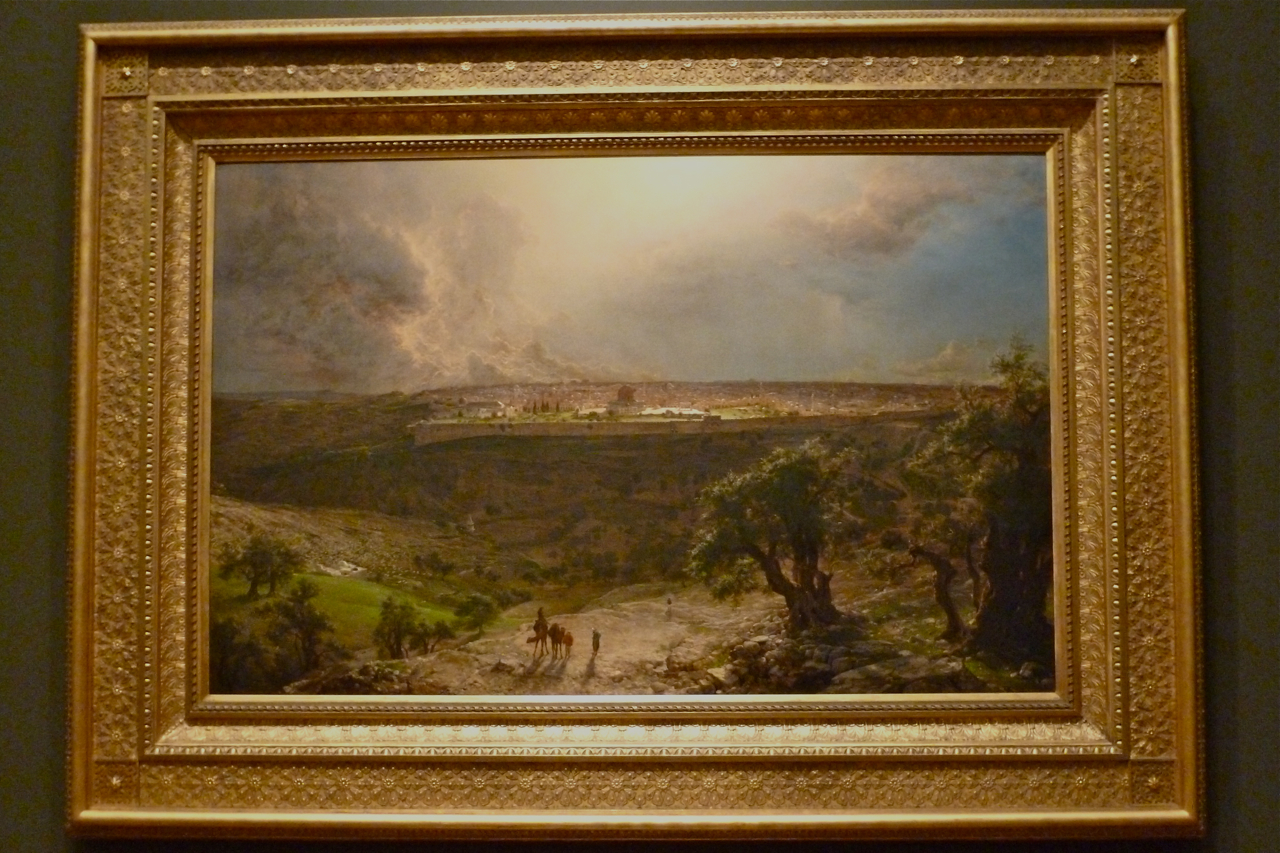
On our way to finding Winslow Homer, we came across a spectacular view of Jerusalem from the Mount of Olives by Frederic Edwin Church. Even this high resolution image fails to do justice to seeing the painting in person.


We met our Winslow Homer: Gloucester Harbor shared a room with Jerusalem. I admired the gorgeous pink and cerulean blue and wondered if the lads would fish some day like those fishers of men.

In our first meeting with American art, we saw a Georgie O'Keeffe (Apple Blossoms) loved two paintings by Frederic Remington (Teaching a Mustang Pony to Pack Dead Game and Hostiles Watching the Column) and a End of the Trail sculpture by James Earle Fraser.


This silvery illustration for Drums brought to mind the picture of the fluttermill from The Yearling for N. C. Wyeth illustrated both novels.

We explored Kansas City Sculpture Park, the grounds of the museum, for the first time. The weather warmed us as we watched robins seeking worms and daffodils sporting cheerful bonnets. How could one not smile with ginormous shuttlecocks dancing on the lawn? The last sculpture we will share offers one clue to the value of art: Auguste Rodin's The Thinker, which Pamela imitates in her pose.

Friday, March 01, 2013

Delight in the Lord

Last October, I recapped my efforts at helping children find awe and wonder in the Bible in our church's afterschool program. Our goal was to read the Book of Daniel together. We will start chapter nine next week and are on track to finish the entire book by the end of the school. Over the past couple of months, our group has grown from last year's nine students to this year's twelve, sometimes fourteen. New pupils have folded into the group seamlessly, which amazes me since a Charlotte Mason style of learning is so different. I continue to follow the method described in this post on Bible study.

Very rarely do we have an "off" day. These children are high-energy, and some have labels which means nothing to me because they are all persons first! We do everything we can to let them burn off steam through free play and snack time before lessons begin. Our rhythm of song time and prayers usually settles them down for the Bible lesson. Last week, two new pupils came and the rest, even those who have been coming for years, had a bad case of spring fever. A couple of students were talking, a few looked half asleep, and the others struggled to focus on the text. Instead of slogging through the reading and encouraging more inattentiveness, I cut it short and we shifted to the craft.

I brooded and pondered about what I should do. While I assumed it was a one-time incident, I did not want to let one "off" day lead to more "off" days and eventually the habit of inattention. I also wanted to avoid relying on lectures, artificial rewards, or token systems to encourage better behavior. As pointed out in the New York Times article "Train a Parent, Spare a Child", "offering short-term incentives to elicit behavior is unreliable, ineffective and causes 'considerable long-term damage.'" Why? Once the reward is removed, the desired behavior disappears. I agree with Charlotte Mason's belief that such measures turn children into pawns in a game. She wrote, "Our crying need today is less for a better method of education than for an adequate conception of children,––children, merely as human beings, whether brilliant or dull, precocious or backward" (Page 80).

Not only did she avoid direct manipulation of behavior, Mason had concerns about indirect ways of trampling upon the dignity of a child. Clearly, we all agree upon the dangers of influencing children through fear. What about love and approval from a teacher? Surely, a positive emotion cannot be harmful? The admiration of a teacher often leads to lessons learned, proper behavior, good will, and the development of virtues. But, what happens when the teacher is no longer in the life of the student? Because these positive reactions depend upon an outside influence, ground gained may be lost. What determines lifelong character is ideas that live inside children and inspire them. If nothing has been done to sow ideas that make acts worthwhile, then we undermine their ability to act independently.

The article on parent training offers lame advice: make sure children understand why what you're asking them to do is important, show interest in their point of view, and admit that it is really not but give them a reason why they should do it anyway. Oh, yeah, if you can reward them after the fact, sparingly, preferably something that the child picks (money, treats, or quality time). Blah, blah, blah!

Mason discounted suggestion, persistent influence, emulation, etc. What is left? Letting children fall into slipshod habits may be the greater of two evils. The answer lies within the student. "The work of education is greatly simplified when we realize that children, apparently all children, want to know all human knowledge; they have an appetite for what is put before them, and, knowing this, our teaching becomes buoyant with the courage of our convictions" (Pages 89-90).

I began to realize that spreading a feast of awe and wonder every week had sharpened their appetite for knowledge of Daniel. They desired to know; they had proved to me their habit of attention. However, they needed to take responsibility for managing it.

Then, I began to think about the reason why I study the Bible and how the brain stores memory. Those two big ideas lead to my plan, which worked like a charm!

Before the Bible lesson, I explained to them that Daniel had lived six hundred years before Jesus was born as a man. Since Jesus was born two thousand years ago, the book of Daniel was written about twenty-six hundred years ago. Their eyes grew wide. I added, "That means God kept the book of Daniel safe for hundreds and hundreds and hundreds of years—just so we could read it." I asked them, "Why do you think God protected this book all of these years?"—which lead to a wonderful conversation. Some of the kids enjoy writing notes on the dry-erase board after we do our craft. I just love this reflection:


Once they realized how precious this book was, I explained to them how memory works. When I asked if anyone had ever made paper chains for Christmas trees, hands flew up. I explained that the mind links together memories just like we make paper chains. "The reason why we talk about what we learned last week is so that our brain know where to put the next link. Every time we read the next part of Daniel, our chain of memory grows longer." We talked about what happens if we miss a week or if we are not paying attention. Our chain will have a broken link. Eying the strips of paper lying on the table, one of the boys asked, "Mrs. Tammy, can we make some chains about Daniel?" Before the reading, the kids drew what they remembered about the sheep and the goat. After the reading, all but two drew more links for their chain. One added links for the previous dreams. Another asked if we could do this every week.

I love how Leslie Laurio paraphrased Mason's conclusion to this chapter.
Knowledge for its own sake is pleasing because it's so fulfilling. When you see evidence that a student in your class shares your delight in knowing, and shares your pleasure in expressing what he knows, and shares your affinity for some wise philosopher or brave hero, you both connect and share a kind of bond. A student who has that kind of satisfaction from learning is less likely to have a compulsive need to be better than everyone else.

Saturday, October 20, 2012

Wish Granted . . . Abundantly and Lavishly

If you have ever read The Five Children and It, then you know the dangers of wishes come true. If you have never read that gem of a book, step away from the computer, find that book now, and enjoy!

Little wishes aren't so dangerous. On Thursday, Paperbackswap granted my wish for a science book that has been sitting on my wish list for two years. It is the kind of book that is truly worth only $15 new but, because it is out-of-print and sought-after in homeschooling circles, is going for $9,999 new paperback, $313 used paperback, and  only $82 new hardcover at Amazon. To think that I'm getting mine for the cost of media mail isn't really mind-blowing because the 48-page book truly isn't worth the inflated-pricing schemes. Perhaps, the tulip mania chapter in Hans Brinker and the Silver Skates isn't so far-fetched after all.

A friend of mine posted a photograph of the Io moth caterpillar about a month ago. This creature is so amazing that I wished to see it in real life. Yesterday, when we headed out to Santee National Wildlife Refuge, my request was granted. The children spied one soaking up sunshine, while resting on the railing of the boardwalk. My cellphone doesn't do it justice, but the picture was clear enough to earn a confirmed sighting of the Io over at BAMONA. Apparently, I'm not as weird as I thought because my sister-in-law, who is so much more hip than I ever was or ever will be, had a cool shot of a caterpillar from her yard on her cell phone too!

I've had another wish, a very long-term wish, really a prayer that finally came true yesterday. In our third year of homeschooling (back in 1997), we joined a homeschooling co-op and loved it. Two things happened in 2000 that changed everything: we moved to another state (and have moved several times since) and we shifted to a Charlotte Mason style of homeschooling. Our paradigm change meant that, while we still occasionally attended co-ops, they never really meshed with how we homeschooled.

Until yesterday!

Backing up a bit, since moving to Carolina, I have tried to start local Charlotte Mason discussion groups, but nobody seemed interest. One spring, a group of us starting meeting in Columbia, but it was such a long drive and life was so busy that it fizzled out. Often, my timing isn't God's timing, nor my plan His plan.

Then, in Spring 2011, God dropped a study group in my lap, or Phase I of my Heavenly Father checking off an item on my bucket list. Long story short, a friend came to me when she first started thinking of homeschooling and I let her borrow For the Children's Sake. Six months later, she plunged into homeschooling and never brought up Mason's ideas, so I assumed that our unusual ways weren't meant for her family. Six months after that, she began telling me that she and some of her homeschooling friends had been reading Mason and they wanted to get together so they could learn more. The first couple of meetings I did some "show and tell" so they could see the sorts of things Pamela and I did and the sorts of books we read. Then, we began plowing through Home Education and moved onto Towards a Philosophy of Education at the beginning of 2012, talking about habit training, exams, mother culture books, and other things CM. Pamela has show an interest in getting to know the babies of the families. During the past eighteen months, we have grown together in our friendship and understanding of Mason's ideas. One friend delighted me with a gift from the British Museum (her husband's favorite haunt in London when he isn't busy flying airplanes).

Last summer, we began hatching a new plan, Phase II of progress toward a bucket list. We all felt brave enough to launch an afternoon of enrichment, which we now call "The Feast". That may sound like an odd name for a homeschooling gathering. We are trying to avoid the "c" word because we are on the road less traveled. We hope to alert fellow homeschoolers we aren't quite what one expects in a typical co-op.

One of my friends said recently that the hardest part of homeschooling and living this way is that you feel sorry for the children who are cooped up in rooms, doing worksheets, reading textbooks, regurgitating facts, too busy to think, imagine, or dream. At that moment, I could finally confide that I felt the same way two years ago when we headed off on our raptor adventure together. I kept the thought to myself that they would probably enjoy the freedom of homeschooling. When she started homeschooling last fall, I kept the thought to myself that they would probably enjoy the Charlotte Mason homeschooling life. Now, her family as well as others in our area are traveling the same road and building relationships as we learn together and share a feast that is both abundant and lavish.

I will hold off on posting on how the day went. Instead, I will share how we spent the past two Friday mornings: walking the trail at the Santee National Wildlife Refuge. The first time we went, Pamela didn't know exactly what to do, surrounded by so many children. She joined in to see what we all found but didn't seemed to find anything herself. Yesterday, she collected sticks, which made me smile.


Friday, October 05, 2012

Awe and Wonder in Bible Study

Children should have the joy of living in far lands, in other persons, in other times—a delightful double existence ~ Charlotte Mason
Since January 2011, I have had the pleasure, yes pleasure, of teaching young children a Bible lesson in my church's afterschool program every Wednesday. I shared my first reflection in June 2011 and my second in November 2011. Our class spent the first few months of 2011 studying Moses and the school year of 2012 reading most of the book of Mark. We ended the year three chapters short of our goal. This year, we plan to finish one whole book of the Bible: Daniel. When I looked up June's post, I noticed a new comment in which Courtney asked the following question about coordinating Sunday school curricula:
We started from scratch and I have attempted to implement Charlotte Mason principles from the beginning. I have done a fair share of the leading, but others have definitely caught on to some of the principles. However, I need a break from creating the curriculum. My hope is to find a curriculum, tweak it to free it from twaddle, competition, teacher pleasing techniques, etc and equip our leaders to lead the children with this method. We have about 20+ children in one room ages 3-8. It’s been a challenge to get in a rhythm. If you have any words of counsel on where to find a base curriculum that would free me from some labor – I would be so appreciative.

Unfortunately, I am rarely happy with children's curricula, so I stick with finding high quality pictures to immerse them in a time period, maps, and the Bible itself. Our class rhythm continues to be the same: play time, snack, song (I downloaded a version of Something about That Name that doesn't drag), prayers, Bible lesson, activity (sometimes related, sometimes not), homework time, and play time. After 2.5 hours, the children leave physically, mentally, emotionally, and spiritually fed!

We continue to use The Illustrated Children's Bible for the Bible lesson (for free samples, go here). I downloaded a copy of of the Old Testament, but you can order it in a binder with CDs with the PDF files. Every week, I scour the Internet and download a couple of high-resolution pictures of artifacts from the time of Daniel to give the children background knowledge and to help immerse them in all things Babylonia. It typically takes a half hour to find suitable images. For example, to go with the first week, they studied and talked quite animatedly about soldiers attacking the Jews in Lachish and another of soldiers carrying Jews into exile. (I didn't go into depth on the fact that the Assyrians are the masters here, instead of the Babylonians, because of the quick change of hands during this period of history.) Seeing men, women, and children heading into exile personalized Daniel to them: they were astonished to see children their age having to walk five hundred miles in the desert to live in a new land with a new language and new customs. They noticed all kinds of details: the differences in clothing styles, vehicles, weapons, hair styles, etc.

I introduced them to King Nebuchadnezzar and showed them what a document looked like in his day. We talked about the clay tablets and how they were baked in ovens. One girl was amazed that you couldn't simply close a book. I told them about how the king had build an amazing palace that had fallen apart and had been covered in sand over the past two-thousand years. I showed them a picture of modern mud-brick palace built by the late Saddam Hussein next to the ruins of Nebuchadnezzar's palace. I told them that a hundred years ago some German archaelogists started finding these beautiful blue bricks that are very much like the tile we use in fireplaces and bathrooms today. They realized it was the gorgeous Ishtar gate and reassembled it in a museum. We talked about the animals on the walls and how many represented Babylonian gods, which were animals, planets, the sun, and moon. I showed them a second picture to give them an idea of the scale of the gate, and they were impressed!

I used to worry about how children unaccustomed to a Charlotte Mason style of education would react. Looking at those pictures and talking about them together incorporates the study of architecture and sculpture, which I am quite sure is neglected in their education. I offer it in a familiar medium, television, but done in an active, not passive way. I created two slideshows into a DVD (which one could also do in powerpoint): one has the pictures just described and the other has pictures of the pages of the Bible we are reading, cut and paste from the PDF file). One benefit of using a DVD is that, if a child misses a week, I can send home the DVD for them to catch up on what they missed the previous week. I simply show a picture and pause it while we have a grand conversation. They love it! The children learn so much just by seeing the artifacts of Daniel's world and noticing little details. It takes me a half hour to prepare the weekly DVD.

Last week was a wonderful example of how our afternoon goes. Children arrive in stages because different schools have different dismissal times. They go to the gym or youth room to play. Once everyone has arrived, we go to the fellowship hall for a snack. Then, we go to the classroom, sing a hymn or two, and pray. Then, we have a conversation about last week's lesson. Typically, I have a student who missed last week. So, I said, "Laura missed the lesson. Who would like to tell her what happened to Daniel last week?" Hands flew up. I picked her friend, sitting next to her, who gave a narration that went something like this
There was this guy. I don't remember his name. [Someone pops up with, "Daniel!"] Yeah, Daniel. This king with a really long name came to his city and chose only young men who were healthy and good-looking. He took them to the palace to be a servant. First, Daniel had to learn a new language and learn to read and write. When he got to the palace, this guard told him he had to eat the king's food, which was really bad for you. But, Daniel only wanted to eat vegetables and water, but the guard wasn't happy. He might get in trouble with the king, and, when the king got mad, he cut off people's heads. Daniel asked for a test of ten days. If he and his friends looked bad after ten days, then they would eat the king's food. We don't know what happened because Mrs. Tammy stopped reading at that part.
Hands flew up after her narration, and I picked a boy who was eager to share his part, which went something like this,
Daniel used to live in a city that was surrounded by walls. When the king's army came to Daniel's town, soldiers were everywhere. Nobody could leave the city. They didn't have guns. They had bows and arrows and, if anyone tried to leave the city, the guards would shoot like this. [He demonstrates shooting an arrow with a bow.] Daniel's city didn't want to run out of food, so they gave up.
Another boy added something like this,
We wondered why Daniel didn't run away when he was in the palace. I thought he should have waited until everyone was sleeping and then sneak out. But, Mrs. Tammy said that they had soldiers guarding them even in the middle of the night. Somebody was always watching them.
Reminded of another reason why, I added, "The other problem, Laura, is that the king's palace was five-hundred miles away from David's old home. He would have to survive in the desert to get home."

You might think that narrating comes easy to these students because they have been in my class for almost two years. This year, we have three new boys. They eagerly added smaller parts. One said something like,
Hey, do you remember the soldiers had pointy hats? Daniel's people had round hats, so that's how you can tell them apart!
Another added,
Oh, yeah! And, the king didn't take just young men. There were children, boys, and girls. Some were so little they rode the carts!
Another remembered,
Mrs. Tammy showed us pictures of the king's city. They had a wall with pictures of animals that were their gods. They had all kinds of gods, not at all like God.

My class is an even mix of public and private school children, so they  have never been in a Mason setting outside of my class. I teared up watching them narrate so happily and so beautifully. They have their own way of expressing their thoughts, and they enjoy sharing what inspired them the most. They were so excited to talk that I had to help them transition to the Bible lesson.

First, we studied the pictures on the television screen and discussed new artifacts from Babylon and a map of the area. Then, we read Daniel 1:15-2:12. I still read all the parts by the narrator and hand out the dialog to volunteers. We pause from time to time and the children tell what they notice or ask questions. Several gasped when I read Daniel 2:2, "So the king called for his fortune-tellers, magicians, wizards and wise men." They cried out, "Wizards? Magicians?" So, I asked them a question to encourage them to think it through. "What if you could bring King Nebuchadnezzar to our time and let him watch television? What would he think about it?" One answered, "He would think we were magicians." I added, "We know that televisions are based on science, but Nebuchadnezzar wouldn't." I stopped at a cliffhanger to leave them begging for more: Daniel 2:12, "When the king heard that, he became very angry. He gave an order for all the wise men of Babylon to be killed." The kids were properly horrified because they realized that Daniel and his friends were on the hit list.

After the lesson, we did an activity: they painted the clay sculptures they made last week. In the background, Gershwin's Rhapsody in Blue played. Pamela and I are studying it right now, and David's marching band is including it in their half-time show. Sometimes, our activities have nothing to do with the Bible lesson. This week, I'm brought in our temporary pet snail for nature study. Then, the children did their homework and had free play after that.

I want them to enjoy wondering about the Bible. The big question they asked me on the first day concerned Daniel 1:2, "The Lord allowed Nebuchadnezzar to capture Jehoiakim king of Judah. Nebuchadnezzar also took some of the things from the Temple of God. He carried them to Babylonia and put them in the temple of his gods." One of them popped up with, "Why did God let that happen?" Another was angry about the stuff he stole from the temple for, when we studied Moses, we built the tabernacle out of cardstock. I never answered the question about why God let it happen. I told them that, by Christmas, they might figure it out. Every time we come across the word "wise men" I hold my tongue because they will experience more awe once they make the connection themselves.