Showing posts with label science. Show all posts

Sunday, February 09, 2014

Great Backyard Bird Count 2014

We've had a rare snowfall here in the midlands of Carolina. I couldn't resist taking pictures of birds and their tracks. We saw our typical favorites: northern cardinals, chipping sparrows, and goldfinches.


I also spotted two kinds of birds that are new to my feeder. How exciting! Truly! I squeal when I discover new birds. The first was something completely new to me: an eastern towhee. Its unusual behavior first caught my eye: the towhee was flicking leaves up as it foraged. Later, I spotted it perched on tree branches not far from a sparrow. Since towhees look like a large sparrow, the picture with the chipping sparrow clinched the identification for me.


The other bird that thrilled me is the slate-colored, dark-eyed junco. I first met them behind Pike's Peak where they live year round. In years of bird watching here, I've never seen any. Monday, I spotted a flock at the school. I loved seeing them at home today. Aren't they cute?


Long-time blog readers know that we celebrate the Great Backyard Bird Count every February. This year will be quite an event since Pamela and I will be counting at two locations: our schoolyard on Friday and our backyard the rest of the weekend. Because we needed to prepare an entire school for this event, I came up with several things to teach students and staff to identify birds. At the beginning of the new term last December, I incorporated a bird theme into some elements of our curriculum.

Living Books - At the beginning of the school year, the elementary students started reading UltraSwan by Elinor Osborn and The Wright Brothers by Quentin Reynolds. Now, they are reading John Audubon: Young Naturalist by Miriam Mason and the primary students are reading The Boy Who Drew Pictures by Jacqueline Davies. I also recommend a birthday present I gave to a young naturalist: For the Birds: The Life of Roger Tory Peterson by Peggy Thomas.

Nature Study - We have bird feeders stationed in the school yard, and students help us keep them filled. When playing outside for recess, students see things in nature and ask us about them. We give them proper names so that most of them have from saying red bird and blue bird to cardinal and blue jay. They also know mourning dove, robin, mockingbird, and tufted titmouse. Some students are quite advanced and know yellow-bellied sapsucker and Carolina chickadee. Instead just knowing the name of our state bird, many students can describe how the Carolina wren looks. They ask for the names of birds that they see while looking out the window at school and even at home. They have to give a good description, and then we head to our bird books.

Our staff and students have come a long way since the beginning of the school year. We are all more aware of birds and able to identify some and able to observe and describe them in enough detail to classify them. It's quite common for children to ask me about a bird that they saw at home or grab me at recess to take a picture of one. It's not unusual for students to flock around the big window near the bird feeders suddenly because one student exclaims, "I just saw a huge bird!" The other morning, one girl asked me to identify a bird. "It's brown on the back and has brown splotches on its chest. It's about the size of a blue jay. It was on the ground looking for seeds or worms." I showed her a picture of a brown thrasher, and she smiled, "That's it!"

One little boy's mother majored in biology in college. They were out bird watching and he said, "I think that's a tufted titmouse." She thought he was making up the name, so she looked it up on her smart phone. He was right, and she was amazed at what he knew about birds. We have a little flock of tufted titmice that adore our bird feeders.

For science, they have made detailed drawings of a dead yellow-bellied sapsucker that we found on the grounds one day. While recording observations in our science notebooks, a live sapsucker was bring into a red maple tree nearby, so we quietly stalked it and found the holes in the trunk. While we were gone, an anonymous bird dropped a "gift" onto one girl's notebook and we all had a good chuckle.


Science - To go along with the book on the Wright brothers, the students learned about Leonardo da Vinci's flying machines and built some models as described in this book. It also helped them understand some principles as flight and they saw how da Vinci used nature study to design his flying machines. They were quite amused at how da Vinci tested them.

Picture Study - The artist we chose for picture study this term is John James Audubon, specifically this book. Since we have about a dozen students per class on Fridays (our homeschooler day), we have two books and two pictures. They have to sit quietly and study the picture for at least two minutes. They are such chatterboxes it is hard for them not to talk. When they are ready, we close the books and each child gets a chance to say one thing. They go around in a circle until they run out of things to say. Then, they switch pictures.

Silhouettes - We've read several books about our state. Mama, Let's Make A Moon by Clay Rice, a silhouette artist who has been to our county many times, inspired us to study bird silhouettes. I've made about ten of them. Sometimes we hand out individual silhouettes to half the class and bird pictures to the other half. Each student has one. They have to match the silhouette with the picture. I used a picture from this GBBC blogpost as a guide.


Plans for February 14 - I plan to make copies of the checklist and count birds during the day. I'll have a small group of children with me to help me spot and count the birds. As always, I'll have my camera, bird books, and my Nook available for tricky identifications.

Monday, October 14, 2013

Science for Students in the Autism Spectrum

Temple Grandin worries that schools do not value of hands-on learning. In a recent blog, she wrote, "One of the worst things the schools did was taking out the hands-on classes such as art, music, sewing, woodshop and auto mechanics." Art gave her something to look forward to doing at school every day: "My ability in art was always encouraged, and both my mother and my teachers encouraged me to draw and paint many different things. I loved getting recognition for several of my best elementary school art projects."

We are blessed to have part-time and full-time students in the autism spectrum at our school. I think Grandin might like our approach to science and art by the scenic trail of nature study. The primary and elementary classes are reading Minn of the Mississippi by Holling C. Hollings. To help them feel the "realness" of the story, I shared pictures of my family's visit to the headwaters of the Mississippi at Itasca State Park about ten years ago.


Some autistic students develop the habit of frustration for a variety of reasons. It takes time to help them find joy in learning what is beyond their pet interests. Every person is different, so what works for one autie may not inspire another.

Eman is teaching me so much. He often refuses to try because either "it's too hard" or "he's bored." He does not enjoy keeping a nature notebook until he finds something that delights him, in which case he begs to draw. One day when he was dragging his feet, I let him tape pictures to a page and narrate what I should write. Novelty is a big hook for him, and being able to use double-sided tape for the first time made a few notebooking experiences positive. When that novelty wore off, I tapped into a positive episodic memory of last year when he joined us for the turtle release party. I showed him pictures of those very turtles: the cage my friend constructed to protect them from crows, the nest, the hatchlings, and the dud.


When the classroom after lunch was too much for him, we switched to reading Minn in the morning. We focused on finding joy in his tasks. When he wanted to draw a story about Minn in his silly notebook (comic strip things that make him laugh), I encouraged him to start an unsilly notebook (comic strip things related to what he is learning). When he asked to read outside on a sunny day, I agreed if he promised to do his best on the notebook. And, he did! One day, he drew seven different scenes representing the most emotional moments of Minn's life: her hatching, getting her leg shot off, her canoe ride, meeting the fox, scaring the boys in the pond, laying eggs, and snapping at the dog's tail.

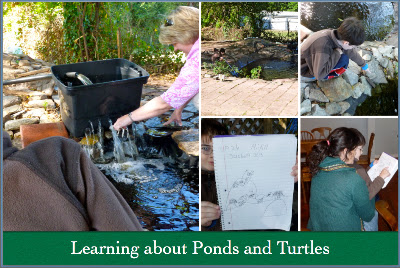
Right now, working on the pond gives him joy. Watching what happens when we turn on the water pump that pushes water through our homemade water filter is exciting. We stand at the little pool and watch it with anticipation until the water reaches the top of the stones and forms a waterfall. One day, the filter overflowed and he watched the headmaster solve the problem. Somehow, cleaning leaves out of the pond gets him to thinking about turtles. Before long, he is ready to read more about Minn's adventures, draw it in his unsilly notebook, and read it to his mother.


On another day, a cockroach caught his eye. He was shocked when I shared my plans to draw it in my nature notebook. "You keep one, too?" He was so interested in seeing mine that I promised he could look through it once he had finished making an entry in his.

At another time, two doves enchanted us with a stroll around the little pool to get a sip of water.


Speaking of problem-solving, Grandin spotlighted another value of hands-on projects: "Practical things do not always work right and people skilled in the real world learn how to improvise. When I made a mistake on a sewing project, I was sometimes able to fix it and other times I could not. Mistakes I made cutting the fabric wrong on a sewing project taught me that I had to slow down. I had to be more careful before I cut the material."

One day, he helped his class with the compost bin. The lesson screeched to a halt when they discovered worms. He watched the students find grubs and toss them into the pond to feed the fish. Two weeks later, his cat showed up at school. He decided to see if she would eat a worm and he knew exactly where to find them. The cat did not!

And, then, there was the day he found the dead fish. Eman studied it in the net for quite some time. He wanted to touch it but was afraid he might get cut. So, I offered to do it first. A bit grossed out, I put my finger on it for only an instant. "No, you need to do it longer!" So, I held my finger on the squishy fish and it must have been long enough. He mustered his courage and touched it himself.


Mason's thoughts in connection to literary books like Minn of the Mississippi: "The approach to science as to other subjects should be more or less literary, that the principles which underlie science are at the same time so simple, so profound and so far-reaching that the due setting forth of these provokes what is almost an emotional response" (Pages 218-219).

Mason's thoughts in connection to outdoor work: "They are expected to do a great deal of out-of-door work... They keep records and drawings in a Nature Note Book and make special studies of their own for the particular season with drawings and notes" (Page 219).

Mason's thoughts on nature notebooks: "The nature note book is very catholic and finds room for the stars in their courses and for, say, the fossil anemone found on the beach at Whitby. Certainly these note books do a good deal to bring science within the range of common thought and experience; we are anxious not to make science a utilitarian subject" (Page 223).

Monday, May 27, 2013

The Pitfalls of Reason

Two weeks ago, I shared a situation that had bogged me down. Focus on self had blinded me from alternatives. Amazing things began to unfold once I exercised "the way of will" and focused on God "instead" of the morass. Once God opened my eyes to see beyond my nose, new options arose. The Holy Spirit softened hearts and led us to a resting place from which we began afresh. In a clash of unbending wills, I see how the way of will and the way of the reason each played a part. In this situation, the persons involved aimed for a noble outcome (helping others). Selfish motives, rash thinking, and haste kept them from consulting more experienced guides. Once the will was set, the reason kicked in and justified deceit, betrayed trust, and led them into broken relationships. These consequences could have been avoided had the will chosen to seek wiser counsel than their own.

The reason operates on two fronts: (a) the logical playing fields of mathematical truth and (b) the real world of accepting or rejecting competing ideas. Some frivolous ideas are not even worth our time (dog versus cat, over or under orientation of toilet paper, back or middle squeezer of toothpaste, etc.)—or are they? Trying to apply mathematical reason to a sticky situation is as ridiculous as Sheldon's flow chart for a friendship algorithm on Big Bang Theory. The social arena fails to play by the rules of logic. Reason also overlooks sticky consequences to justify what the will desires. Charlotte Mason gives several poster children for reason run amuck: Macbeth, Cain, Richard III, etc. "Well-reasoned arguments are brought into play for a wrong course as for a right.... It is only when [the will] chooses to think about some course or plan, as Eve standing before the apples, that reason comes into play."

You might think that scientists are the most reasonable people in the world for their livelihood depends upon logic. One of the discoverers of the double helix structure of DNA thinks otherwise. He explains in his personal account of the journey to a Nobel peace prize, "Science seldom proceeds in the straightforward logical manner imagined by outsiders. Instead, its steps forward (and sometimes backward) are often very human events in which personalities and cultural traditions play major roles." Parents in the autism world will appreciate his description of skeptics, "Many were cantankerous fools who unfailingly backed the wrong horses.... In contrast to the popular conception supported by newspapers and mothers of scientists, a goodly number of scientists are not only narrow-minded and dull, but also just stupid."

Dr. Watson is quite candid about his own moral failings. Laziness and carelessness in the lab in the form of an explosion drove away any interest in biochemistry. He headed to Copenhagen on someone's dime to spend a year doing research with a renowned biochemist and return home with enough knowledge to map out the structure of viruses. Indifference to the biochemist's work and poor communication between the two drove Watson to work with a virologist. Clearly violating the terms of his fellowship made him a bit uneasy at first. Yet, three months into his stay, reason told Watson to fudge plans for the following year. His purpose shifted from working with the biochemist to working in the stimulating environment of Copenhagen. Reason helped him feel justified about his shiftiness because his boss trained another biochemist back in the states.

At first, Watson felt guilty about avoiding the biochemist who must have some concerns about his frequent absences. His conscience cleared up when he learned of the biochemist's divorce. Reason reassured him that the poor man would not be able to focus on science anyway. Watson was doing him a favor by not asking to be taught nucleic-acid biochemistry. Deceiving the fellowship electors was morally superior to forcing the divorced man to talk about biochemistry. In fact, reason congratulated him on doing great work: he had collected enough experimental data on bacterial-viruses to take a break for the rest of the year. Reason assured him that he could publish a paper and still look productive. He left the bitter cold of Copenhagen and spent April and May in sunny Naples. The poor biochemist was healing his broken heart doing work at a zoological station in Naples anyway. To ease a twinge of guilt, reason suggested that Watson could still look busy doing work on the embryos of marine animals and quietly study genetics on the side. His request for permission to join the biochemist in nature was rewarded with a cheery letter and a two-hundred-dollar check to cover travel expenses. Watson concluded, "It made me feel slightly dishonest as I set off for the sun."

Watson's story illustrates the relationship between will (the ruler) and reason (the servant). The scientist had no desire to learn biochemistry. His will chose to continue studying virology instead. Then, reason stepped in and justified why he should continue deceiving the fellowship electors. In retrospect, as Watson wrote his account, reason cooed that the trip to Naples led him to a researcher who did fire his enthusiasm for biochemistry and eventually lead his prize-winning research. His lies led to a noble outcome (pun intended).

Moreover, our sanitized version of scientific research leads us to believe that reason and objectivity manage to push out ambition, pride, deceit, etc. Reading a subjective and literary account of how research really happens reveals the truth of the matter. Even the most logical, reason-loving people on the planet make morally flawed decisions. This is why I chose a literary approach to science.

There is no single point upon which two persons may reason,––food, dress, games, education, politics, religion,––but the two may take opposite sides, and each will bring forward infallible proofs which must convince the other were it not that he too is already convinced by stronger proofs to strengthen his own argument. Every character in history or fiction supports this thesis; and probably we cannot give a better training in right reasoning than by letting children work out the arguments in favour of this or that conclusion. ~ Charlotte Mason

Saturday, April 20, 2013

Science—Absolutely FASCINATING, or creepy—or BOTH!

Another chapter in The Raptor in My Prius series.

Every other week, bloggers write for the Charlotte Mason Blog Carnival. This round we discussed how education ought to be about a life well-lived. I like how the hostess of this week's carnival added a nugget to the principle "Education is a life"—"Homeschooling for life and not a lifestyle." Another shared, "Being the living, breathing example we wish our kids to follow is one powerful way to educate them. Allowing them to see us being self-disciplined, kind, interested in the world, curious, loving, humble, happy, thankful, careful—just letting them see good things in us—is one-third of a Charlotte Mason style education."

That got me to thinking about our weekly walks...

Amy Tuttle, organizer of the carnival and homeschooler in the mission fields of Peru, also got me thinking about those walks: "What about the bits that LOTS of people, including myself in my youth, have had a mind to think are unbearably boring and void of living matter, like Math? And Science? There's so much memorization of Latin names and body parts and tables and elements and formulae and hypotheses and lab book entries... We might admit, if it weren't for such an immense body of facts, it would be absolutely FASCINATING."

Is your study of science absolutely FASCINATING?

Ours is. The Friday feast at Santee National Wildlife Refuge is one reason why. Every week, something new captures our attention and thoughts and ideas begin to sprout in our minds. Last Friday, we came across an oak gall. We noticed caterpillary things crawling out of it, which didn't make sense for wasps pupate in galls (we know that from reading these wonderful nature readers). At first we were absolutely fascinated and wondered what these "caterpillars" could be. We saw some here.


We saw some there, clinging to moist spots on tree trunks. We even found a "tree of life"—a term coined by one of our young naturalists—a spider, slug, and caterpillars all in one crook.


As we walked, we began to notice more of these things, writhing on tree trunks. Hundreds of them. The hair began to creep up on the back of my neck. Or was that one of those, um, THINGS?


Then, we began to see thousands of them. It seemed like millions of them: wriggling and writhing. We started to feel a bit horrified, as in Alfred Hitchcock movies. While I felt like fleeing from the woods screaming, never to return again, the Mrs. Frizzle in me calmed down and took pictures. "I can't wait to post these on Facebook!" However creepy they are, they are part of nature. God created these things for some reason.


Then, we came to the gauntlet—branch hanging over the path. And, I know you can guess what was crawling all over that too-low-for-comfort branch. THOSE THINGS!!!!!!!!!!!!!!! Somehow, we kept our composure and managed to stifle our discomfort into small shudders. I admit to ruffling my hair and shirt just to make sure no unwanted visitors had hitched a ride. And, what was the reaction on Facebook from friends whom I know to be avid enthusiasts of nature? "EWWWWWWWWW!" "Oh, and what is this?" "nononononono" "Oh! I was about to say how beautiful the design on that tree was. Didn't realize they were alive! lol!" "Bleh!" "That is weird." Nobody seem to know what they were, so I posted a spotting at Project Noah (hat tip: Jennifer Gagnon). As much as I adore BAMONA, my intuition said that these things were not going to transform into lovely moths and butterflies.

The folks over at Project Noah identified them as MILLIPEDES! Their reaction was a bit warmer. "These are definitely millipedes—I can see two sets of legs per segment. I've never seen so many together before! Neat Find Tammy." "Interesting! This is awesome Tammy." "It is probably also a group of young millipedes that are about to leave the home site." "Here's another millipede aggregation of a different species. It looks like it happens every once in a while! Lucky you! :)"

LUCKY US!

I've always wanted to see MILLIONS of MILLIPEDES! I can take that off my bucket list now. Did we go back the following week? Of course! We had to know if they were still haunting the trails of Santee.

An idea struck me. All of our students are still in elementary school and preschool. They are a few years, or more, away from all that memorization often required in high school biology. When they reach the study of myriapods, they will remember when they saw millions of them leaving their home site.

These children will not have to memorize the difference between toads, frogs, and tree frogs. Just yesterday, they caught a southern toad eating a worm. They are raising southern leopard frogs from egg to frog. They know where green tree frogs hang out on sunny mornings (in the swamp grass).


They have seen parents grow curious about a spider. This arachnid is a wolf spider, but not our state spider (the Carolina wolf spider). This sad little fellow, Schizocosa crassipes does not even have a common name! How tragical is that?

When the time comes to learn about the order Odonata, they will remember the day they had to sit still in the grass and wait for dragonflies to rest on some grass or a leaf. The meadow where eastern pondhawks buzzed overhead like a horde of helicopters, and their littlest sister kept trying to catch them. They will know why dragonflies earned such a name because they saw one carrying around some bug for breakfast. High school biology will be more about memories, rather than memorization, for them.


They will remember how odd we must have looked, sitting on the grass, quietly waiting for the perfect moment to shoot these pictures of predator pondhawks.


They will remember how different seeing a fleeting picture of a horde of pondhawks is from experiencing the real deal. They will appreciate how fewer mosquito bites occur with dragonflies on patrol.


They will know that nature is to be respected. When you kick at an ant hill, you might get bit!

Consider, too, what an unequalled mental training the child-naturalist is getting for any study or calling under the sun––the powers of attention, of discrimination, of patient pursuit, growing with his growth, what will they not fit him for? Besides, life is so interesting to him, that he has no time for the faults of temper which generally have their source in ennui; there is no reason why he should be peevish or sulky or obstinate when he is always kept well amused. ~ Charlotte Mason

Monday, April 15, 2013

Turtle Release Day

What is an idea? we ask, and find ourselves plunged beyond our depth. A live thing of the mind, seems to be the conclusion of our greatest thinkers from Plato to Bacon, from Bacon to Coleridge. We all know how an idea 'strikes,' 'seizes,' 'catches hold of,' 'impresses' us and at last, if it be big enough, 'possesses' us; in a word, behaves like an entity.

If we enquire into any person's habits of life, mental preoccupation, devotion to a cause or pursuit, he will usually tell us that such and such an idea struck him. This potency of an idea is matter of common recognition. No phrase is more common and more promising than, 'I have an idea'; we rise to such an opening as trout to a well-chosen fly. ~ Charlotte Mason
An idea is a slippery thing. It is not something to capture in a snapshot because an idea is alive. It is hard to recognize until seen in action. Once an idea takes hold, it grows into something beyond the initial inkling. When I first saw a friend post pictures of slider turtle eggs on Facebook in the summer of 2011, I thought it would be neat to study them. She ended up bringing her babies to Pamela's watercolor class. Seeing the turtles swimming made me long to study them more in-depth and attend their release.

Last summer, when my friend posted pictures of the nest, I begged her to let us come over and study them. She graciously obliged us, so Pamela and I saw their nest, peeked at their eggs, and visited them for a well baby check up. Bubbling over with excitement about the turtles, I shared the news with the children in our church afterschool program about nine yellow-bellied slider turtles a friend of mine was raising over the winter. The idea of seeing these little reptiles seized hold of those children. Unfortunately, my friend, a very busy volunteer who gives her time to others in so many ways, could not line up time for the turtles to visit us at church. Nearly every week, the kids would ask, "Mrs. Tammy, when is your friend going to bring the turtles?" Once the idea caught hold of them, they did not let up on begging to see them.

My homeschooling friends were also intrigued at the thought of studying the turtles. I suggested the idea of having a release celebration to the turtle lady, and she thought it would be marvelous to have a send-off for her babies. We timed the party for after our homeschooling gathering, and I invited the children from church, too. It turned out to be a wonderful day. After the initial surge of excitement died down, all my little friends had a chance to study the turtles up close.


Then, my friend dabbed non-toxic paint on the shells. It ended up being a bit messy because the turtles began climbing all over each other, smearing the painted. She placed the turtles in the center of a ring we formed around the turtles. We had a race to see which critter would reach a person first.


After my friend washed the paint off the turtles, we lined them up at the beach and watched them swim away, one by one. Some boldly headed off into the water. Others needed a little more guidance and encouragement from us, as you can see in the video below.


The traveler’s eye picked up a turtle trail,
Between the dotted feet a streak of tail,
And followed it to where he made out vague
But certain signs of buried turtle’s egg;
And probing with one finger not too rough,
He found suspicious sand, and sure enough,
The pocket of a little turtle mine.
If there was one egg in it there were nine,
Torpedo-like, with shell of gritty leather,
All packed in sand to wait the trump together.
~ Robert Frost