Showing posts with label picture study. Show all posts

Sunday, February 09, 2014

Great Backyard Bird Count 2014

We've had a rare snowfall here in the midlands of Carolina. I couldn't resist taking pictures of birds and their tracks. We saw our typical favorites: northern cardinals, chipping sparrows, and goldfinches.


I also spotted two kinds of birds that are new to my feeder. How exciting! Truly! I squeal when I discover new birds. The first was something completely new to me: an eastern towhee. Its unusual behavior first caught my eye: the towhee was flicking leaves up as it foraged. Later, I spotted it perched on tree branches not far from a sparrow. Since towhees look like a large sparrow, the picture with the chipping sparrow clinched the identification for me.


The other bird that thrilled me is the slate-colored, dark-eyed junco. I first met them behind Pike's Peak where they live year round. In years of bird watching here, I've never seen any. Monday, I spotted a flock at the school. I loved seeing them at home today. Aren't they cute?


Long-time blog readers know that we celebrate the Great Backyard Bird Count every February. This year will be quite an event since Pamela and I will be counting at two locations: our schoolyard on Friday and our backyard the rest of the weekend. Because we needed to prepare an entire school for this event, I came up with several things to teach students and staff to identify birds. At the beginning of the new term last December, I incorporated a bird theme into some elements of our curriculum.

Living Books - At the beginning of the school year, the elementary students started reading UltraSwan by Elinor Osborn and The Wright Brothers by Quentin Reynolds. Now, they are reading John Audubon: Young Naturalist by Miriam Mason and the primary students are reading The Boy Who Drew Pictures by Jacqueline Davies. I also recommend a birthday present I gave to a young naturalist: For the Birds: The Life of Roger Tory Peterson by Peggy Thomas.

Nature Study - We have bird feeders stationed in the school yard, and students help us keep them filled. When playing outside for recess, students see things in nature and ask us about them. We give them proper names so that most of them have from saying red bird and blue bird to cardinal and blue jay. They also know mourning dove, robin, mockingbird, and tufted titmouse. Some students are quite advanced and know yellow-bellied sapsucker and Carolina chickadee. Instead just knowing the name of our state bird, many students can describe how the Carolina wren looks. They ask for the names of birds that they see while looking out the window at school and even at home. They have to give a good description, and then we head to our bird books.

Our staff and students have come a long way since the beginning of the school year. We are all more aware of birds and able to identify some and able to observe and describe them in enough detail to classify them. It's quite common for children to ask me about a bird that they saw at home or grab me at recess to take a picture of one. It's not unusual for students to flock around the big window near the bird feeders suddenly because one student exclaims, "I just saw a huge bird!" The other morning, one girl asked me to identify a bird. "It's brown on the back and has brown splotches on its chest. It's about the size of a blue jay. It was on the ground looking for seeds or worms." I showed her a picture of a brown thrasher, and she smiled, "That's it!"

One little boy's mother majored in biology in college. They were out bird watching and he said, "I think that's a tufted titmouse." She thought he was making up the name, so she looked it up on her smart phone. He was right, and she was amazed at what he knew about birds. We have a little flock of tufted titmice that adore our bird feeders.

For science, they have made detailed drawings of a dead yellow-bellied sapsucker that we found on the grounds one day. While recording observations in our science notebooks, a live sapsucker was bring into a red maple tree nearby, so we quietly stalked it and found the holes in the trunk. While we were gone, an anonymous bird dropped a "gift" onto one girl's notebook and we all had a good chuckle.


Science - To go along with the book on the Wright brothers, the students learned about Leonardo da Vinci's flying machines and built some models as described in this book. It also helped them understand some principles as flight and they saw how da Vinci used nature study to design his flying machines. They were quite amused at how da Vinci tested them.

Picture Study - The artist we chose for picture study this term is John James Audubon, specifically this book. Since we have about a dozen students per class on Fridays (our homeschooler day), we have two books and two pictures. They have to sit quietly and study the picture for at least two minutes. They are such chatterboxes it is hard for them not to talk. When they are ready, we close the books and each child gets a chance to say one thing. They go around in a circle until they run out of things to say. Then, they switch pictures.

Silhouettes - We've read several books about our state. Mama, Let's Make A Moon by Clay Rice, a silhouette artist who has been to our county many times, inspired us to study bird silhouettes. I've made about ten of them. Sometimes we hand out individual silhouettes to half the class and bird pictures to the other half. Each student has one. They have to match the silhouette with the picture. I used a picture from this GBBC blogpost as a guide.


Plans for February 14 - I plan to make copies of the checklist and count birds during the day. I'll have a small group of children with me to help me spot and count the birds. As always, I'll have my camera, bird books, and my Nook available for tricky identifications.

Friday, November 15, 2013

Where I Host the Charlotte Mason Blog Carnival

I am thrilled that our gracious hostess Amy Tuttle has invited me to write the Charlotte Mason blog carnival on my very favorite topic: mathematics. Of all people, our missionary friend, who lives in a valley between mountain ranges in Peru, understands why Mason called mathematics "a mountainous land which pays the climber, makes its appeal to mind." I encourage you to read Mason's actual words because what she wrote about this invigorating topic may not be what you expect: pages 230 to 232 in her sixth volume (the modern paraphrase of this section is here).

Once you have Mason's words firmly in mind, check out Nebby's consideration of Mason's warning about proportion and mathematics, which rings true in our STEM-obsessed society: Why Study Math? Barb McCoy, a veteran homeschooler who has graduated her children, describes in great detail what I mean by STEM-obsessed society in her post, Our Children Have Not Changed, Math Standards Have. The culture, wrapped in its Enlightenment thinking, has forgotten the point of education: "We homeschool to create a better person in our children. We all are not brilliant in math or science or art or whatever subject you can fill in the blank with. We can let our children be the best that they can be without looking at a standardized test score."

Children are born persons, not percentiles!

You may be scratching your head and wondering how math could offer joy and beauty. Read what Amy Marigold, who is starting to see math with her Maker's eyes, shared about her journey with math: "The natural world is filled with numerical and spatial relationships, that man has been discovering for generations. And God put it all there—to create it, to order it, to keep it running."

How does it look teach math in a way that invites children to appreciate its beauty and truth? Mason stated that "Mathematics depend upon the teacher rather than upon the textbook and few subjects are worse taught; chiefly because teachers have seldom time to give the inspiring ideas, what Coleridge calls, the 'Captain' ideas, which should quicken imagination." As Sarah points out in Math Lesson, good teachers like her husband use the textbook as a springboard and supplement with manipulatives when necessary. In Third Grade Math, Laura also offers real-life activities with concrete objects to go with a computer program and a free arithmetic textbook from Mason's time.

Good teachers present living ideas that inspire and engage and consult textbooks for problems.

Some of us in the Charlotte Mason community are exploring what Richele Baburina calls living teaching in her book on mathematics. I encourage you to read it since she had access to a short, but insightful publication that Mason quoted extensively: The Teaching of Mathematics to Young Children by Irene Stephens. Because the pamphlet is copyrighted by none other than His Royal Majesty, King of England, you cannot simply find it on a search engine nor can you find it on eBay. Thus, one cannot digitize it and post it as a free PDF. Richele drove to Harvard Library in researching Stephens' writing for her book. Richele filled in many gaps for me.

I met Richele at the Living Education Retreat where her talks on math inspired some of us to apply and blog inspiring ways to reveal the truth and beauty of math. In her blog carnival post, she explains how to teach children about multiplication. Bobbie-Jo also attended the retreat and posted her reflections on how to teach mathematics in a living way. I have also written about applying living teaching methods to a child in the autism spectrum who likes math as much as Sam liked green eggs and ham. Two blasts from the past at the Common Room offer ideas for teaching math through play and laundry. At LER, Bobbie-Jo introduced us all to paper sloyd, a wonderful way to blend mind, hands, and heart with math (a student made the envelope in a paper sloyd class) and Nancy Kelly, one of LER's founders, shares what loving eyes and patient hands in her home have done. And, if you still have not had your fill of math, check out another blast from the past: math week at Afterthoughts.

Because "education should be a science of proportion, and any one subject that assumes undue importance does so at the expense of other subjects which a child's mind should deal with," I am happy to share posts on other topics dear to this mathematician's heart. Why? As much as I love math, I love other beautiful things in God's creation. No life should be shut out of the living page, poetry, nature, and art!

Notebooking - Notebooking is integral to how Pamela lives and learns. Every time we visit a museum she draws at least one picture of her favorite item. Today, we joined our school away from homeschool, Harvest Community School, on a field trip to the South Carolina State Museum for the Tutankamun: Return of the King exhibit. Because our school follows Mason's principles, the students brought notebooks and sketched their favorite item (or two or three). If you want to learn more about notebooking from a Charlotte Mason perspective, The Living Page by Laurie Bestvater, is a must-have, even if it is the only book you buy for the rest of the year! She is the person who inspired my excitement about notebooking and now we have a whole school of children filling up living pages. For a lengthier review, check out what Dewey's Treehouse has to say about this new and worthy contribution to CM literature.


Poetry - One of the delights of this week was being able to hear every student in the elementary class recite. One young lady blew me away with nearly perfect recall of Joshua 1:6-9, which she memorized during the first two weeks of school! Several children chose "Autumn" by Emily Dickinson, the poem from last week, while one picked "Hope" and another, "If I Can Stop One Heart from Breaking". For an example of students reciting poetry, read Bonnie Buckingham's thousand thoughts blog post. Ann at Harvest Moon by Hand also offers how her daughters react to the intriguing words of Walter de la Mare. You cannot help but long for beautiful words after reading these posts!

Nature Study - What would a Charlotte Mason blog carnival be without nature study? You are never too young or too old to become enchanted by God's marvelous handwork. Here, one of the scribes (recorders of oral exams) meets our classroom pets: Ben, the worm snake, and his friends, a frog and a slimy salamander. Our school has weekly nature outings to a nearby wildlife refuge as does Celeste, who documents her family's experience with pictures of their visit, collections, and notebooking (glorious living pages for you to see). If you are up for an Outdoor Hour Challenge, Barb McCoy offers some ideas for studying woodpeckers. I know it's cold out there, but get out and enjoy creation! And, if you decide to blog time spent watching nature, feel free to post a link at Fisher Academy International.

Picture Study - Our school just wrapped up a study of an artist whom they affectionately call "Rainbow Man" because of the colorful way he paints his hair and beard in self-portraits. During the term finale, I marveled at the wide and varied things our students remember about van Gogh. Of course, the salacious story about why his ear was bandaged is at the top of the list. One student thought his art was very messy, but another was fascinated how awful it looks when you are close to the painting and how it transforms into something beautiful as you back up. One child observed how sad he must have been when he painted the peasants because they were so dark. The three most talked about paintings were Starry Night, Sunflowers, and Self-Portrait in Front of an Easel. We concluded our study with a two-sided puzzle and an alternative way to recall the painting of van Gogh's bedroom. For more impressions of what children have to say about art, read a post by Ann at Harvest Moon by Hand about a study of the work of Carl Larsson.


A hearty thanks to all contributors which made this carnival blog possible!

Sunday, March 31, 2013

Pondering Art on a Good Friday


What makes art worth stealing? As my friend Megan shared this week, Nazis robbed paintings from Jews whom they massacred in the Holocaust. Many items are in museums and private homes. Survivors have struggled to recover treasures of their perished beloved. By the way, this Portrait Study of a Child by Lilla Cabot Perry reminds me of Megan's daughter Hannah, a brilliant violinist with a fabulous voice and author of Brightleaf.

Why is art so important?

Edith Schaeffer—mother of Susan Schaeffer Macaulay who wrote For the Children's Sake, dear to ones applying Charlotte Mason's ideas—left a legacy of art to her children. She died yesterday. Her son Frankie wrote in his tribute to her,
Mom’s great-grandchildren were growing up loving what she’d loved: words, art, music, gardening, cooking and playacting. Mom was unable to speak any longer but she was nevertheless communicating with her children, grandchildren and great-grandchildren every time they were read to, listened to music or when we painted together.
Frankie lists the world's finest artists his mother introduced to him as a child. Now her great-grandchildren love them as well.

I really can't explain why art is so important.

We visited the Nelson-Atkins Museum, which may be an odd way to spend Good Friday. Then, again, maybe not.

Our aim was to meet a Winslow Homer in person. First, we bathed in the art of Europe. Steve spotted St. Francis of Assisi Adoring the Crucifix by Guido Reni. He snapped and posted this picture on Facebook. A new pope with a new pope name has put St. Francis in the headlines. Steve grew up Catholic in Latin America as did Pope Francis.

Speaking of which, Edith Schaeffer was both mother and wife to men named Francis. Frank, the son, wrote of his mother, "Mom was a wonderful paradox: an evangelical conservative fundamentalist who treated people as if she was an all-forgiving progressive liberal of the most tolerant variety." Francis I, also a paradox in thinking conservatively and acting liberally, showed his love for the marginalized by washing, drying, and kissing the feet of twelve juvenile delinquents at a nearby prison, including two girls and two Muslims.

Opposite to St. Francis was Christ on the Cross by Philippe de Champaigne. Christ. The ultimate paradox. And between them, Nicolas Poussin's The Triumph of Bacchus—the very opposite of that paradox, foreshadowing of the excess in our culture.

Studying Peace on Earth by Jacques Lipchitz on Good Friday brought Easter home. Love come down from heaven on the wings of the Holy Spirit. The dove's body, shaped into a cross. Love, the foundation to the gruesome reality of the ultimate sacrifice. What a lovely touch to see clouds hovering overhead, a symbol of the tears shed by our Lord on that dark Friday and of the tears of joy to come three days later. "He will wipe away every tear from their eyes, and death shall be no more, neither shall there be mourning, nor crying, nor pain anymore, for the former things have passed away."

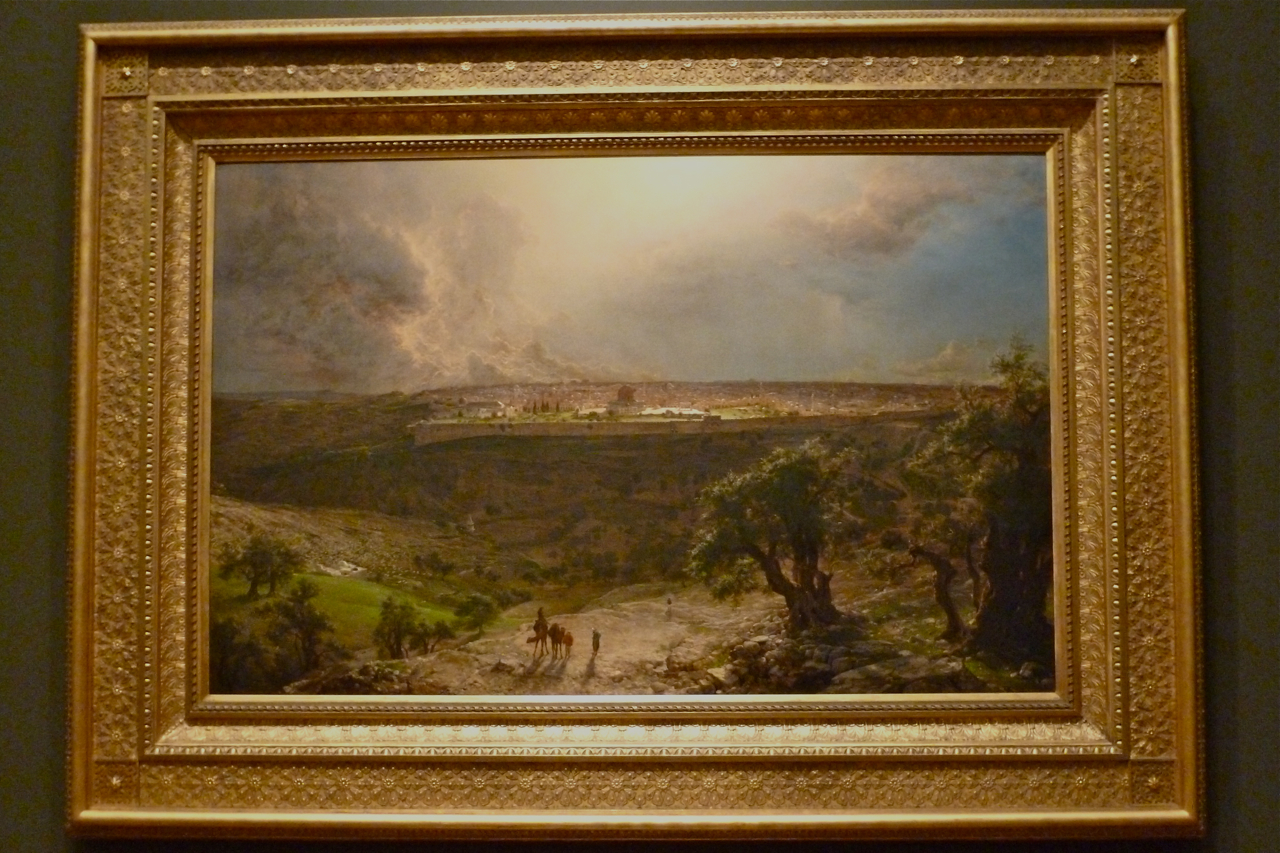
On our way to finding Winslow Homer, we came across a spectacular view of Jerusalem from the Mount of Olives by Frederic Edwin Church. Even this high resolution image fails to do justice to seeing the painting in person.


We met our Winslow Homer: Gloucester Harbor shared a room with Jerusalem. I admired the gorgeous pink and cerulean blue and wondered if the lads would fish some day like those fishers of men.

In our first meeting with American art, we saw a Georgie O'Keeffe (Apple Blossoms) loved two paintings by Frederic Remington (Teaching a Mustang Pony to Pack Dead Game and Hostiles Watching the Column) and a End of the Trail sculpture by James Earle Fraser.


This silvery illustration for Drums brought to mind the picture of the fluttermill from The Yearling for N. C. Wyeth illustrated both novels.

We explored Kansas City Sculpture Park, the grounds of the museum, for the first time. The weather warmed us as we watched robins seeking worms and daffodils sporting cheerful bonnets. How could one not smile with ginormous shuttlecocks dancing on the lawn? The last sculpture we will share offers one clue to the value of art: Auguste Rodin's The Thinker, which Pamela imitates in her pose.

Friday, March 29, 2013

Gleaning Habits from Picture Study

People confuse classical education with Charlotte Mason's method for our materials are similar. What we do with books and things is quite different. The first four years of a classical education is the pouring in and spitting out of specific facts (the Grammar Stage). Connecting ideas is not expected until the next stage. Students in a Mason paradigm form relations early and remember what stirs the mind. Since I plan to blog art, I searched briefly for how a classical folks teach art, and most sites link to "Charlotte Mason style" lessons. Curious.

Mason educators aim for good habits. Mason wrote,
No intellectual habit is so valuable as that of attention; it is a mere habit but it is also the hall-mark of an educated person.... The habits of fitting and ready expression, of obedience, of good-will, and of an impersonal outlook are spontaneous bye-products of education in this sort. So, too, are the habits of right thinking and right judging; while physical habits of neatness and order attend upon the self-respect which follows an education which respects the personality of children.
The following video depicts order which Pamela learned from watching me. As discussed in my last post, she has taken order to a new level. For years, she saw me transition us from one task to another. When she seemed ready to take on these duties, I let her. Pamela is a bit slow in how she puts away a highlighter, retrieves the pencil, checks for lead, adds more lead to the pencil, grabs the highlighter, highlights the schedule to mark off a task, puts the highlighter back, grabs her language arts composition book, and turns to the right page. People with autism process more slowly. Some struggle with the level of executive function Pamela shows here.


The habit of order eases one's life. Mason wrote, "Consider how laborious life would be were its wheels not greased by habits of cleanliness, neatness, order, courtesy; had we to make the effort of decision about every detail of dressing and eating, coming and going, life would not be worth living." Where static thinking helps us most is in the execution of routine tasks. It frees up our working memory for higher-level thinking.

What is higher-level thinking? Dynamic thinking—which people in the spectrum find challenging. While picture study seems so simple—and it is—chances arise to think dynamically. My last picture study post recapped how we practice theory of mind, "fitting and ready expression," and attention, retrieve memory, and make historical connections. Picture study is how I scaffold Pamela in writing paragraphs, too.

Pamela knows what is expected of her. I have slightly altered how we do picture study to work on dynamic thinking. She picked one of the twenty-four Winslow Homer picture cards and studied carefully. She does the work of imprinting details from the picture into her memory and of describing it so clearly from her memory that I can pick it out of the stack. This is the "act of knowing" for a picture study. In the following video, you can see how fluently she narrates the picture which I have hidden from view. Although she has left gaps in her description, I do not interrupt her.

After she finished, I reflect upon her narration and ask her meaningful questions that help me construct an image in my mind. Rather than ask direct questions, I paraphrase her words. I tell her what I don't know. She spoke of something blue outside, and I told her I didn't know what was blue. Making a declarative statement about gaps in my understanding gives her a chance to listen more carefully and think. I do ask open-ended questions.

You can see how she enjoys our exchange of information. As you watch her listen, think, and respond, you can see how quickly she processes now. The pace of our conversation is much faster! Pamela illustrates what Mason said about listening with full attention, "We can all imagine how our work would be eased if our subordinates listened to instructions with the full attention which implies recollection."


Now, we come to the moment of truth! Can Pamela's efforts guide me to the correct picture? This process illustrates how differently we do things. When a teacher creates a worksheet, the teacher robs the opportunity to think from students. Some teachers explained to me not long ago that open-ended questions create anxiety in students of today. They are afraid of saying the wrong thing. They don't know what details teachers want. They fear low grades. While they are adept at static thinking (direct questions with only one right answer), they have difficulty with dynamic thinking. When we do picture study, Pamela does most of the work for she has to know how much information is good enough. I am more of a guide in our journey to a shared understanding.

In the next video, I go through each card and explain my decision to accept or reject it. You can see Pamela's anticipation until I find the right one. Then, interest wanes because the element of surprise is gone. I persist through the entire stack since two or more pictures might fit her description. In this case, I narrowed it down to two: Snap the Whip and School Time.


Below are the two pictures. They have so much in common that they almost look the same.


I use this opportunity to explain why I choose the top picture. Upon further reflection, I think I could have spotlighted "same but different" thinking instead. Then, I would have given Pamela another chance to think dynamically. Next time we have a close call, I will do that! I also spotlighted errors to help her refine her observation before doing a written narration. I asked her what season she thought it was to give her a chance to infer. At around minute 1:20, Pamela shifts her gaze and studies her schedule. I kept talking to see if she would turn to me on her own. She did not, so I cleared my throat. She inferred that I had noticed her lack of attention. (Note to self: slow down and talk less!)


When I ask Pamela to write the title of the painting, I see an opportunity to work on gray thinking. Winslow Homer named it Snap the Whip, and yet no whips are in sight. I am thrilled when Pamela immediately realizes the boys were the whip! To encourage her to lengthen her descriptions, I first ask her how many sentences she can write. After she said, "Six," I apply "Edge Plus One" (an RDI term) and suggest seven. Pamela balks vociferously, so I back off and leave the matter unresolved.


Pamela has written three narrations for picture study so far: Girl with Laurel, Fog Warning, and, of course, Snap the Whip. While she writes, I say absolutely nothing. I don't even peek over her shoulder. I try to find something else to do. She has to do the work.


Originally, Snap the Whip had six sentences. I scaffold her into writing a seventh by suggesting she had forgotten to mention the season. She comes up with "It's fall" and I prompt "because" to encourage her to write a longer sentence. And, she does!

Sunday, January 27, 2013

Another Elaboration on Picture Study

In past posts, I have blogged many aspects of picture study, Charlotte Mason style: focus on theory of mind for Monet and Vermeer, making connections, videos of Monet study and da Vinci study in action, and museum visits.

What is picture study, you ask?

Mason taught pictorial art along two lines: appreciation and expression. We study masterpieces to see what a truly gifted artist can do. We focus on one artist per term, a new artist every term, to heighten their sense of beauty and foster a relationship with the work of an artist.

Mason outlined how to do a picture talk and basically you ask the child to (1) recall the previous picture, (2) study a new one carefully, and, when ready, (3) narrate the picture after you put away the card. Afterwards, you might have a conversation about the picture (the backstory, for example) or have child sketch the chief lines in the composition. You really do form a relationship with the work of an artist. You cannot imagine the exhilaration of seeing an original painting in its proper size and space with the finest detail of brushwork, form, and feeling before your eyes in a museum. The joy feel comes from our deep appreciation of an artist's accomplishments.

Since my last update, we have studied Millet, van Gogh and modern artist Makoto Fujimura, and Pamela met the latter last June as narrated in the following clip.


This term, we will be getting to know Winslow Homer, who, like Pamela, fell in love with watercolors. The "wrinkle" I added to picture study emphasizes the importance of theory of mind—knowing that what is in your mind may not be in the mind of another person unless you communicate. Pamela selects one picture from the stack of cards (the ones by Dover are quite handy and, once an artist I have in mind is available in one of Emily Cottrill's portfolios, I will try that). After she finishes studying the card, she must narrate the painting so well that I can figure out the one she had in mind. The following paintings illustrate the importance of describing a scene fully: Girl with Laurel (the upper painting) and Peach Blossoms (the lower painting). The two paintings have much in common: one young woman wearing a long dress and hat standing near flowering trees and a green field. If Pamela leaves out the wrong details in an oral narration, I might pick the wrong painting!


Since this was the first picture study of the term, Pamela probably did not realize how similar the two paintings looked. She selected Girl with Laurel, studied it, put away the card, and narrated the full scene. She described the girl and the background. Based upon her narration, I boiled down my selection to the two paintings. To spotlight the importance of offering a detailed description, I pointed out the information she had given me that helped me choose the right one. I said, "You told me there was a blue sky, but this one [Peach Blossom] has a gray sky. You also told me the girl was wearing a blue dress, but this girl is wearing a yellow dress. And, you said she carried a basket, but this one has no basket. So, it can't be Peach Blossom, so I am going to say it was Girl with Laurel." Giving her feedback on my thinking is an important part of helping see the effectiveness of her communication.

This year, I am adding another level of elaboration to Pamela's picture study. Because she is still learning English as a first language due to her aphasia, I let go of written narration a few years back. Pamela simply was not developmentally ready. Every day, she still works on the foundation for writing: oral narration, recitation, reading living books, copywork, and studied dictation. Her ability to describe paintings has improved to the point of being able to try her hand at written narration.

Because I would like her to write one narration a week, I plan to have her do picture study once a week as well. After she finishes her oral narration and I give her feedback, she will write a narration. I limited the scope of what she had to describe for her first attempt: I asked her to write about the girl while she was looking at the painting. I left the room to avoid influencing her in any way, and I am pleased with her efforts. She had already erased and made her own corrections before I returned. You can see the grammar glitches that come with syntactic aphasia. You can also see that her use of irregular verbs and personal pronouns is spot on!


The paintings themselves with offer natural elaboration: some will have two or more human subjects, several will have a crowd. The dramatic scenes will offer her the chance to describe actions and emotions. The seascapes and landscapes will require her to focus on background. When she feels comfortable in all of the above, then I can ask her to describe the whole picture while viewing it. Once she can do that well, I will remove the final piece of scaffolding and she will have to write her narration based upon her memory of the picture.

It is quite natural to make elaborations from Mason's ideas. There is one I plan to avoid. Some families try to take picture study from the line of simple appreciation to expression by making their own copy of the painting. I did this in the late 1990s before I came across Mason's ideas. It backfired on us because we were terrible at drawing and were clueless about elements of artistic composition. It became a chore, and we were never satisfied with our work. Mason was concerned for a different reason, "Beyond this of a rough study from memory of a given picture or of any section of it, these picture studies do not afford much material for actual drawing; they are never copied lest an attempt to copy should lessen a child's reverence for great work" (Page 216).

There is a time and place for art expression. Mason encouraged children to illustrate their favorite scenes from a book. And, if an artist has truly inspired them, perhaps they can try in the spirit of said artist.

Saturday, November 26, 2011

Avoiding a Culture of Overload

"More is better" thinking is everywhere. When making calls to set up wireless Internet at Steve's apartment, I stunned sales peeps by declining bundles. How could anyone turn down all those channels at such low prices? They laughed when I suggested calling me back when they offer the few channels that I really want for a lot less.

It is so hard to avoid "More is better" thinking. We stuff ourselves on Thanksgiving and follow it up shopping until we drop on Black Friday. Our textbooks are getting heavier and curriculum, more extensive because every topic a student could possible learn must be covered during the K-12 years. We even feel guilty if we do not hit every single ride, attraction, or exhibit when on vacation or touring a museum.

That is why the "more is less" thinking behind a Charlotte Mason philosophy of education is so liberating.

Yesterday was Black Friday. Except for books, I am neither browser or shopper. When I buy clothes, I go in like a SEAL team. I know my mission, and I get in and out of the store as fast as humanly possible. Black Friday doesn't tempt me in the least. So, how did Pamela, Steve, and I spend the day? We spent our Black Friday bucks on lunch at an authentic Thai food restaurant, two McCoffees, parking and a donation at an art museum, four postcards, notecards, a can of whole cranberry sauce, and a can of fruit cocktail. We even applied "more is less" thinking at the museum, skipping outdoor sculptures and the exhibits upstairs.

So, how does one avoid overload at a museum in which it just wouldn't feel right if one didn't hit each and every room? We focused on the science of relations, or the relationships that we already have with items in the gallery. I scouted the website for artists we have already studied through picture study. Our top priority was to see the works of people we know well (Monet and Millet). We strolled from room to room until we found three paintings by the former and one by the latter: Boulevard des Capucines, View of Argenteuil—Snow, Mill at Limetz, and Waiting. Pamela's favorite was Monet's Boulevard des Capucines, but mine was Millet's Waiting. I loved the story behind Waiting, illustrated by Tobit's blind father with his walking stick and his mother Anna, eagerly waiting for their son. I admired the details of rural life: a beautiful sky, the perching crows, the sheep poking their heads out of the pen, etc. I kept looking at the ginger cat, wondering what was causing it to hiss and arch its back. Will we ever learn the source of the cat's discomfort?


As Pamela has not been formally introduced to van Gogh, our artist for the next term, I opted for a picture study in reverse. I described to her the picture of interest (Olive Orchard) and let her find it from all the ones in the room. I managed to record this digitally and I love how carefully Pamela listens and looks for the painting I'm narrating. After she spotted it, we sat on a bench and enjoyed the view.


This picture of Pamela cracks me up for it reminds me of Rodin's The Thinker. And, whose exhibition do you think is visiting Kansas City? Rodin! One Facebook friend asked if Pamela's mirror neurons kicked in, but I couldn't recall seeing The Thinker. But, indeed, it was there and somehow we missed it!


"True painting is only an image of the perfection of God, a shadow of the pencil with which he paints, a melody, a striving after harmony." Michelangelo