Saturday, November 26, 2011

Avoiding a Culture of Overload

"More is better" thinking is everywhere. When making calls to set up wireless Internet at Steve's apartment, I stunned sales peeps by declining bundles. How could anyone turn down all those channels at such low prices? They laughed when I suggested calling me back when they offer the few channels that I really want for a lot less.

It is so hard to avoid "More is better" thinking. We stuff ourselves on Thanksgiving and follow it up shopping until we drop on Black Friday. Our textbooks are getting heavier and curriculum, more extensive because every topic a student could possible learn must be covered during the K-12 years. We even feel guilty if we do not hit every single ride, attraction, or exhibit when on vacation or touring a museum.

That is why the "more is less" thinking behind a Charlotte Mason philosophy of education is so liberating.

Yesterday was Black Friday. Except for books, I am neither browser or shopper. When I buy clothes, I go in like a SEAL team. I know my mission, and I get in and out of the store as fast as humanly possible. Black Friday doesn't tempt me in the least. So, how did Pamela, Steve, and I spend the day? We spent our Black Friday bucks on lunch at an authentic Thai food restaurant, two McCoffees, parking and a donation at an art museum, four postcards, notecards, a can of whole cranberry sauce, and a can of fruit cocktail. We even applied "more is less" thinking at the museum, skipping outdoor sculptures and the exhibits upstairs.

So, how does one avoid overload at a museum in which it just wouldn't feel right if one didn't hit each and every room? We focused on the science of relations, or the relationships that we already have with items in the gallery. I scouted the website for artists we have already studied through picture study. Our top priority was to see the works of people we know well (Monet and Millet). We strolled from room to room until we found three paintings by the former and one by the latter: Boulevard des Capucines, View of Argenteuil—Snow, Mill at Limetz, and Waiting. Pamela's favorite was Monet's Boulevard des Capucines, but mine was Millet's Waiting. I loved the story behind Waiting, illustrated by Tobit's blind father with his walking stick and his mother Anna, eagerly waiting for their son. I admired the details of rural life: a beautiful sky, the perching crows, the sheep poking their heads out of the pen, etc. I kept looking at the ginger cat, wondering what was causing it to hiss and arch its back. Will we ever learn the source of the cat's discomfort?


As Pamela has not been formally introduced to van Gogh, our artist for the next term, I opted for a picture study in reverse. I described to her the picture of interest (Olive Orchard) and let her find it from all the ones in the room. I managed to record this digitally and I love how carefully Pamela listens and looks for the painting I'm narrating. After she spotted it, we sat on a bench and enjoyed the view.


This picture of Pamela cracks me up for it reminds me of Rodin's The Thinker. And, whose exhibition do you think is visiting Kansas City? Rodin! One Facebook friend asked if Pamela's mirror neurons kicked in, but I couldn't recall seeing The Thinker. But, indeed, it was there and somehow we missed it!


"True painting is only an image of the perfection of God, a shadow of the pencil with which he paints, a melody, a striving after harmony." Michelangelo

Sunday, November 13, 2011

Blessings

This morning started out like any other Sunday morning. Pamela and I headed to Sunday school class with a devotional about the hymn Count Your Blessings printed out. Our class has spent the summer studying hymns, their history, their meaning, and their impact on the lives of people. The author of this hymn was a retail and insurance salesman and, if he had time to compose 5,000 gospel songs, he probably had many down cycles in his work life. In the class discussion, I brought up how people can be going through similar circumstances with very different outlooks on life. I gave the example of autism and how some families become bitter and angry while others find blessings in disguise. What helps me do the latter is to keep my focus on God, not circumstances.

Right now, Steve is working in Kansas, so we do not get to spend as much time with him as we would like. His absence has unfolded a disguised blessing for us. While I am in the choir room practicing and sitting with the choir until the sermon begins, Pamela sits in the pew alone. If Steve were there, his careful vigilance would prevent her from doing something distracting and the people around her would miss the joy she brings to the service. Here are the blessings I am counting today:
  • Before the service began, one of the elders gave Pamela a happy meal toy. He knows she is on a special diet, so he collects toys to give to her from time to time. She smiled and told him, "That's a good one!"
  • She sat in the same pew as our associate pastor's family. Today, his wife was caring for their four-year-old granddaughter. Pamela sat next to the girl, sweetly held her hand, and kissed it. When asked about the little girl at lunch, Pamela told me, "We're friends."
  • She exuberantly and loudly recited "The Lord's Prayer." There was a time when reciting in unison with a large group was impossible because Pamela found it difficult to time her actions with others. Today, she was just a hair's breadth behind everyone else, which meant I heard her from the choir. After everyone said, "Amen," she bellowed, "AMEN!" So many people came to me after the service to share how inspiring they find her recitation. "If only we all could recite like we really mean it."
  • With Steve gone, Pamela has taken the responsibility of turning in our offering envelop. Pamela was so excited she stood up as soon as the deacons headed down the aisle, got tired of waiting, sat down, and then stood up again. "If only we all could give with such joy."
What strikes me most is not only the small miracles I see in Pamela, but it how people respond to her. I have read stories that break my heart about how poorly God's people treat families with special needs. Our kids can be awkward. Their behaviors disrupt the well-oiled machine of church ritual. They remind us that God doesn't always heal the way we want.

My church family really does get Ephesians 3:17-18, which our pastor quoted in his sermon today. They delight in sharing sweet moments with Pamela and telling me about them later. They see the blessings in what Pamela does, not the distractions. The "wide and long and his and deep" love of Christ pours out of their hearts when they see her doing something atypical.

I will not deny that sometimes life with autism is difficult beyond belief. On days like that, blessings are next to impossible to see. Just as life inspires the great truths in hymns of yesteryear, the ups and downs of life inspire hymns being written today. If you are having one of those days, I encourage you to warm yourself with your favorite hot beverage and read the story behind the song, Blessings. Singer-songwriter Laura Story may not know autism but she knows how to see blessings in the most difficult of circumstances.
Ephesians 3:17-18 And I pray that you, being rooted and established in love, may have power, together with all the saints, to grasp how wide and long and high and deep is the love of Christ, and to know this love that surpasses knowledge—that you may be filled to the measure of all the fullness of God.

Tuesday, November 08, 2011

Images of Delight

Charlotte Mason visualized the art training of young children along two lines: the ability to express himself and the ability to appreciate. "His appreciation should be well in advance of his power to express what he sees or imagines" (page 307).  Through picture study, Pamela learns to appreciate the work of master artists by observing their masterpieces carefully and describing each work in her own words. We focus on one artist at a time, studying their pictures and reading of their lives when we can find a living book. Pamela is already making connections of her own about art, that the style of Millet and Monet look similar and that painting really became alive with da Vinci as the Middle Ages waned.

Pamela is also learning to express herself through art, and watercolor classes with a wonderful teacher are helping Pamela develop a lovely sense of style and color. On Sunday, the local artisans held an open house and reception to meet all of the artists and their students. They were kind enough to display the artwork of students to encourage people interested, but perhaps hesitant about taking classes. As she isn't quite the conversationalist, we popped in for about 45 minutes. We checked out all the artwork, took pictures of her with her own display, and greeted some of the artists. Then, she sat in her favorite spot (the yellow couch) where she takes little breaks during class.

I overheard one artist describe the most important aspect of drawing: the ability to see, truly see an object, which is exactly what we try to do in a Mason philosophy of education:
This is what we wish to do for children in teaching them to draw––to cause the eye to rest, not unconsciously, but consciously, on some object of beauty which will leave in their minds an image of delight for all their lives to come. Children of six and seven draw budding twigs of oak and ash, beech and larch, with such tender fidelity to colour, tone, and gesture, that the crude little drawings are in themselves things of beauty. (Page 313)
Our friends are very kind and encouraging about the scans of Pamela's watercolors that I post on Facebook. The other artists were sweet to Pamela too, even though she didn't quite know how to work a crowd. After we made an early exit as planned, a potter from Edisto toured the gallery. She loved Pamela's framed turtle enough to ask about buying. Wow! A real person who is not a friend thought that highly of her painting.

These classes have been indispensable. Pamela and I have learned so much about watercolor, drawing, and technical elements of art. She started in the spring of 2010 and took a year hiatus when her teacher gave birth to her third child. She jumped right back into classes as soon as they started up again. Here are two monochromatic landscapes; she painted the before in 2010 and the after in 2011. These two watercolors show clearly how much more refined Pamela has become in her painting and her style.

Before (Spring 2010)


After (Fall 2011)


Pamela at Her Display


The Watercolors of Classmates


Watercolor Pieces in Chronological Order


Studies - Sometimes, before starting a project, Pamela's teacher will have the class do a study that improves their ability to see and express what they see. At the beginning of the year, they tried out different kinds of brush strokes. The color value strips prepared Pamela to do the shading and shadows of the pink cake. The warm/cool colors were for the apple: the warm colors for the fruit and the cool colors for shading and shadows. The fronds taught us all lessons on what not to do for the palmetto tree. The bold green with salt sprinkles helped her see the effects of salt for the monochromatic landscape. The color star showed complementary colors for her pumpkin.


This is the background of the palmetto tree. The cloud studies she did in the first term of the school year have paid off. Pamela painted this background confidently and quickly.

Friday, November 04, 2011

Wonder-Girl

Pamela never, I mean NEVER, ceases to amaze me. She read this passage from Nathaniel Hawthorne’s retelling of King Midas and the golden touch in The Wonder-Book for Boys and Girls.
He took up a book from the table. At his first touch, it assumed the appearance of such a splendidly bound and gilt-edged volume as one often meets with, nowadays; but, on running his fingers through the leaves, behold! it was a bundle of thin golden plates, in which all the wisdom of the book had grown illegible.
When she narrated it, Pamela corrected his anachronistic description of the greedy monarch turning a book into gold by substituting the word scroll for book. She knew very well that these stories date back to ancient Greece, which are in B.C. times as she calls them, and that people read from scrolls, not books!

For the past two weeks, she has asked me to pick books randomly, out of chronological order. She turned it into a game by covering her eyes with her hand and asking me to make a sound to give her a clue. When I made the sound, she giggled and screamed with delight. All that changed yesterday for Pamela went back to asking for books in chronological order with a slight refinement of her old system. She inserted a hymn about Jesus between the readings on Caesar andAlfred the Great, followed by a reading set in the 11th century and music by a Baroque composer.

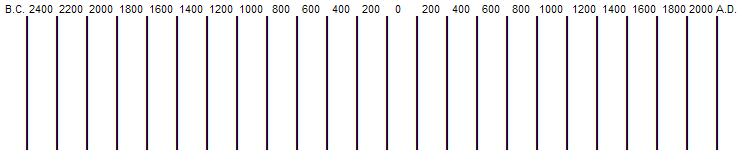
Then, Pamela really amazed me. Yesterday, she made four fascinating time charts in her free time. Starting at 10,000 B.C., she broke up time into thousand year chunks. You can tell what two persons and what great book have impressed Pamela. Once she hit A.D. times, Pamela shifted to century blocks. She shifted to decades once she hit the twentieth century. You can see Pamela's keen eye for the development of her favorite kind of technology. I chuckled when I saw the final block: 2010 - ???? AD.


Did I mention she did this in her free time? The best feedback on how homeschooling is going happens when you aren't homeschooling!

Some find it hard to believe that children can learn to put people and events in proper order when we have several threads of history going at once. In her book addressing children between the ages of six and nine, Mason recommended using a timeline, which we did when our children were younger, or a table of centuries. While we have never done a table of centuries, what Pamela did today looks a great deal like what is illustrated in an article on teaching chronology. I love that Pamela's own brainchild dovetails so nicely with our philosophy of education!

But, even better than that, Pamela continues to make progress in her social thinking:

On Halloween, we delivered meals on wheels in the pouring rain. It was wet and miserable, and Pamela was recovering from a mild cold. A few hours before sunset, Pamela told me to go to Walmart to get candy. Then, she promised she was taking her babies trick-or-treating in 2012.

On Tuesday, our study group was meeting. One of the moms was out in the hall, holding her baby. Pamela smiled and watched them. Then, she walked over to them and held the baby's hand. My friend knew I had brought one of Pamela's babies to show everyone the scarf she had fingerknitted, so the mom asked, "Where's your baby?" Pamela ran off, went to my box of stuff, grabbed her baby, ran back to my friend, and showed off her baby.

And, if that wasn't enough, on Wednesday, I was teaching at our church's afterschool program. Pamela looked in the window of the door to the classroom and all the kids said, "There's Pamela!" She walked into the room, waved her hands, and said, "Hi, kids!" She stuck around long enough for several to tell her their names before she bolted. Fifteen minutes later, one of the boys struck up a conversation with her while he was on his way to the restroom. Someone else was escorting him, so I have no idea what was said. However, there were several exchanges back and forth.

Of course, face blindness (not being able to recognize people by faces, especially if they are in the "wrong" place) did rear its ugly head too. After watercolor class on Thursday, we bumped into one of the ladies from the class in the checkout line at Walmart. We started chatting and, when Pamela came up to us, I asked Pamela, "Do you remember Mrs. X? We just saw her." Pamela looked puzzled and asked, "Is it church? Meals on wheels?"

Oh, well, you can't win all the time!

P.S. About an hour ago (in her free time),  Pamela said, "11th century is Middle Ages. What about 1500?" So, I explained to her that when it was changing to the Reformation and Renaissance. She added, "Yes, and painting!"

Thursday, October 20, 2011

Book of Centuries

History is the story of the way in which man has learned, and is still learning, how to live: of how through long centuries he has sought to satisfy the practical needs of his body, the questioning of his mind, and the searching of his spirit. It is the story of the greatest adventure in the world, this story of how man, from very small beginnings, has progressed in body, mind, and spirit. ~ Dorothy Mills

When I was in school, history was not "the greatest adventure in the world." It was downright boring. History was my least favorite subject in school, and, over time, much of what I memorized for the test flew out of my head. Textbooks had all the adventure squeezed out of them to make room for dates, facts, and other "important" things. I learned only what was required to get an A. What I had to regurgitate was just factoids that went in one ear and out the other once I turned in the textbook for good. History was history after graduation.

I fell in love with history as an adult, reading and discussing living books, usually written for the young, with my children. I enjoy reading nonfiction history, historical fiction, biographies, etc. especially those written by people with a passion for their subject. Thanks to reading wide and varied living books, I remember more history now than I ever did before. And, I don't even study! I want to know more because history really is a great adventure, when well told.

I learn interesting tidbits all the time. Do you know that Wisconsin is nicknamed the Badger State, but not because of the animal? Or, that President James Garfield came up with an original proof of the Pythagorean theorem? I get to follow people in their personal quests and journeys: facing dangers in the Lewis and Clark expedition, winding through twists and turns to invent the telephone, helping family and friends survive an epidemic to which the protagonist have immunity, and finding a new home after seeing your old village burned down to the ground. I sometimes find myself taking a peeking ahead after a particularly exciting chapter. Sometimes, I even stay up until the wee hours of the morning to read straight through to the end.

The most challenging aspect of teaching this way is finding books that are living without being moralizing. Not much has changed in the century and a half since Mason wrote, "There is nothing which calls for more delicate tact and understanding sympathy with the children than this apparently simple matter of choosing their lesson-books, and especially, perhaps, their lesson-books in history."

Charlotte Mason imagined the mind as a beautiful home which we fill with ideas found in storehouses (living books). She found it better to get to know a time and place through the life of one person or event instead of a timeline or chart of the entire history of that period listing all the important facts that somebody things children ought to know. Forming a relationship with someone in the context of their time, whether they are famous or otherwise, will teach children far more about that time than a list of dates that are just as confusing as times tables to the young. A history book that reads like an encyclopedia article has sucked the life of history. She favored books with a story that "moves on a few broad, simple lines" (Page 281).
They purl along pleasantly as a forest brook, tell you 'all about it,' stir your heart with the story of a great event, amuse you with pageants and shows, make you intimate with the great people, and friendly with the lowly. They are just the right thing for the children whose eager souls want to get at the living people behind the words of the history book, caring nothing at all about progress, or statutes, or about anything but the persons, for whose action history is, to the child's mind, no more than a convenient stage (Page 282).
"The writer has chosen such stories as he thought would amuse and please his readers, and give them at the same time some knowledge of the lives and thoughts of their forefathers. To this end he has not written solely of great folk––kings and queens and generals––but also of plain people and children, ay, and birds and beasts too." Mr. York Powell  (Page 288)
Other characteristics of living history are:
  • A single voice chronicling history in a way that was "succinct, yet often warm with life; business-like, and yet childlike in its tone; at once practical and spiritual, simply just, and the work of a true scholar, breathing love to God and man" (Page 283).
  • Firsthand accounts, those based upon eye witness testimony whenever possible, and contemporaries.
  • The heroic age, or "the echoes of some dim, rich past" (Page 284) before recorded history began because "these were giants in the land in those days, and the child wants to know about them"  (Page 284).
  • "Graphic details concerning events and persons upon which imagination goes to work" (Page 288).
  • "Replete with interest, sparkling with episode, and full of dramatic incident" (Page 291).

But the bottomline is what happens to the child when given a living history book:
  • "The child's imagination is aglow, his mind is teeming with ideas" (Page 284).
  • "A child's individuality plays about what he enjoys, and the story comes from his lips, not precisely as the author tells it, but with a certain spirit and colouring which express the narrator"  (Page 289).
  • "A narration should be original as it comes from the child––that is, his own mind should have acted upon the matter it has received" (Page 289).
  • "They love, too, to make illustrations" (Page 292).
  • "They play at history lessons, dress up, make tableaux, act scenes; or they have a stage, and their dolls act, while they paint the scenery and speak the speeches" (Page 294).
  • "The child will live out in detail a thousand scenes of which he only gets the merest hint" (Page 295).
This sounds vague until you see it in real life. When my son was little, he ran back to his room to get the "perfect prop" before we started a reading. He built triremes out of legos and pitted the Greeks against the Persians on Pamela's blue blanket. He built the seven wonders of the ancient world in legos too. A friend recently shared that her youngest has traded Leif the Lucky for Batman. Pamela peeks ahead after every Plutarch and Shakespeare lesson to figure out how long it will be until the Ides of March. When she reads aloud, her voice betrays her emotions: she is a bit worried that two different characters are about to lose their beloved horses, another faced a dramatic grizzly bear attack, a cable broke and sidelined an important project, and Aleck Bell never seems to have enough money or time to invent the telephone.

Younger children keep the order of heroes straight by century through a very large timeline, setup by centuries, in which children wrote the names of people in their proper chronology. The table of centuries provided a graphic panorama to things in their time order and exact dates becomes information overload. An article in Charlotte Mason's periodical provides greater detail if you are really interested. AmblesideOnline has another example here.

Older children (those ready for writing their narrations, or about upper elementary) keep a book of centuries. It started out as a place to record illustrations for a book written about the British Museum.

Pamela has tried keeping one off and on, but it has never quite gelled for her. So many things are coming together for her this year, so I thought I'd try again. What is a book of centuries? Well, my good friend Laurie Bestvater has scored the Charlotte Mason's archives for information to supplement what we find in her six volumes and describes her research here. Laurie sums it up her thoughts in a FAQ and is now offering a beautiful, high-quality volume that will last a child many years.

Stone Age Pages


43rd Century B.C. Page


Map Pages


Wednesday, October 19, 2011

Mono Monarch Mania

So, there we were minding our own business, doing nature study. As planned, we were drawing the young Southern magnolia in our backyard in watercolor pencil. Suddenly, pandemonium erupted!

Out of the corner of my eye, I saw a bright orange flash. It wasn't the red, wobbly flight of a cardinal. Nor was it an orange leaf drifting to the ground. It glided more gracefully. My heart pounded when I realized a monarch butterfly had gently landed in the butterfly bushes in front of my beloved camellia.

I scampered frantically into the house and grabbed my cheap camera, which was set to four-shot sequences. The butterfly must have realized I was stalking it because I scared it, and it too frantically fluttered around trying to avoid that crazy woman. I pointed the camera at random spots and came up with a couple of cool shots (out of a bunch of duds) that I couldn't have planned better.


The monarch finally settled down, as did my heart and I took a couple of pictures of it drinking nectar.


Then, I drew Pamela into the scene and we watched the butterfly until it left. Tomorrow, we will draw pictures in our nature notebooks! When we returned to the house, I went to the regional checklist for my county at Butterflies and Moths of North America. Alas! The monarch, a migrant for our area, is not listed, so I submitted a sighting as a monarch butterfly. It lacks the black line on the hind wings, which its copycat the viceroy butterfly sports. And, ladies and gentleman, we have a confirmed monarch, and BAMONA now includes in the listing of butterflies for our county!

Beautiful in Its Time

He has made everything beautiful in its time. He has also set eternity in the hearts of men; yet they cannot fathom what God has done from beginning to end. I know that there is nothing better for men than to be happy and do good while they live. That everyone may eat and drink, and find satisfaction in all his toil—this is the gift of God. Ecclesiastes 3:11-13

Today (er, Monday, but I'll pretend I posted two nights ago) should have been a disaster. Steve came home for an extremely short visit over the weekend, leaving us bummed at how little we see him. Pamela and I began the weekend about a half a day behind schedule. In the name of masterly inactivity, we took Friday afternoon off, hoping to catch up here and there over the weekend. We did knock out some books, but we started Monday a tad behind.

I meant to wake up early to start promptly at eight o'clock. I didn't roll out of bed until eight after dreaming about accidentally putting my nature notebook in the washing machine. On top of that, I had a headache and we had to go on an errand that required an hour of driving plus an hour of running around.

We started late, already "behind." Since I don't obsess over schedules, I figured we would do what we could do with delight and no more. Pamela did her best to supply the delight. She picks the order of what we do: some days she is methodical. She usually walks her favorite route and selects books in chronological order (from ancient to modern and vice versa). Sometimes, she picks her favorite route backwards or takes a completely new one. Lately, she has preferred reading books in random order.

Today, random didn't add enough joy, so Pamela invented her own game. For every book, she covered her eyes and told me, "Pick a random one." She giggled while I picked a book out of the crate and laughed when she saw what I picked. I improvised on her game and gave her clues while she had her eyes covered. I would hum the tune of a train song when I picked a book on that topic or "Hail to the Chief" when I picked one on the presidents. Then, she really laughed uproariously. Selecting the next book was a hilarious game that melted my headache.

Mother Nature had a lovely surprise when we headed out to study the magnolia tree. The creamy peach fruit, a fascinating study in its own right, popped out cheery red seeds, something we had never noticed before. We collected three different colors of leaves and recorded all of our finds in our nature notebooks. Then, we headed to the computer to classify the tree with the help of the Clemson Extension biological key. Pamela wrote down the name in English (Southern magnolia) and Latin (Magnolia grandiflora). Pamela has enough Spanish under her belt to translate the Latin word grandiflora. Without any help, she figured out right away that it meant "big flower".


Pamela found joy in mathematics too. She was looking at the relationship between the circumference of a circle and the diameter, calculating the ratio of the former to the latter. When the book asked her "How many times does the diameter fit around the circumference?" Even though she wrote an equation based upon the ratio (C = 3.1 x D), Pamela did not think to solve for D (D = .34 x C). I think the decimal was throwing her off. Since she enjoys playing with numbers, I showed her how to plug numbers into her calculator to figure it out.

I encouraged Pamela to guess a starting number, any number. She guessed three and plugged it into an equation based on an actual data point (a cookie cutter tin): 14.3 x _____ = 4.5. Her guess (3) yielded a number much too high, so she tried and discarded 2 and 1 (too high) and 0 (too low).
14.3 x 3 = 42.9
14.3 x 2 = 28.6
14.3 x 1 = 14.3
14.3 x 0 = 0

With a upper boundary (1, which was too high) and a bottom boundary (0, which was too low), I guided her through the search: the point half-way between 1 and 0. She plugged in .5 found it too high.
14.3 x .5 = 7.15

Then, she tried and rejected .4 (too high) and .3 and .2 (too low):
14.3 x .4 = 5.72
14.3 x .3 = 4.29
14.3 x .2 = 2.86

Every time we tried a new number, Pamela grew more and more delighted as the product got closer and closer to 4.5. She squealed with joy! Then, I asked her to try "Point three what?": .3__.

She tried .35 and squealed at getting even closer: 5.005! More joy with .34 (4.862), .33 (4.719),  and finally .32 (4.576)!

As always, we spent our time in the car wisely, doing our audio work (Spanish, recitation, a few audio books, music), and waiting for assistance in various offices, doing written work. I smiled at Pamela's misspellings in her studied dictation: how can you not see the logic of writing introducted? I smiled at her choice quote for her commonplace book, "Care for him as for the apple of your eye." She started her narration about gorillas in her science notebook and added two drawings of ancient sculptures to the drawings of those we have found in town.


Another delightful study is on the telegraph. I created five audio files (one per day) of a message in Morse Code. I picked quotations and lines Pamela might recognize from her reading to practice decoding using a tree. The file was not too difficult to create: I used Audacity to create series of 1,000 Hertz tones lasting 1/4 of a second for a dot and 1 second for a dash. Today's message was the title of a hymn we learned last year: Open Our Eyes, Lord. Watching Pamela's face light up anytime she makes a discovery is another source of joy.


Last June, I bought a calendar of firsts from Red Mountain Community School, but it has taken some time to wrap my head around it. How do you know a first is a first? God clued me in on Saturday when the camellia that always blooms in October revealed its blossoms right on schedule. The second issue for a math geek like me is that the book has 86 pages, each of which has four columns, which equates to 344 days of entry. A leap year, which has 366 days, would skip 22 days. That meant we needed to have two days per column, twice, in ten of the months and two days per column, once, in ten of the months. I made a command decision to set up January 1 through 27 on single columns, put 28/29 together, and 30/31 together. We will apply the same logic to the last four days of every month until we hit November and December, which will only be the last two days of the month. You can see why I have put off making any decisions because I can't even follow my reckoning here. Since we had plenty of spare time, Pamela started setting up her calendar and made it half of the way through February. Because Pamela loves calendars, she enjoyed this immensely.


They find that, in Bacon's phrase, "Studies serve for delight"; this delight being not in the lessons or the personality of the teacher, but purely in their 'lovely books,' 'glorious books.' ~ Charlotte Mason