Sunday, July 08, 2012

What Do You Want to Make Today?

It's not an easy question to answer, if we are used to doing what we are expected to do to graduate or to pass this portion of the class. We live in a pragmatic, utilitarian world in which our "bottom line" questions usually deal with questions of usefulness or profitablity; often these decisions are made in a Darwinian competition of who can win out the battle to be the most powerful, to take what you can out of life. In the scarcity mindset of such a dehumanized system, we usually ask "what can I take from you today?" What do I take from others, or to do as little as I can to get the maximum results, and we do not ask "What do you want to make today?" Deep questions of life are the same whether you are at a starting point or at an ending point. Would you make today a future that is worth beholding? Will you choose to dedicate your days to creating a world that is worth passing onto your children?

~ Makoto Fujimura
The artist Makoto Fujimura was the keynote speaker at this year's ChildLightUSA Conference. My dear friend Bonnie Buckingham instigated this after she read Refractions, a collections of essays originally written for Makoto's blog. A series of events led Bonnie to New York City to attend an arts conference and to see the Four Holy Gospels paintings on display at the Museum of Biblical Art. I didn't really understand why she saw connections between his thinking and Mason's until Bonnie gave me a copy of his book to thank me for speaking on mathematics and special needs for homeschoolers in the Charlotte area. I'm only half of the way through the essays, and his ideas dovetail very well with Mason.

My favorite essay is based on a blog post called Bert's Disappearing Weather Maps. Back in 1983,  Mako worked with special needs students who didn't fit inside the box of special needs programs. He saw extraordinary gifts in a young man named Bert who drew weather maps aired on the previous night's news broadcast on the blackboard with his spit. This perseverance disgusted and annoyed most adults, but not Mako. Treating Bert as a person with unique gifts, he invited unusual artist to make a mural of a weather map on the bulletin board with markers. “No one’s ever asked me to draw a weather map before in school; they just complained about it” was the enthusiastic response. Through their relationship of mutual respect, Mako convinced Bert that drawing with tap water was healthier because eating chalk every day might not be good for his health. He concludes with the same ideas I have about Pamela and her job prospects in this dead-end economy: "I also knew that the society that would make Bert 'useful' by giving him menial jobs after his graduation would not be as kind."

So, what do you want to make today?

Lately, I have been on a needlework binge. My basket of leftover yarn sits there blinking at me, waiting to be transformed into something other than a ball of yarn. I always have my eye on making gifts for Steve, who is working Kansas, away from our cozy home. To keep him from feeling lonely, Pamela and I have been making things for him that surround him with beauty and love. Everyone of Pamela's  watercolors that we have framed so far adorn the walls of his apartment. Last December, I finally finished my magnum opus (five years in the making, I think) to keep him warm on chilly winter days. I crocheted half a dozen coasters with the scrap yarn and still had scrap of the scrap yarn.


Then, I saw a pattern for making reusable Swiffer cloths. Why not make something beautiful that saves me a chunk of change? A small piece of something in Kansas is here in Carolina, and, whenever I do one of my least favorite things (housework), the colors will remind me of Steve.

A homeschooling friend sent Pamela and me handmade bracelets that her daughter knitted. So, I returned the favor and fingerknitted a pair of scarves.

What do you want to make today?


Then, a Facebook friend, who's also a skin friend, tagged me on picture of a knitted coffee cozy. What a perfect gift for Steve, who I think was weaned on coffee! Only it needs to be crocheted (my better medium when it comes to needlework) that will take advantage of colors in my scrap yarn. Ooooo, I really like that one! Only, it needs to have a steaming cup of Joe instead of a tea bag as an embellishment and a built in coaster. And, the potholder I had been crocheting for him disappeared to the backburner....

What do you want to make today? 

Pamela is learning to knit, and she has all but one little step of the garter stitch down (blog post to follow on teaching her to knit as well as making her own wooden needles). She picked out hot pink for a baby blanket for her four "babies".

Pamela loves to doodle, especially on church friendship pads. Something about them sets her creative juices in motion. Every Sunday, she fills them with doodles. Some might assume she isn't paying attention but do not let that fool you. Today, we were visiting a different church to hear my friend's husband preach. While we recited the Lord's Prayer, Pamela doodled. As soon as we finished, she looked at me pointedly and said, "Which!" She noticed that our church says "which are in heaven" while this church choses the more familiar "who."

Since I haven't posted any of Pamela's watercolors in awhile, I thought you might like to know that she is still going strong in making beautiful things.

Pamela's Latest Watercolors


Friday, July 06, 2012

A Rare Review

I hardly ever review a product. A Charlotte Mason paradigm eliminates the need for tons of formal curricula. We cut out the middleman by focusing on living books (not abridged versions or snippets in a literature anthology); on whole, specific composition by a composer (not the best of); on grade-level poems of four persons a year (not a mish-mash of mediocre works to fit a theme or literature selection). People probably get tired of my oddball responses to questions about a Bible study curriculum for children: we read the Bible, study maps, historical artifacts, etc. and talk about what we learned. When asked about language arts programs, I give an outline of Mason's building blocks for language acquisition. Not exactly what most people want to hear. Since prepackaged curriculum are off my radar, reviews are rare on this blog.

Steve knows me well and bought two perfect gifts for me this year: a Nook tablet and Wii Fit Training Plus. Pamela and I have been using the fitness games for almost four months now: she is on her 109th day, and I'm on my 113th. At first, I required her to do 30 minutes of every homeschool day, reminding her. She enjoys the program so much she faithfully exercises every morning for at least a half hour of her own free will. She even exercises on weekends. I have not paid any attention to her workout charts until deciding to do this review. She has exercised every single day for the past 24 days (as far as the activity log goes). She has averaged 37 minutes a day, burning about 113 calories per day. Her MET (metabolic equivalent) is 3 because she is burning 93 calories per half hour. That means her intensity level qualifies as moderate-intensity exercise.

Pamela has been averaging 256 minutes a week of moderate-intensity exercise, all of her own free will. Here is a chart of her recent workout:


Comparing her activity to a chart of Sports and Leisure, Pamela is doing the equivalent of playing casual volleyball:


To put it into perspective, without any parental nagging, Pamela far exceeds the CDC guidelines for people her age (150 minutes a week). Every day, she works all major muscle groups because she selects non-game exercises (yoga and strength training).

I call that a win!

Other benefits include a change in Pamela's choice of beverages. She has taken Wii Fit's advice seriously, and now, when we hit McDonald's drive-thru for my McCoffee fix, she orders bottled water instead of soda. She has picked a bunch of new health-related vocabulary words like deep breathing, warm-up, yoga, strength training, obstacle course, aerobic training, boxing, Kung Fu, balance, advanced, etc. Not only did it develop a new interest (fireworks), Pamela has conversations with me about exercise: "You skipped boxing today," "I skipped the obstacle course today," "I got a little further," "Yippee! My personal best!" "Two humans did Perfect 10"—and Pamela is a supercalculator in that game.

I have benefited from the program as well. Every week, I aim for four to five one-hour workouts that burn at least 310 calories per session (my MET of 155 per half hour is equivalent to dancing with a partner). My muscle control, balance, and strength has improved greatly: my Wii Fit age scores are consistently below my chronological age, which wasn't the case during my first month. A typical session for me begins with twenty-five minutes of either yoga or strength training, followed by twenty minutes of aerobics and fifteen minutes of play. Moreover, the center of balance (COB) assessment helped me solve the problem of aching heels when I'm on my feet a lot. Feedback from Wii Fit trained me to move my COB forward and my heels rarely bother me now.

Conveniences include:
  • I can workout at any time, regardless of weather or daylight changes. Pamela prefers early in the morning (7 a.m.) while I prefer evenings (9:00 p.m.—weird, but it works for me). We can work out according to our unique body clock.
  • I don't have to waste gas money (21 miles to the nearest YMCA or 1 mile to our town's only fitness center).
  • I can exercise on my schedule not the limited hours of the local fitness center: M-F 5:30 a.m. to 8:30 p.m., S 8:00 a.m. to 12 noon, closed Sunday.
  • I am not bored out of my mind: I do not enjoy exercise of any form, except for swimming. I find the games entertaining. Being smacked in the head by imaginary sneakers or having a clay pot crash on my head are more amusing than some pretty, perky person encouraging me to feel the burn.
  • I don't have to pay monthly fees or skip workouts when we are visiting Steve in Kansas. Our exercise equipment is quite portable.

Does Wii Fit help people who are already in good physical condition? It depends. Steve is in great shape: he runs and bicycles regularly in a hilly Kansas city along the banks of the Missouri River. In his youth, he lived at the tennis court (in fact, his father still plays tennis—he's in his eighties!). Steve can run a 10K without any special training. A couple of years ago, he even ran a few marathons and many half-marathons.

Unfortunately, he neglected core muscle groups not used in running and rarely stretched or worked on flexibility. On the day before Thanksgiving of 2011, he pulled a muscle in his back. Pain shot up his back, and his spasms were so severe he made an appointment with a chiropractor that day. Steve had never seen a chiropractor in his life. While manipulating Steve's back, the man exclaimed regularly, "Dude, you are so stiff!" And, he was right!

Steve spent about six weeks in treatment. The chiropractor recommended Steve spend more time cross-training to work his core muscles, so he and some buddies made a pact to take Zumba classes ("whatever happens in Zumba stays in Zumba"). He found the classes helpful but inconvenient, so the Wii Fit has filled that void. When he first tried the Hula Hoop game back in April, he failed within a few seconds. Now, he can last for five minutes in each direction for a total of ten minutes. His back feels great, and we are both relieved that he found natural treatments to address his injury, avoiding addictive pain medication and surgery.

Wednesday, July 04, 2012

Another Milestone

As you can imagine, fireworks and people with hypersensitive hearing don't always get along. Since David usually takes off with a bunch of friends, we haven't bought fireworks in years. While she enjoys the big show in the sky, viewed from afar, Pamela has never shown an interest in the tame stuff peddled at the fireworks shacks that pop up all over town this time of year.

Until now....

It all started with Wii Fit Training Plus (review here). Just as the movie Toy Story 2 taught her the joy of elevators (overcoming a decade-long phobia), the balance game Tilt City has sparked an interest in fireworks. For the past two weeks, Pamela has talked about shooting off some sparkly stuff when Steve came home to visit us for the Fourth of July festivities. I thought he would pick up something tame like sparklers, but he's an engineer. He bought a family package of all sorts of arsenal, including Roman candles, cakes (not the chocolate cake Pamela insisted I bake), snaps, poppers, something called "mad dog" (a gazillion firecrackers lined up in a belt of earsplitting noise), etc.

You know, of course, which one Steve went for first: the "mad dog".... He made a crack comment about giving it to our mad dog (the beast), and she exclaimed, "You're joking!!!"

Safely perched on the back porch, Pamela watched Steve launch one bomb after another. She kept a running commentary going in between squeals, giggles, and a few Nazgul-like shrieks.

"Dont' burn down the house!"

"Don't burn your hand. Reminds me of Johnny Tremain."

"THOMAS SUMTER! REBECCA MOTT!" (two revolutionary war heroes from South Carolina that we studed last year: The Fighting Gamecock and  The Courageous Patriot)

"Just like Little House!"

Laura Ingalls Wilder's mention of fireworks had slipped my mind, but sure enough, right on pages 249 and 250 lies a description of an Independence Day celebration Laura spent with Almanzo in These Happy Golden Years:
At supper Almanzo proposed that Carrie go with him and Laura to see the fireworks in town.... They kept the horses well outside the crowd, so that no one would be trampled or run over. In an open space at a safe distance they sat in the buggy and waited until a streak of fire rose in the darkness above the crowd and exploded as a star.... After each explosion of beauty against the darkness, Almanzo drove the circle, always bringing Barnum and Skip around in time to face the next rush and blossom of fire. Not until the last shower of sparks had faded did Almanzo and Laura drive away
Pamela watched every move Steve made and stuck around until every last explosive had been fired off. She even joined Steve in the noise making. She prepped a small balloon and stomped on it (a fear she conquered three years ago). She blew up another ballon, threw some pop pop snappers at it, but never got close enough to pop the balloon. She laughed, "I failed!" She ended up stomping on another balloon.

After the fun ended, Pamela looked at the debris on the brick walkway and announced, "Clean up tomorrow!" I encouraged her to thank her father for buying the fireworks and she walked down the driveway to the front yard, where Steve was turning off the sprinkler. She told him, "Happy Fourth of July!"

When she returned, she told me of her plans to do fireworks in 2013.

Now the Lord is the Spirit, and where the Spirit of the Lord is, there is freedom.
2 Corinthians 3:17

Tuesday, May 08, 2012

Curing Boredom


One of my favorite Dickens mini-series is Bleak House. Gillian Anderson captured haughty Lady Dedlock's boredom brilliantly. In the book, the author attributes Dedlock's boredom to monotony. What a wonderful surname he gave to someone who is perpetually bored.
They cannot go away too fast, for even here my Lady Dedlock has been bored to death. Concert, assembly, opera, theatre, drive, nothing is new to my Lady under the worn-out heavens.
Charlotte Mason observed something quite similar about teachers and children in typical schools:
The complaints made by teachers and children of the monotony of the work in our schools is full of pathos and all credit to those teachers who cheer the weary path by entertaining devices. But mind does not live and grow upon entertainment; it requires its solid meals. (Page 90)
The mind does not live on entertainment alone! How many evenings do people spend surfing hundreds of channels only to find nothing interesting? (You know we have all wasted precious hours in this mode.)

She also noted a link between boredom and rewards (grades, prizes, class rank).
The teacher who proposes marks and places as worthy aims will get work certainly but he will get no healthy love of knowledge for its own sake and no provision against the ennui of later days. The monotony I have spoken of attends all work prompted by the stimuli of marks and places; such work becomes mechanical, and there is hardly enough of it prepared to last through the course of a boy's school life. (Page 91)
What is wrong with rewards? The same thing that is wrong with trying to teach by entertainment. Both depend upon an outside person or force acting upon the person. With entertainment, somebody else performs the act of entertaining: those watching become passive. Passive learning assumes the mind is an empty bucket, waiting to be filled. It assumes that the quality of learning depends upon the skill of the teacher. The instructor can compile lessons over a year or two and repeat the course, year after year. The student can simply go through the motions, memorizing only what is needed with little thought to make the kind of connections that makes learning stick.

With rewards, somebody sets up the system and dishes out the reward when requirements are met. They do what has to be done and no more. I know of kids who will read the simplest books to rack up points for programs like Book-It or summer reading programs at the library. When one high schooler told me she never reads books, I asked, "What about school? Doesn't your school have Accelerated Reader?" She explained that she looks up information online and can pass the test without reading the book. If the grade or prize is more important to the student, then the book is the means not the end. After graduation, when the system is no longer in place, what happens to the student? Some never crack a book for many years after leaving school because they have no need to read.

Mason suggested that knowledge for its own sake is the key to holding attention.
There is no faculty within the soul which can be spared in the great work of education; but then every faculty, or rather power, works to the one end if we make the pursuit of knowledge for its own sake the object of our educational efforts. We find children ready and eager for this labour and their accomplishment is surprising. (Page 93)
She recommended that knowledge be wrapped in a story form or gained through firsthand experience. Research today shows that the mind really does hang onto ideas presented in a story format. (Why do you think Jesus spoke in parables?) Daniel Willingham, the cognitive scientist, explains that stories with four features grip the mind the best:
  • Causality - one event causes or initiates another
  • Conflict - a main character must overcome obstacles to reach a goal
  • Complications - attempts to overcome an obstacles create problems that must be solved
  • Character - strong, interesting people come alive

I have been homeschooling Pamela since 1995. We started using Mason's methods in 1999. I do not find the daily effort dull because I just never know what to expect from Pamela. In the past week, here are some things that have delighted me.

Pictures Pamela Drew for Her Architecture and Natural History Exams


Pamela's New Exploration in Science

How The Psalm This Week Was Exactly What **I** Needed to Read

How God Orchestrates Connections That I Don't Plan in Advance... Two months ago, I chose "Good Night, Moon" in Spanish to begin this term this week, which just "happens" to be the same week we begin reading a chapter on the moon in our weather book, which just "happens" to be the same week as the super moon.

How I See Pamela's Progress over Time... Three years ago, I could only say one word at a time for studied dictation of one sentence. Today, I can see three words at a time and I can pull one sentence out of a paragraph that she studied.

How Pamela Constantly Surprises Me... Before reading our book on the Alamo, which written as a first person account, Pamela announced, "I'm pretending to be Billy." Then, she said three sentences in the first person with perfect use of personal pronouns.

Do you know how many social milestones are required for a person with autism to do that?

Saturday, May 05, 2012

"Why Is There an Apple with a Knife Stuck in It in the Fridge?"

Husbands and fathers of homeschoolers have to put up with all kinds of weirdness. When we were staying with Steve in Kansas, he wondered why an apple with a knife stuck in it was in the refrigerator. I explained that we were modeling why seasons occur. Then, he asked why I had the string and tacks out. I told him I forgot to put them away after drawing an ellipse with a string. He had never heard of that before, so it was our turn to teach our resident engineer something new!

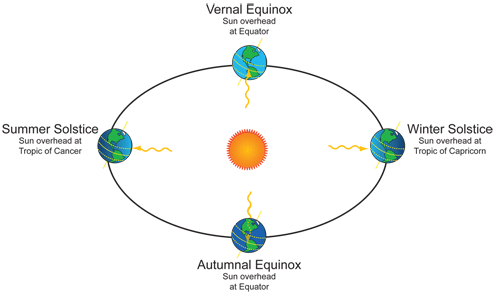
When we read science books, we don't just read them. Often we try to live them. Pamela and I were learning about the seasons and why they occur. I had a feeling that the diagram in the book and written explanation might not be enough to make it clear. I labeled an apple with the letter N for north pole and S for south pole. Then I drew a line representing the equator and labeled that. I stuck a knife in it to represent the polar axis.

Then, we took a piece of cardboard and practiced drawing circles and ellipses with a piece of string. We drew an ellipse on a big piece of cardboard, and I made four marks to represent the four seasons. I did not label them because that is what we were going to discover! We darkened the room, removed the lampshade, and placed the lamp in the middle of the ellipse. The plan was to tilt the apple, move it around the lamp in an elliptical orbit, and mark the seasons.

We did something similar to illustrate night and day way back when I homeschooled Pamela and David. David caught on immediately to the idea that day was where the light shined and night was in the shadow. Pamela could not make the connection at all but, at least, she learned that the earth spins. Last year, we revisited the day and night demonstration, and it clicked for Pamela. I suspected she might be ready to grasp the connection between the earth's orbit and seasons.

Her background knowledge played a role in how I structured this. Pamela, a savant in calendars, knows many facts about the calendar. She taught this to herself by researching it on Google.
  • A common year has 365 days.
  • A leap year has 366 days.
  • February 29 only occurs in a leap year.
  • Spring begins around March 20 or 21.
  • Summer begins around June 20 or 21.
  • Fall begins around September 22 or 23.
  • Spring begins around December 21 or 22.

Unlike most people I know, Pamela has an advantage: not only have we lived in Alaska where days are really long in the summer and nights are really long in the winter, we have visited family in two countries near the equator (El Salvador and Guatemala). We have also stayed in South America for nearly a month. In 2006, we left Carolina on a hot summer day before the equinox and arrived in Santiago, Chile on a chilly winter day. Three weeks later, we said adios to the spring blossoms of Chile and hello to the cooling fall temperatures of Carolina. Pamela saw for herself seasonal oddities that other children must be told. Life experiences have given her more facts.
  • When it is summer in North America, it is winter in South America (and vice versa).
  • When it is spring in North America, it is fall in South America (and vice versa).
  • Days are longer in summer, and shorter in winter, especially when you live closer to one of the poles.
  • Some countries never have snow (the ones near the equator).

Since she understood why we experience day and night last year, I had hope the seasons would make sense to her. First, we tried the day/night demonstration to tie into her prior understanding and she had no trouble pointing out to me which part of the apple had day and night. Then, I tilted the apple and began moving it along an elliptical orbit. I stopped at the location for summer in North America, and Pamela could easily see how the sun was shining very constantly on the North Pole while the South Pole was stayed in darkness. Because of her previous experience, she saw right away how it had to be summer in the northern hemisphere and winter in the southern. We marked that on the elliptical cardboard. We continued working through the seasons, and the next day Pamela copied the diagram from her book into her science journal.
After she drew her diagram, we spent the week reading about the seasons and their connection to the motion of the earth. We drove back to Carolina and read another chapter on the northern lights the following week. We studied the seasons three weeks ago and have not reviewed any of the material. I did not drill her on facts because that is not part of a Mason paradigm. The video is a short clip of what she narrated about the chapter on seasons. While the transcript does not look like much, you have to watch the video and see how she uses her hands to illustrate the orbit of the earth and demonstrate her clear understanding.
The earth was spinning from year. Days—about 365 and 366 days leap year and common year. Around Spring, Summer, Fall, Winter.

Tuesday, May 01, 2012

"I Can't Wait for Exams!"

People are starting to wake up to the thought that high-stakes testing is burning out our kids and teachers. It's also undermining creativity and encouraging cheating. Even homeschoolers are not immune to the pressure, either because some states require it or parents feel pressured to cave into societal expectations. People do not realize we can assess learning without creating anxiety. Our secret is oral exams: Pamela tells me everything she knows about each and every book or thing we did.

Because of Pamela's delayed language, we didn't even try exam week until last year. We did another round of exams last fall, and we started our third attempt yesterday. We are not even half way through exam week, and I can see such progress in Pamela's ability to communicate fully. More importantly, for the first time in her education, I feel like we are equally yoked!

What does equally yoked mean? Study the picture of Farmer Boy and his yoked oxen. When one ox is physically stronger than the other, they do not share the load very well. Not only that, one walks faster and one walks slowly, resulting in going around in circles. For years, I have been the one driving us to make things happen. I made the yearly plan, the weekly schedule, the daily box. If I was too burnt out to keep going, we stopped. Usually, by spring, we slowed down considerably because (1) I was tired, (2) my tree pollen allergies zapped me even more, and (3) I was gearing up for the June conference. The end of our school year would dwindle, which didn't make me fret too much for Pamela always find something to keep her mind going, but at a slower pace.

This year is different!

Pamela now sets up the daily box. When we are finished with a book for the week, she puts it next to the computer because she knows I stack them until I add them to the schedule for the next week She watches me make the weekly schedule and catches me when I make typos! She has even figured out the first few tasks I perform in Excel to get a new week going. When I'm tempted to call it a day, she often inspires me to keep up with her. Instead of taking five hours to get through our subjects, she's only requiring three or four. Pamela's zeal is helping me get through the spring blahs. She has even figured out how I categorize books, saying to me, "I want border history," when she wants to read our books on Mexico and Canada!

I can see this mindfulness in her exams too. Monday morning, the first thing Pamela said to me was "I can't wait for exams." Pamela eagerly narrates her exams. She speaks a tad more fully. Sentences are flowing more easily. She elaborates with her body language. She knits her brow in concentration. She even looks up in our weekly sheets what chapter we were reading at the beginning of the term. It is almost like she has prepared for this because she often goes from chapter to chapter, often recalling the title of each one, without peeking in the book. We are finally living what Charlotte Mason described in a passage our study group will be discussing next week:
Parents and those who stand in loco parentis have a delicate task. There must be subjection, but it must be proud, work as a distinction, an order of merit... There is no great gulf fixed between teacher and taught; both are pursuing the same ends, engaged on, the same theme, enriched by mutual interests; and probably the quite delightful pursuit of knowledge affords the only intrinsic liberty for both teacher and taught. (Page 71)
This "equality" between teacher and taught is what high-stakes testing steals from our kids. Because teachers end up drilling children to prepare (I know some staying after school right now because their pre-tests hadn't measured up), students lose interest and their minds wander. "To allow repetition of a lesson is to shift the responsibility for it from the shoulders of the pupil to those of the teacher who says, in effect,––'I'll see that you know it,' so his pupils make no effort of attention. Thus the same stale stuff is repeated again and again and the children get bored and restive, ready for pranks by way of a change." (Page 75)

Through our daily efforts of learning together, side-by-side, Pamela has achieved a most important lesson of education: "Children are aware of the responsibility of learning; it is their business to know that which has been taught." (Page 74) The proof is in the determination she has shown in her exams and in owning what she can do in planning.

I decided to compare Pamela narrating the same book for all three exams: A Wrinkle in Time. Keep in mind that, when we moved to Carolina in the summer of 2005, I was thrilled if Pamela could remember three words after we closed a book. THREE WORDS. Folks! She was sixteen years old, well past the magical age of neural plasticity when the door to language is supposed to slam shut forever. We began reading this book in September 2010, and we finished in the middle of February 2012.

January 2011 - Pamela is eager and quietly narrates. She needs me to guide her to the next thought when she gets stuck. She doesn't use many proper names. Her verbs are a bit limited.

[Meg and Charles] had no dad somewhere. Somebody, it had no father anymore. They had family. They had hot cocoa. It was snow. It’s too cold.

They saw the ghost. “Boo!” Scared. They had the soup. It’s good. They had the magic. It [the ghost] turned into a unicorn, white horse. Unicorn is white. It giddy-up. Mrs. Whatsit. Three ghosts.

They go space. They fly into space. They saw the stars and the shadows. It’s darkly. It’s scary. It’s boo! The happy medium in the crystal balls. They had the earth. Meg with children, they were cute.
November 2011 - Pamela's narrations flow more easily, and proper nouns come to her more easily. She gestures a little bit.

Meg, Calvin, Charles Wallace saw a man spinning with the eyes. They had the bad man. They were grumpy. They were in a space. The space was awful. Charles Wallace was soul. He disappeared. It’s gone. They can’t find Charles Wallace anymore.

They had a computer and electricity. They saw a bed. The bed was huge and chair was huge. They can’t Father anymore. They go look for space. They have to find Father. They found it. They have to go It. They have to find Mars, wrong one. It was a space. Space wasn’t wonderful. It had brain. “Boop-boop!” Charles Wallace turned into cold. Father was so sad. They can’t find Charles Wallace.

They had Mrs. Who, Mrs. Which, wearing the glasses and the ghost. They go to space. They had the stars. The stars had in their eyes.

Calvin had two children. Charles Wallace turned cold fingers turn into cold. Meg was a cold. She has a frozen. It was so cold. They [Father and Calvin] were helping a rescue to the two children. They were save.
May 2012 - Keep in mind that Pamela finished reading the book TEN WEEKS AGO! She would have remembered far more details had I recorded an exam then. Pamela is delighted, eager, and confident. Her body language and face are so animated. Names come to her more easily. She tries to pronounce words like "tesseract" which she can see on the page in her mind (something I've seen her do in her daily work). She includes sequencing words like next and last. When I look up the title of the last chapter, she leans in with interest.

Meg doesn’t have father anymore. They feel sad. It has no more sky. Right. They went. They drinking hot cocoa. They saw Mrs. Whatsit. Was a ghost. They saw Mrs. Who, Mrs. Which. Who was a ghost.

Charles and Calvin. Black Thing: They said, “You can’t go! They’re very dangerous!” Tesseract about 3D.

They had a happy medium. They had saw Central, Central [and] man with the red eyes. Spinning. Scared. Charles Wallace! The next chapter, “It.” They found the father. They go Absolute Ten. They’re flying. About Aunt Beast: they were furs, tentacles. They had tentacles, alien.

Last chapter about foolish weakest. Foolish and the Weak, they can go find Charles Wallace’s soul. They feel happy. They return to the earth; said, “Good-bye,” to Mrs. Whatsit, Mrs. Who, and Mrs. Which. “So long!”

Thursday, April 19, 2012

Pa's Music: Another Great Rest Area

We just got back from staying at a state park in Oklahoma. On the way home, we picked another memorable rest stop about half way along our eight-hour drive. We visited a replica of the cabin Pa built thirteen miles south of Independence, Kansas where the Ingalls family lived for about a year. This spot is the setting of a book in one of my favorite book series from childhood: Little House on the Prairie. Inside the cabin, we found articles reminiscent of that era, even a chair carved out of a tree trunk. We found an oil lamp with the hurricane class, a washboard and tub, very few decorative knick-knacks, a bucket of kindling, etc. Pamela had to try out the coffee grinder. Pamela found the place utterly delightful. We wandered behind the cabin and found a hand-dug well set-up to look like that Laura watched Pa make.
Sheepishly, we headed to our next stop was the little gift shop to the right of the cabin. We felt a tad guilty for we had no cash to make a donation (and the visit was well-worth a token of our appreciation), so we opted to buy momentos: a Kansas coffee cup for Steve and the CD of the songs Laura described in her books Pa's Fiddle. I'm such a LIW junkie that I have The Little House Cookbook, Laura's Album, and The Little House Songbook in my home library. An outfit called Pa's Fiddle Project has recorded two more albums that you can sample and download at Amazon: Arkansas Traveler and Happy Land. Before you roll your eyes that this is kiddie stuff, folks are taking Pa's music seriously: last January some big names (Randy Travis, Natalie Grant, and Ronnie Milsap) got together in Franklin, TN for a live session of Pa's music to be aired on PBS during June's fundraising campaign. If you still doubt me, check out this you-tube clip. To capitalize on the serendipitous timing, I plan to pick folk songs from the album for our third term. While Steve paid for our purchases, Pamela decided to relax on the rockers on the front porch of the store.

This placard in the field behind the post office points out the Doc Tanner (the doctor who probably saved the Ingalls life when they were hit with a terrible fever) lived on the land past the highway. Standing here was glorious because birds serenaded us with their lovely music. I didn't take many pictures inside the post office because they were in the middle of renovations. Pamela signed the guestbook for us.

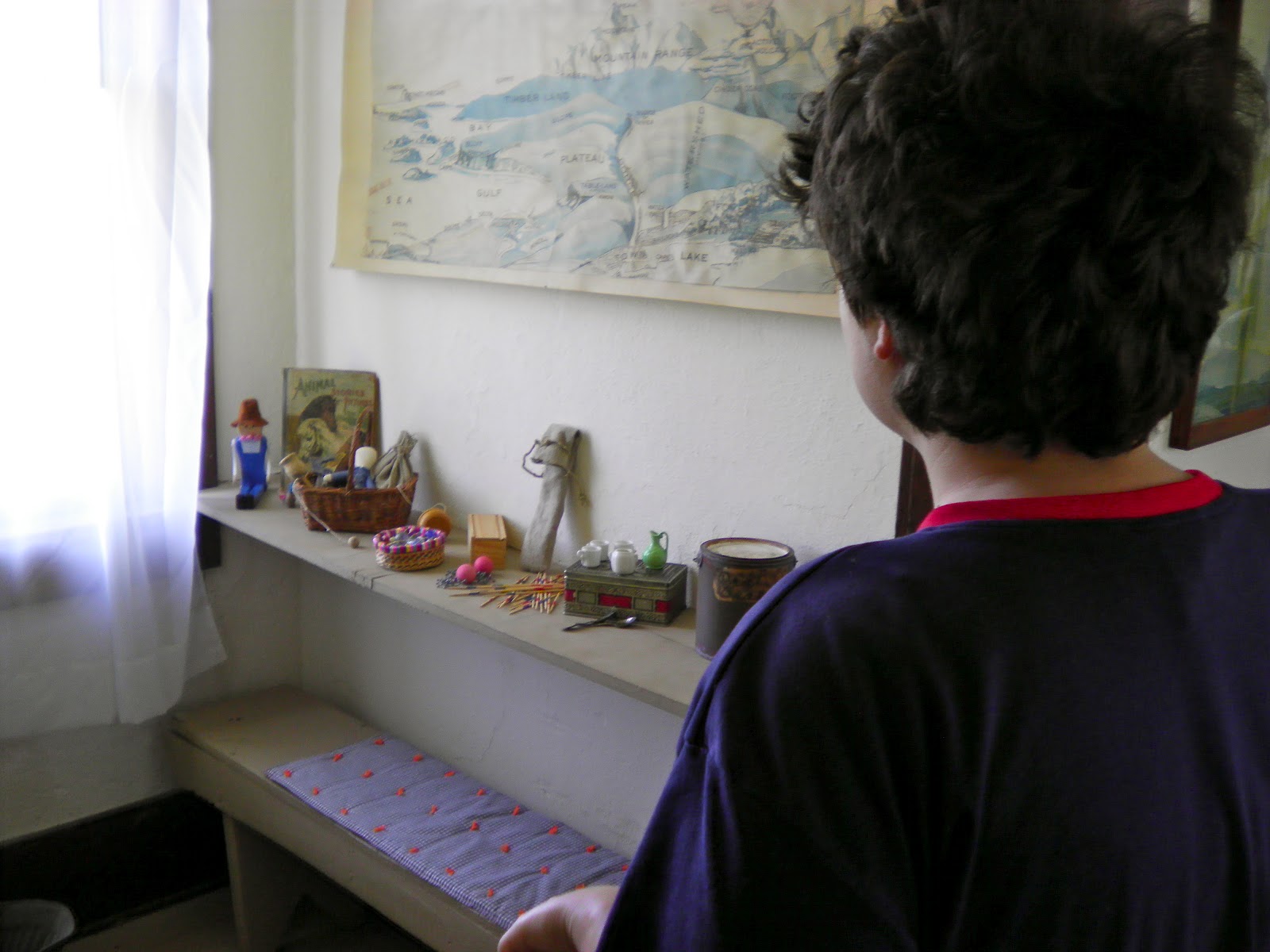
Then, we took a tour of Sunny Side school, which opened not long after Laura left. The room reflects how the school appeared at the turn of the century. Two rooms displayed toys, medicine bottles, and other artifacts. Pamela smiled at the sight of a coon skip cap for Davy Crockett gave a young teen one in our books on the Alamo. I noticed the McGuffey readers on the desks, which some homeschoolers use today (we prefer whole, living books in our homeschool).

You may be wondering how the Ingalls went to the bathroom. Thankfully, the restroom facilities were NOT authentic to the pioneer era. However, they did have a rustic look in their wood and stone structure and the wooden table for changing diapers. I don't think Ma had one of those!