Monday, November 11, 2013

Help for Those Who Hate Math

Last July, I had the pleasure of meeting Richele Baburina, author of Mathematics, An Instrument for Living Teaching, at the Living Education Retreat. Her insights have helped me enormously with a student in the autism spectrum who has declared loudly to us at the school: "I HATE MATH!" "IT'S TOO HARD!" "IT'S BORING!" "YOU JUST WANT TO ME WRITE PAGES AND PAGES OF STUFF!"

I empathize with his views of typical math curricula. As Richele points out in her first blogpost on mathematics, "Though its use in daily life was important, it was the beauty and truth of mathematics, that awakening of a sense of awe in God’s fixed laws of the universe, that afforded its study a rightful place in Charlotte’s curriculum."

Does typical math curricula inspire awe over God's fixed laws of the universe? Does it point to the beauty of mathematics?

When he sees a worksheet full of equations, my young friend shuts down or melts down! As Richele states in her second post on mathematics, such worksheets are not CM-friendly. They are convenient for moms and teachers because they give us a break from individualized instruction.

Rather than haul out workbooks, I assessed his addition facts orally with different manipulatives: dominoes, dice, etc. He seemed to know them, so the headmaster of our school and I assessed him in two-digit addition. Rather than pass out a worksheet, Angie pulled out her 5" x 8" notepad to emphasize the shortness of the lesson! She asked him how many problems he could do. He told her six. So, she gave him a couple of problems that did not require carrying. He made no errors.

When she wrote down one that required carrying, he struggled. Rather than disrupt the flow by pulling out manipulatives, she appealed to his sense of reason. She wrote above the two columns of the problem, tens and ones, and explained that this number is like a house. It has two rooms, the tens room and the ones room. Only numbers that are 9 or less can fit in the room. She asked him where he thought then ten part of 13 should go. He answered, "The tens room. Is that why they do that?" (carry the ten). From that day, he always knew when to carry and when not to carry. That week, he gave correct answers for tricky two-digit addition problems: some with a three-digit answer or with 0 in the ones place of the solution. He sailed through three-digit problems!

His math book offered addition problems with decimals next, so I asked his mother what he understood. Not much. I asked her about his understanding of fractions because they lead to decimals. She stated that he knows the basics, so, this week, I shifted to assessing him in fractions.

My friend bores easily, so variety is the name of the game. Because I am mindful of shared experiences (the joy that comes from collaboration—a challenge for those in the autism spectrum), I seek situations that invite him to work with me. Richele calls this living teaching:
  • Teach math concepts in a hands-on, life-related way that assures understanding.
  • Encourage daily mental effort from your students with oral work.
  • Cultivate and reinforce good habits in your math lessons.
  • Awaken a sense of awe in God’s fixed laws of the universe.
On the first day of our foray into fractions, he explored fraction overlays. To pique his interest, I asked, "Guess what I made!"

"What!"

"I made this basket."

"You did? What's in it?"

"Some fraction overlays.

"What are those?"

"Take them out and see!"

Eman pulled out all of the overlays and made circles with the fraction slices. As he put them away in the way he found them, we talked about the names of the denominators for halves, thirds, fourths, fifths, sixths, eighths, tenths, and twelfths. He knew them all, so I took notes on what he did and what he knew. This task covered more than fractions: taking out and storing the pieces exactly as he found them required fine motor skills and practiced the habits of attentiveness and order. He spent at least twenty minutes doing math and enjoyed it!

Knowing that Eman loathes repetition, I found another hands-on task the next day. I asked, "Guess what the kids in your class are making!"

"I don't know. What?"

"Leonardo da Vinci's parachute."

"Really? Can I try?

"Sure."

"But I want to work outside!"

"We can do that."

We headed outdoors with pencil, ruler, and four pieces of paper. Together we folded each paper in half, drew diagonals, and cut along the diagonals until we had four triangles. We talked about the shapes we noticed (rectangles and triangles). Then, we put them together as shown in the picture and I said, "It reminds me of the fraction overlays from yesterday." He agreed, so I probed.

"It looks like there are pieces missing. How many do you think are missing?"

"Two"

"So, if we had those pieces, what kind of fraction would we have?"

"Sixths."

After that exchange, I began to wonder if boredom might be the culprit. This hands-on, meaningful task revealed a keen understanding of fractions that rows and rows of problems might not have uncovered. Then, we taped the triangles together and I showed him how he could make a tent. I asked, "Do you know what this shape is called?" "A pyramid." Yes, he really is bright.


Eman's mother loved the parachute project and told me that his visual-spatial awareness is keen. The next day, I printed out a model of a dodecahedron. Before we started, we had a little chat about the pentagons. Then, he wanted to know what a ten-sided shape was called and then a twelve-sided shape. I made a grid with twelve squares for him to color to represent each side: 3 red, 3 green, 3 yellow, and 3 blue. My printer was running out of cyan, so only one pentagon was true blue. Eman insisted that the other two were purple, which made for a more interesting problem. While coloring the grid, he said, "I remember doing these in school. I liked it." Then, he wrote fractions for all five colors.

He seemed worried that cutting would be too hard. When asked what he could not do, he said, "The black lines."

"I can cut the white tabs. What can you do?"

"The colored ones."

We took turns cutting, and then he folded all the sides without any help. Then, we took turns taping it all together. When finished, he just had to roll the dodecahedron like a dice!


To avoid boring him, I chose six red and six blue buttons the next day. Eman had to sort them by color, size, and number of button holes and make fraction grids. After doing the color count, he told me he wanted to try his own problem. He insisted.

I asked for a topic. He chose cats and dogs, and I selected a much more challenging problem: conduct a survey about liking cats or dogs. When Eman had a hard time choosing cats or dogs, he created a new category: both. He polled students, teachers, parents, and even the ladies painting the new elementary classroom. He interviewed 27 people and checked their preferences. He asked how to spell their names and wrote them down! This math problem encouraged writing, communication, social interaction, attentiveness, and patience (we had to wait for kids in the primary class to come out for bathroom breaks and lunch). Moreover, this problem inspired Eman beyond the length of a typical math lesson.

I made a printout to show his data and apply equivalent fractions. Tasks were picking a color scheme, coloring a grid that had bars the same size as labels for him to convert thirtieths to fifths, and making a bar graph as well as a pie chart in both denominations of fractions.

Because of the trust we have built, his first reaction was not complaining about it being too hard. He studied it for few seconds and asked, "Did you make this?"

"Yes. I did. I learned how to make these in college."

"Really?"

He enjoyed picking out the color scheme, counting up the responses, and coloring in the grid. At one point, he told me, "I like this!" He figured out the fraction in thirtieths and had no problem seeing that 6/30 was the same as one bar and that he needed three brown bars to make 18/30. He has not fussed about math in over a week.

Tomorrow, we will make the connection to fifths, color the bar graph, and make the pie charts. In time, I hope he will learn to love math for its sake because he has encountered enough inspiring ideas to endure the repetition required to learn those facts that must be learned.

Education should be a science of proportion, and any one subject that assumes undue importance does so at the expense of other subjects which a child's mind should deal with. ~ Charlotte Mason (page 231)

Mathematics depend upon the teacher rather than upon the text-book and few subjects are worse taught; chiefly because teachers have seldom time to give the inspiring ideas, what Coleridge calls, the 'Captain' ideas, which should quicken imagination. ~ Charlotte Mason (page 233)

Monday, October 14, 2013

Science for Students in the Autism Spectrum

Temple Grandin worries that schools do not value of hands-on learning. In a recent blog, she wrote, "One of the worst things the schools did was taking out the hands-on classes such as art, music, sewing, woodshop and auto mechanics." Art gave her something to look forward to doing at school every day: "My ability in art was always encouraged, and both my mother and my teachers encouraged me to draw and paint many different things. I loved getting recognition for several of my best elementary school art projects."

We are blessed to have part-time and full-time students in the autism spectrum at our school. I think Grandin might like our approach to science and art by the scenic trail of nature study. The primary and elementary classes are reading Minn of the Mississippi by Holling C. Hollings. To help them feel the "realness" of the story, I shared pictures of my family's visit to the headwaters of the Mississippi at Itasca State Park about ten years ago.


Some autistic students develop the habit of frustration for a variety of reasons. It takes time to help them find joy in learning what is beyond their pet interests. Every person is different, so what works for one autie may not inspire another.

Eman is teaching me so much. He often refuses to try because either "it's too hard" or "he's bored." He does not enjoy keeping a nature notebook until he finds something that delights him, in which case he begs to draw. One day when he was dragging his feet, I let him tape pictures to a page and narrate what I should write. Novelty is a big hook for him, and being able to use double-sided tape for the first time made a few notebooking experiences positive. When that novelty wore off, I tapped into a positive episodic memory of last year when he joined us for the turtle release party. I showed him pictures of those very turtles: the cage my friend constructed to protect them from crows, the nest, the hatchlings, and the dud.


When the classroom after lunch was too much for him, we switched to reading Minn in the morning. We focused on finding joy in his tasks. When he wanted to draw a story about Minn in his silly notebook (comic strip things that make him laugh), I encouraged him to start an unsilly notebook (comic strip things related to what he is learning). When he asked to read outside on a sunny day, I agreed if he promised to do his best on the notebook. And, he did! One day, he drew seven different scenes representing the most emotional moments of Minn's life: her hatching, getting her leg shot off, her canoe ride, meeting the fox, scaring the boys in the pond, laying eggs, and snapping at the dog's tail.

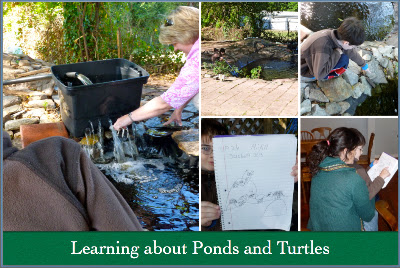
Right now, working on the pond gives him joy. Watching what happens when we turn on the water pump that pushes water through our homemade water filter is exciting. We stand at the little pool and watch it with anticipation until the water reaches the top of the stones and forms a waterfall. One day, the filter overflowed and he watched the headmaster solve the problem. Somehow, cleaning leaves out of the pond gets him to thinking about turtles. Before long, he is ready to read more about Minn's adventures, draw it in his unsilly notebook, and read it to his mother.


On another day, a cockroach caught his eye. He was shocked when I shared my plans to draw it in my nature notebook. "You keep one, too?" He was so interested in seeing mine that I promised he could look through it once he had finished making an entry in his.

At another time, two doves enchanted us with a stroll around the little pool to get a sip of water.


Speaking of problem-solving, Grandin spotlighted another value of hands-on projects: "Practical things do not always work right and people skilled in the real world learn how to improvise. When I made a mistake on a sewing project, I was sometimes able to fix it and other times I could not. Mistakes I made cutting the fabric wrong on a sewing project taught me that I had to slow down. I had to be more careful before I cut the material."

One day, he helped his class with the compost bin. The lesson screeched to a halt when they discovered worms. He watched the students find grubs and toss them into the pond to feed the fish. Two weeks later, his cat showed up at school. He decided to see if she would eat a worm and he knew exactly where to find them. The cat did not!

And, then, there was the day he found the dead fish. Eman studied it in the net for quite some time. He wanted to touch it but was afraid he might get cut. So, I offered to do it first. A bit grossed out, I put my finger on it for only an instant. "No, you need to do it longer!" So, I held my finger on the squishy fish and it must have been long enough. He mustered his courage and touched it himself.


Mason's thoughts in connection to literary books like Minn of the Mississippi: "The approach to science as to other subjects should be more or less literary, that the principles which underlie science are at the same time so simple, so profound and so far-reaching that the due setting forth of these provokes what is almost an emotional response" (Pages 218-219).

Mason's thoughts in connection to outdoor work: "They are expected to do a great deal of out-of-door work... They keep records and drawings in a Nature Note Book and make special studies of their own for the particular season with drawings and notes" (Page 219).

Mason's thoughts on nature notebooks: "The nature note book is very catholic and finds room for the stars in their courses and for, say, the fossil anemone found on the beach at Whitby. Certainly these note books do a good deal to bring science within the range of common thought and experience; we are anxious not to make science a utilitarian subject" (Page 223).

Monday, September 16, 2013

Teaching a Second Language if You Don't Already Have One Yourself

I have not blogged our work in Spanish lately, and this week's Charlotte Mason Blog Carnival topic is a great time to do so!

Before I share what I believe was Mason's thinking near the end of her life, I would like to share what you should try first: get a head start in learning a second language before beginning lessons with your children. Knowing a year's worth of language develops confidence, prevents mistakes, and helps you become a better guide. Spend six months developing your ear for that language. What helped me was (1) listening to children's audio books in Spanish that I have featured in earlier posts, (2) the Learnables Level 1, (3) Spanish nursery songs and rhymes, and (4) stories written and recorded by my husband who is bilingual (you could hire a tutor to do this for you).

After six months, find more complicated audio books and songs and try the dull, but useful Basic Structures Level 1. Another very frustrating, but helpful, approach you can try AFTER you have worked on your ear for six months is duolingo. This free, online-course will show you why the ear-first approach is superior for you will quickly see how taxing a non-developmental system can be: learning to hear, speak, read, and type in Spanish is exhausting, and I do not recommend it for your students! I repeat duolingo could easily kill any spark of interest in learning a second language! While I do not care for the software's style of teaching, the price is right (free) and you can grind away at grammar, albeit unpleasantly.

People new to Mason tend to latch onto Gouin's work because she raved about his method in her first volume. While I am thankful Cherrydale Press has published audio and written files that apply his approach in our modern world, I do not believe their offering stands alone. Why? First, Mason did not mention Gouin in her last volume (pages 211-212):
Children in Form IIB have easy French Lessons with pictures which they describe, but in IIA while still engaged on the Primary French Course children begin to use the method which is as full of promise in the teaching of languages as in English, that is, they are expected to narrate the sentence or paragraph which has been read to them. Young children find little difficulty in using French vocables, but at this stage the teacher should with the children's help translate the little passage which is to be narrated, them re-read it in French and require the children to narrate it. This they do after a time surprisingly well, and the act of narrating gives them some command of French phrases as far as they go, much more so than if they learnt the little passage off by heart. They learn French songs in both divisions and act French Fables (by Violet Partington) in Form IIA. This method of closely attentive reading of the text followed by narration is continued in each of the Forms.
Mason does not even mention what she is doing for the early forms! Moreover, the Primary French Course by Otto Siepmann and French Fables in Action by Violet Partington are not based on Gouin's work. All is not lost! While the six volumes present Mason's theories, Parents' Review articles and programmes reveal what she did in practice. To find out what she did in Forms IB and IA (first through third grades), check out the programme for that form in 1922. To glean insight on what might have informed her change in direction, read Violet Partington's article on teaching French.

Did Mason recommend Gouin for the earliest grade (Form IB)? She used Hachette's Illustrated French Primer, which does not contain any series. Mason recommended to teach words orally based upon pictures from the book. In Form IA, students were ready to see words in print. Teachers read aloud and students narrated passages from Le Livre Rouge by Effie Magee and French Fables in Action.

So, what about Gouin? I believe that Mason gleaned two important ideas from him: (1) build the ear first and then apply Mason's developmental method for language arts to learning a second language and (2) find a context where the words live to foster meaning: songs, rhymes, stories, plays, games, and even series.

I have turned to Partington's article for ideas in teaching Spanish at Harvest Community School. Every morning, I spend ten to fifteen minutes on an interactive, conversational lesson with teachers and students. I have not found the need to spark interest because after the first few lessons everyone warmed up to Spanish. They enjoy learning new words. One of their favorite lessons was when SeƱor Glaser came to school, and they got to ask him to say whatever word they suggested in Spanish! I decided not to drill phonetics because Spanish is not as difficult as French or German. Two children can roll their r's, and I will encourage them to show their friends how!

Partington wrote,
What better way could there be of teaching a child a living language than by letting it live that language for the time being? Therefore, find out what are the children's favorite games and favorite amusements, and as far as possible, turn these into French, and above all let the children themselves help you do it.
The students have learned how to play "Duck, Duck, Goose" ("Pato, pato, ganso") and "Red Light, Green Light" (Luz roja, luz verde") at recess. I plan to teach them all the words in Word Bingo in Spanish to build vocabulary for common objects.

Partington wrote,
Memorizing of little pieces of poetry, nursery rhymes, riddles, etc., all these are helpful, too, in swelling the stock of everyday phrases and expressions which will come in so useful in the little "play building" lessons. And if the teacher is at all musical, what a delightful resource there is in the teaching of French songs and singing games.
Everyone loves "El chocolate" by JosƩ-Luis Orozco, and they are now learning his "Diez deditos." Both songs foster counting to ten. I plan to continue teaching songs and rhymes from his albums "Diez deditos" and "De colores" this year.

Partington wrote,
At Queens' College School, Harley Street, London, we started last year a French games and conversation class, which is held twice a week, and which is conducted entirely on the lines suggested above. The results have been most gratifying and encouraging.
Right now, our class has a conversational tone. We are working on greetings, simple conversations, counting, colors, etc. I am building their vocabulary with an eye toward being able to understand "Oso pardo, oso pardo, quƩ ves ahƭ?" by Bill Martin, Jr., available as a board book and audio CD. We might even learn lines to act out the story, "La gallinita roja" ("The Little Red Hen").

At the end of the article, Partington discusses spelling. If a teacher or child wants to know how to spell a word, I will show them. So far, none have asked. Once they can follow and understand the audio version of the two stories above, I will make the texts available for anyone to read.

I think the first thirteen lessons have gone well, but the real assessment of what they are learning will come during the term finale when we will find out what individual children can understand and say.

Saturday, September 14, 2013

Experiencing the Fuller Life

Pamela and I have just finished our third week at Harvest Community School. We found this week quite hectic because the elementary class teacher enjoyed a week of vacation. That meant the headmaster and I took turns teaching. While I did not engage much with Pamela one-on-one, she still experienced a fuller life. She fascinates children because of her savant skill in calendars, her artistic abilities, her princess lunchbox, and her boldness in telling a teacher—me—, "Director! Director! Cut!" and "You're fired." When I am not working with her, she keeps herself busy, building puzzles and triazzles, swinging on the porch swing, playing with her calculator, and using a laptop. She has far more opportunities to interact with people in an environment similar to the kind of learning environment she has enjoyed for over a decade. Thursday, she helped the elementary class build a water filter for the school pond!


I have thoroughly enjoyed applying Relationship Development Intervention ideas as we help our auties (two full-time students in the spectrum and another part-time in addition to Pamela) adapt to this new way of learning. I glean so much from them in one-on-one moments when they take a break from the classroom. Thursday, I taught one boy who has a mechanical mind and nibble fingers to sew a needle case. On Friday, he hardly needed help in sewing a running stitch in the first line on his tic-tac-toe game. The other boy and I have been sharing many perspective-taking conversations to help him see that what he thinks is not always what another person thinks. Their parents are delighted to have a school where students are doing more than the three R's—where they are engaged with the kind of hands-on, meaningful tasks that Temple Grandin recommends for students in the spectrum: drawing, handwork (right now, sewing), cleaning the pond and surrounding area, building a water filter, etc.

Friday the 13th was delightful! While chatting with a parent dropping off her child, we spotted two hummingbirds seeking nectar from a can of bug spray with a bright orange cap. (Note to self, we need a hummingbird feeder!)


Friday is The Feast, a day in which homeschoolers join us for the whole day if they choose to do so. Pamela joins the elementary class in reading two science books that they only read once a week. She is familiar with one book (Project UltraSwan) but has never read the other book (The Wright Brothers). In this photo taken last week, you can see by the expression on Pamela's face how much she enjoys the class.

Yesterday, after the morning meeting (prayer, pledge, hymn, and Spanish), the elementary students headed to the reading room. Angie walked in and saw Pamela—all smiles—sitting in the teacher's chair. Having observed Pamela and I co-read books, Angie suspected that Pamela wanted to see the text. So, she sat in the chair next to Pamela. Angie was thrilled to see how Pamela felt like she belonged. First, every time, Pamela was asked if she wanted to narrate, Pamela said, "Yes," and then narrated. Sometimes, when other students were narrating, Pamela shifted her attention to the speaker! She smiled and stayed engaged the whole time (about a half hour). Finally, when Angie started reading the unfamiliar book, Pamela leaned in to see the book. Angie and I were so excited for Pamela to take so much delight in learning, side by side, with her academic peers!

Then, the whole school headed out for our weekly nature walk at Santee National Wildlife Refuge. After a little chaos the first week, we learned to assign a group of children to one or two adults and teens. We space out the departure of the groups, some walking the loop trail in one direction and some in the other direction. Last week, one of the school co-founders, who wrote a lovely blog post about nature walks the other day, showed her group how to "fish" for "chicken chokers" (tiger beetle larvae). This week, the children from her group, all assigned to different groups, showed their friends how to lure them out of their holes! None of the adults made this happen: the students figured it out all on their own!

We returned to the school for lunch, and the afternoon was so hectic that I neglected Pamela. The homeschoolers joined us at this point for readings about Egypt (Seeker of Knowledge, Voices of Egypt, and Tutankhamun), a van Gogh picture study, wool felt sewing, living science (projects about flight), and Shakespeare. In time, I hope to fold Pamela in once we figure out our rhythm and everything flows well.

A couple of lovely moments happened yesterday afternoon.

I watched one of our auties marvel over van Gogh's Village Street and Steps in Auvers. He kept staring at it, running his fingers over the brushstrokes, narrating the vivid colors and objects in the painting. The eyes of this boy, who has the same kind of word retrieval issues as Pamela, sparkled with delight as he gazed at the masterpiece.

Before I began reading aloud to the elementary class, one of the students recalled a discussion we had had about how to remember what they read more clearly. He said, "Remember we need to narrate from the beginning of the passage to the end, and not just jump around." In the past three weeks, we have seen greater mindfulness and improved attention.

Shakespeare's Henry V was a blast. Since Act I, Scene I, has only two actors, I broke up the reading into five pages, two students per page. I gave more experienced readers the role of the Archbishop of Canterbury. To help the viewers tell them apart, I made a tall archbishop hat with double horizontal bars on the cross while the bishop wore a shorter hat and a single bar on the cross.

I gave the younger students important actions to perform: posting signs to set up the scene and representing "the church" (by holding a picture of a church), "the angel" (whipping the Adam out of Henry V), "the king" (Henry V) and "the dauphin" (future king of France). Their "acting" was perfect, even though they had not rehearsed. I gave a purse of pennies to "the church" and, when I asked "the king" to try to take it, "the church" tried to take it back from "the king" and said, "It's mine!" That is exactly what the archbishop and bishop were discussing. I gave the "Gordian knot" to the autie with nibble fingers and, while the clergy discussed the studious nature of Henry V, "the king" worked hard to undo the knot. "The angel" giggled at whipping "the king." Our youngest student wore the crown of the dauphin and his lip quivered when "the king" snatched his crown (and I had warned him that is what "the king" was supposed to do).


The past three weeks brings to mind this quote from Charlotte Mason. You can read some thoughtful ideas about one mom's take on this passage here.
Every new power, whether mechanical or spiritual, requires adjustment before it can be used to the full... to perceive that there is much which we ought to do and not to know exactly what it is, nor how to do it, does not add to the pleasure of life or to ease in living. We become worried, restless, anxious; and in the transition stage between the development of this new power and the adjustment which comes with time and experience, the fuller life, which is certainly ours, fails to make us either happier or more useful.

Saturday, August 17, 2013

Composition with an Eye toward Development

Some professors wonder why educators even teach spelling instruction because of spell checkers. Hopefully, their students will not become sign makers (or cake decorators or church secretaries or ...) when they grow up.


While Pamela lags her peers in writing, she has come far. At least, she self-corrects spelling and grammar. She cares about how she writes for she changed grey to gray and was to were in her latest written narration of Fog Warning by Winslow Homer. She enjoys typing on Skype with my husband Steve through my account. The other day I found this exchange:

Tammy: I will buy a pizza today.

Stephen: ha ha

Tammy: I said Buy a Pizza today.

While I do not teach composition, I do assess what Pamela types. The first sentence is perfect. I have never corrected her writing with a red pencil as my English composition teacher did in high school, and Pamela can still write a perfect sentence. What a feat for someone who struggled with verb tense in her late teens! When Steve did not take her seriously, Pamela added emphasis with I said and by capitalizing buy and pizza. I love how subtly she made her point!

Pamela could improve upon that second sentence by adding punctuation, I said, "Buy a Pizza today." But, I do not plan to draw attention to it. Who wants to chat if someone turns everything into language arts lessons? Charlotte Mason's method works on composition without constant correction. The living books we read have many examples of dialogue. The copywork in her commonplace book has quotations. I need to teach her to enclose partial quotes in quotation marks and capitalize the names of countries, which I will incorporate into her studied dictation.


One sentence cracked me up! Commonplace books are basically written scrapbooks of items a person finds important. Pamela turned her old copywork book into a compilation of lists. In this one, Pamela summarized an episode of WordWorld which she watches at my parents' house: Frog helps Bug figure out a rhyme.


Dialogue is part of our recent studied dictation. While the swan dictation has no quotes, the one about Michael Faraday does. I can overlook the misspelling of Ribeau (a French surname) and massaging (a tricky word with French roots). Our next dictation will focus commas and capitalization for quotations.

Because of Pamela's aphasia, I tabled written narrations until this year. I am not alone in waiting for the right time developmentally. One mom at the Living Education Retreat shared that her teenager with autism struggled with writing. She found a therapy that helped him with his oral narration, and she had him spend a year retelling everything. Now, he is writing wonderful narrations with more confidence.

Early is not necessarily better! A recent study analyzing the lives of people over an eighty-year period concluded that, "Early school entry was associated with less educational attainment, worse midlife adjustment and, most importantly, increased mortality risk”. Why? “Most children under age six need lots of time to play, and to develop social skills, and to learn to control their impulses. An over-emphasis on formal classroom instruction—that is, studies instead of buddies, or staying in instead of playing out—can have serious effects that might not be apparent until years later."

This is exactly what Charlotte Mason stated over a century ago! It is why I am a purist in trying to apply her educational ideas before I try others.

It is why I trust recitation of nursery rhymes and Bible songs for children under the age of six. They need to play with words rather than endure formal lessons.

It is why I have not abandoned penmanship (even cursive) in the era of keyboards. Brain imaging reveals that "in children who had practiced self-generated printing by hand, the neural activity was far more enhanced and 'adult-like' than in those who had simply looked at letters." Cursive offers even more benefits: "multiple areas of brain become co-activated during learning of cursive writing of pseudo-letters, as opposed to typing or just visual practice" and "cursive activates areas of the brain that do not participate in keyboarding."

It is why Pamela and I write our own copywork, which John Piper chose as the number one technique for reading and understanding the Bible. The article on cursive noted that "writing letters in meaningful context, as opposed to just writing them as drawing objects, produced much more robust activation of many areas in both hemispheres."

It is why I do hardly any lessons on composition, which Mason discussed in her final volume. The building blocks of composition lie in memorizing beautiful language, reading living books, retelling them in your own words, copying your favorite turn of phrase, and writing passages from dictation. But, above all, oral narration is the foundation of written narration. Uncorrected, uninterrupted oral narration!

Here are my favorite quotes from Mason on the topic of composition in the elementary years:
Children of six can tell to amazing purpose. The grown-up who writes the tale to their 'telling' will cover many pages before getting to the end of "Hans and Gretel" or "The Little Match Girl" or a Bible story. The facts are sure to be accurate and the expression surprisingly vigorous, striking and unhesitating....

Two or three points are important. Children in lB require a quantity of matter to be read to them, graduated, not according to their powers which are always present, but they require a little time to employ their power of fixed attention and that other power which they possess of fluent narration. So probably young children should be allowed to narrate paragraph by paragraph, while children of seven or eight will 'tell' chapter by chapter. Corrections must not be made during the act of narration, nor must any interruption be allowed....

Children must not be teased or instructed about the use of stops or capital letters. These things too come by nature to the child who reads, and the teacher's instructions are apt to issue in the use of a pepper box for commas....

As the object of every writer is to explain himself in his own book the child and the author must be trusted together, without the intervention of the middle-man. What his author does not tell him he must go without knowing for the present. No explanation will really help him, and explanations of words and phrases spoil the text and should not be attempted unless children ask, What does so and so mean? when other children in the class will probably tell....

But let me again say there must be no attempt to teach composition.

P.S. For a modern look at Mason's ideas, try to get a copy of Dr. Jennifer Spencer's dissertation: "Self-Made Writer: A Grounded Theory Investigation of Writing Development Without Writing Instruction in a Charlotte Mason Home School."

Sunday, August 04, 2013

Digital Detox on the Prairie

At first blush, one might think we did not leave home. Clarendon County offers plenty of corn fields, except that the harvest in Carolina is further along.

The first thing we did was sample the harvest of fruit. Pamela has not dined at a mulberry tree since we left Pennsylvania when she was a little girl. You can see her smile that she is enjoying the nostalgia. She feels the magic.

There is nothing like going on a nature walk with kindred spirits at the Living Education Retreat.

Pamela got tired of hearing us talk about what a nature walk is. She already knows that. She went ahead and walked the walk with the wind whipping her hair.

With half our attention tuned into the conversation, we watched Pamela walk out of sight, return, flap her arms in the whirlwind, and twirl like Maria on the mountain.


Then, she waited patiently in her sit spot.


I never visit cornfields in Carolina. Somehow, being with like-minded friends made cornfields seem more inviting. So, I moved in closer.


And closer.


And even closer.


While I took pictures of corn, Pamela explored the prairie grass. It was a miracle that neither one of us brought "visitors" (er, ticks) back with us. Some people did!


While Pamela explored the grass, I took pictures of flowers.


While Pamela looked for the creek where the tree stood, I took pictures of seeds.


No trip to the prairie would be complete without seeing grasshoppers. I managed to get a close-up of one!


One of my fondest memories of the walk was stopping to do some watercolors. Many of us did! We had quite an international gathering painting next to the cornfield. Jemimah, from Australia, wearing her read hoodie, sat in the grass painting. I am especially fond of Jemimah because she gave me some mulberries that made my strawberry shortcake unforgettable! Charlotte Mason blog carnival hostess with the mostest, Amy from Peru, joined us, and I hope to see her work in a nature study painting when she returns home (hint, hint).


Sheila from Canada encouraged me to paint a detail of this milkweed flower, and Jennifer, also from Canada, loaned me some water. Meanwhile, Pamela finished the walk and kept herself entertained while the rest of us painted.


Here is my little attempt at the details of a milkweed.

We didn't just detox on the nature walk. Some of us survived the retreat sans Internet, so I hope I didn't scare my friends on Facebook. The wireless router worked but few knew how to enter the IP address manually. We survived—more importantly, we bought books and I have my very own flutter mill!


I now own a copy of The Yearling with illustrations by N. C. Wyeth while Pamela purchased the Dorling Kindersley Eyewitness Book Oceans by Miranda MacQuitty! I also picked up a children's biography of Amelia Earhart because our home in Kansas is the city of her birthplace and Adam of the Road for the school. I was thrilled to win Dorothy Mills' Book of the Greeks—which I plan to read with Pamela after we finish Book of the Ancient World—for correctly answering the question, "Who was the second child in the Pevensey family in the Chronicles of Narnia?" Steve confiscated the Mills book to read. That's fine since we need to finish the other book first.