Wednesday, November 29, 2006

Penmanship 2006


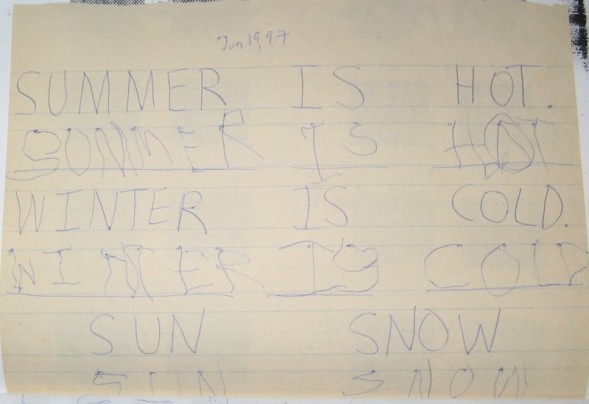
To give parents with struggling writers hope, I thought I would post a snapshot of Pamela's studied dictation of Tennyson's Cradle Song from yesterday. She wrote this on regular filler paper with lines spaced 3/8 of an inch apart. Compare the neatness and legibility of her handwriting today to her shaky capital letters of nine years ago.

One point of studied dictation is to show one's best efforts in penmanship, spelling, grammar, etc. This is a sample of her handwriting at its neatest. Pamela only made three minor errors: she left out a comma, capitalized then, and wrote she rest. I corrected her work in purple ink, and today's grammar lesson covered noun-verb agreement. Today's studied dictation had only one error: she misspelled 'til.

Tuesday, November 28, 2006

Purple Parrots

Pamela enjoyed another awesome night at youth group on Sunday night. She was sitting in the room with other high schoolers, observing an object lesson. The teacher wrapped a fine thread around a student’s wrists. The student had extended her arms in front of her. Pamela took one look and said loudly, “You’re under arrest!” for the teen really did look like someone waiting to be cuffed. Everyone thought her comment funny, and people appreciate Pamela for her unique way of seeing a situation and speaking her mind.

After the lesson, the high schoolers were going to play a quick game that required two teams. The teacher selected the captains. Usually, Pamela and I— as her aide in social settings—are often picked last for two reasons: she is the new kid on the block and is the only homeschooled teen at our church, except for her brother. One of the team captains has only recently started attending youth. I was shocked that he picked Pamela as his second choice out of about twenty potential candidates. If the teacher put him up to it, it was not obvious for he did not act wishy-washy. He pointed to us and blurted out in his brash way, “I want you two on my team!” While we waited for the other captain to pick, he gave Pamela a high five.


Our team captain named us the purple parrots, had us huddle, and revved us up with a pep talk. We each put a hand in the center and chanted, “Purple parrots,” before heading out to the competition. In the relay race, a teammate must don yellow rub gloves (fingers and thumbs filled), clap once, and hand the gloves to the next person in line.


The purple parrots lost the relay, but we had the most spirit. The way in which the captain welcomed Pamela made me feel like a white dove had hoisted the colors of peace over our team. I will store that treasure in my heart for times when the world slaps us with a spirit of confusion rather than that of kindness.

Saturday, November 25, 2006

Blast from the Past: Capital Crazy

At age seven and a half, Pamela had mastered her pre-writing skills and seemed ready to write. An occupational therapist and dear friend, Nancy Kashman, gave me a copy of the first grade level of Handwriting without Tears. Had the pre-K and Kindergarten materials been available, I would have tried those first! The teacher’s guide provided excellent tips, especially for teaching lefties! Many parents of children with autism find this program, developed by occupational therapist Jan Z. Olsen, effective in teaching children to write.

Homeschoolers have many opinions of what penmanship program is the most effective. Some prefer the traditional ball and stick concept because what the child writes matches the kind of text they seen in print. I believe Handwriting without Tears is one of the best programs in this category (backed by research). Her teacher’s guide includes tips for avoiding letter reversals, which is one of the cons mentioned by those who prefer other methods. Pamela struggled to learn curves and found Jan Olsen’s minimalist style with few curlicues and flourishes easier to master. Other homeschoolers prefer italics like Getty-Dubay or D’Nealian because of an easy transition to cursive, reduced number of pencil lifters, and smaller potential for letter reversal. Programs for language delayed children like the association method start with reading print, but writing with cursive to focus the child upon whole words. One creative friend let her son pick letters he likes the most by comparing them at sites like Educational Fonts: he prefers a blend between Getty-Dubay and D’Nealian.

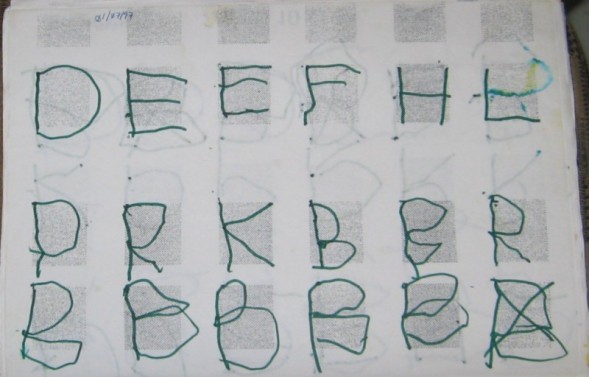
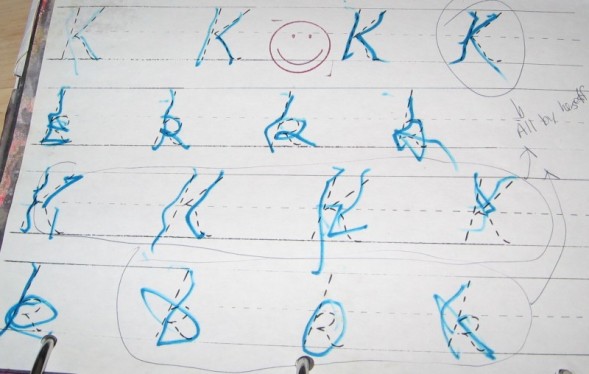
We spent the first half of Pamela’s second year as a homeschooler practicing the formation of capital letters following Handwriting without Tears’ wet-dry-try method on a slate with a piece of chalk and sponges. My kids, the super-smash siblings, broke the slate before Pamela had mastered her capitals, so I improvised by taping a border with electrical tape onto a dry erase board. One advantage to this innovation was that I could gradually make the box for writing capitals smaller and smaller as Pamela’s control improved. I could also spell words on the dry erase board by taping several boxes. Four months may seem a long time to practice capitals off paper, but Pamela’s first efforts on paper in January of that school year show how difficult she found writing legibly.

Thanks to our sabbatical from writing and Blues Clues, Pamela had made friends with markers. When we reintroduced writing letters on paper, three strategies helped her learn to write legibly. First, because she had a tendency to press too hard with pencils, we started her off with markers in January and transitioned to pens in April. Had gel pens been available, I would have tried those before ballpoint pens. Second, she had difficulty writing with small print, and I later learned macrographia was common for children with autism due to differences in their cerebellums. The blocks in Handwriting without Tears’ gray block paper were too small, so I made copies with enlarged images until I found a block size successful for Pamela. As her control improved, she worked her way down to the regular-sized blocks for letters she had mastered, but still needed enlarged blocks for new letters. Third, Pamela wrote with greater ease in the vertical plane, so we started her off with writing on paper taped to the refrigerator. Then we transitioned to a slant board, which is very expensive. Nancy Kashman told me how to make them out of thick three-ringed notebooks. As her writing improved, I gave her thinner and thinner notebooks until she could write on a horizontal plane.

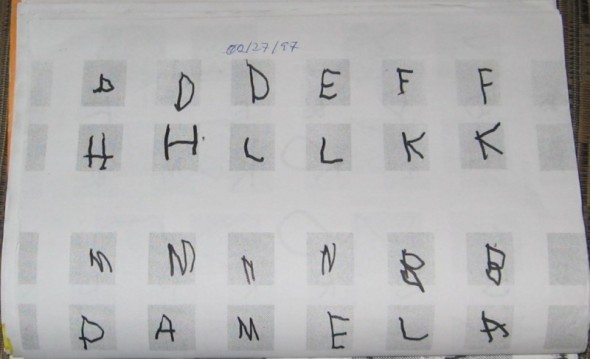
In the second half of that year, we had daily writing lessons of less than fifteen minutes. Like Charlotte Mason, Jan Olsen recommends short lessons. She puts letters in order of strokes, and Pamela practiced those with starting lines that begin in the upper left corner of a block and flow down to the lower left corner. Pamela did well with straight lines and letters with one large curve, so I had her write DEFHLK only once. We practiced her challenging letters first on the dry erase board and followed up with several repetitions of PRB on paper, especially B. She learned M and N next.

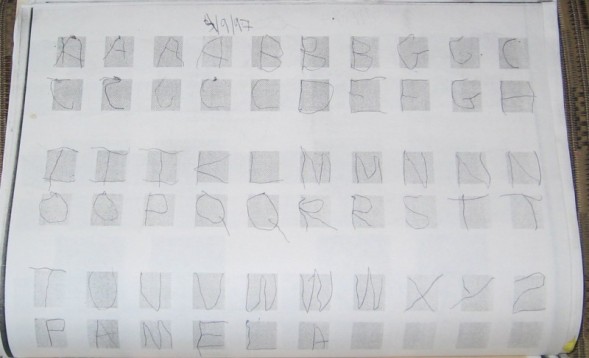
By February, she had learned all the starting letters with a vertical line going down from the upper left corner. Pamela showed signs of being able to print small letters. In February, we worked in letters with starting points in the center of the top edge of the gray block. We choose A first so that Pamela could spell her first name! Then we covered other center starters IJ and those that start in the upper left corner, but go in other directions TVWXYZ.

In March, Pamela was ready for curved letters like COQ, but needed the enlarged gray block paper at first. Then she learned GSU.

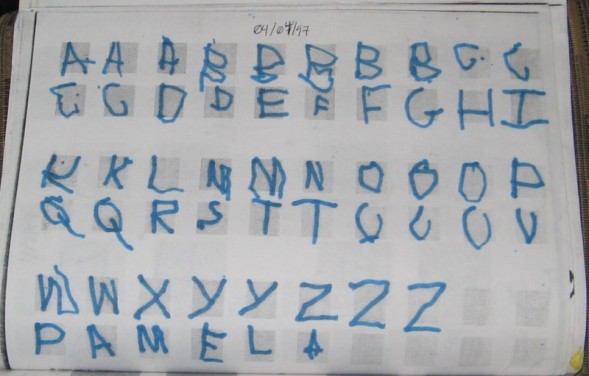
By April, Pamela could write the entire alphabet in capital letters and her first name on the gray block paper. We introduced two new things: writing with a pen and numbers (on the enlarged gray block paper).


In May and June, I assigned extra copywork on primary tablet paper with a seasonal theme.

Pamela’s final paper at the end of the school year was far from perfect. Although she understood catchy little phrases from Handwriting without Tears like “bump the bottom,” Pamela never really mastered perfect control. Her lines strayed outside of the gray blocks and her straight lines sometimes wavered.

Even today, after years of practice, she does not perfectly execute her letters. I keep in mind three soothing thoughts: Pamela enjoys writing and does it in her free time! Her writing is large, loopy, but legible. Some children in the autism spectrum have dysgraphia and struggle to write anything. We are blessed Pamela can write as well as she does.

Thursday, November 23, 2006

Happy GF/CF Thanksgiving

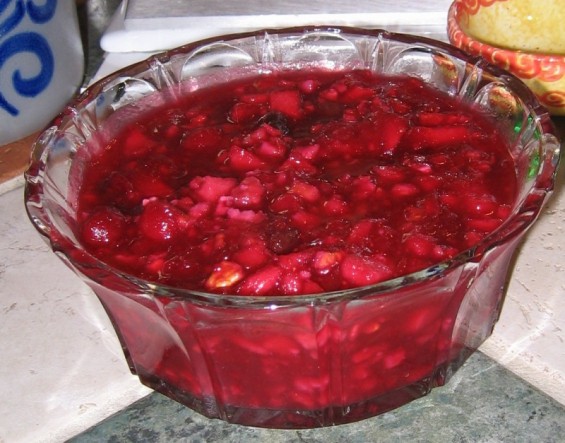
As many parents with autistic children are following a gluten-free/casein-free diet, I thought I would share recipes Pamela could eat in our Thanksgiving feast. My mother found an awesome and completely gf/cf recipe for cranberry fruit conserve. The only change I made was I skipped the zest (which I detest) and used only one cup of sugar. Mom gave me two lemons and pecans fresh off the tree! Everybody raved about the conserve, and they were none the wiser about its lack of zest!

I made two kinds of gf/cf pie: a pumpkin pie and a pecan pie. For the pumpkin pie filling, I follow the directions on the back of a can of Libby's 100% pure pumpkin, substituting coconut milk for evaporated milk. For the pecan pie filling, I follow the directions on the back of the Karo light corn syrup bottle for classic pecan pie, substituting coconut milk for butter. For the shell of each, I made a pecan nut crust. For one shell, grind up about 1 1/2 cups of pecans with 1/4 cup of gf/cf flour (I used sorghum) in a food processor or blender until you have a fine meal. I poured the meal into a bowl. I boiled water, added one tablespoon of hot water to the meal, and mixed it together. Because the meal did not form a ball, I kept adding a tablespoon of hot water and stirred until a ball formed. I oiled a pan and pressed the meal into a pan with a small pizza dough roller to smooth out the shell. I added the filling and baked as prescribed in the recipe.

I made mashed potatoes by boiling four peeled and cubed baking potatoes and a head of peeled garlic. Once they were soft, I mashed the potatoes with a mixer and added salt and olive oil to taste. They were not as fluffy as those made with butter and milk, but very tasty. My mother made a standard gravy out of cornstarch, stock, and salt.

I made both two half loaves of cornbread, one for cornbread and one for stuffing. To make a loaf of cornbread, I mixed the dry ingredients in one bowl (1 1/2 cups cornmeal, a half cup gf/cf flour--sorghum, a teaspoon sea salt, and a tablespoon gf/cf baking powder) and beat the wet ingredients in another bowl (two tablespoons honey, two eggs, 1 1/4 cup coconut milk, and two tablespoons oil). I added the wet ingredients to the dry ingredients and stirred gently. Then I poured the mixture into an oiled 1.5-quart loaf pan and baked in a preheated oven at 425 degrees for about 30 minutes.

I baked a typical Southern style of cornbread stuffing. I chopped two stalks of celery, half an onion, and four ounces mushrooms and sautéed it in olive oil. At the last minute I added two tablespoons of minced garlic to the sautéed mixture so it would not burn. I chopped half a cup pecans and two boiled eggs. I cubed a half loaf of cornbread. Then I mixed it all together with three eggs and my favorite stuffing seasonings (thyme, marjoram, and sage). I added several cups gf/cf chicken stock until the mixture was moist. I poured it all in an oiled dish and baked it in a preheated oven at 350 degrees until the top looked crusty.

Pamela's special diet, which brought about tremendous improvement in her quality of life, reminds me of a person for whom I am thankful and whom I never met. That is Dr. Bernard Rimland. His newsletters gave me all kinds of wonderful ideas for helping Pamela, and I still look up information to this day. He died on Tuesday and that is a great loss to the autism community.

Saturday, November 18, 2006

Blast from the Past: Pre-Writing Skills

Pamela attended special education preschool and kindergarten through age six. Like many children with autism, she has delays in her fine motor skills. Having interacted with many homeschoolers of children with autism, I have found this to be common for our kids. Most children in the autism spectrum, even high functioning ones, find writing frustrating.

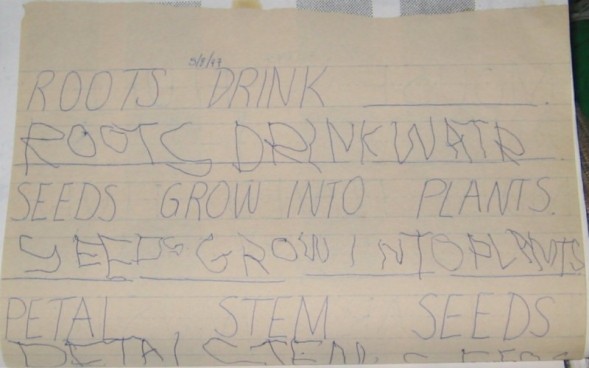
In hopes of helping Pamela catch-up with her peers, her teachers pushed too much writing before she was developmentally ready for it! Pamela had not mastered the fine motor skills expected of a preschooler by the age of six. She did not enjoy scribbling and showed absolutely no interest in drawing, and yet her teacher sent home worksheets for her to practice writing like the one pictured here. Whenever I pulled out paper and something with which to write, Pamela let loose a series of piercing screams to show her dismay!

Fortunately, I “met” another homeschooler with an autistic child online—this was in 1994 and such a creature was rare in cyber space. She encouraged me to take a sabbatical from writing and focus upon pre-writing skills to reduce Pamela’s frustrations. My cyber mentor gave me tips from the National Academy of Child Development for assessing her dominance, lateral abilities, and writing readiness. Another homeschooler with an autism child has recorded her experience with NACD in Too Wise To Be Mistaken, Too Good To Be Unkind.

The first problem I identified with my cyber mentor’s help was dominance, or lack thereof. Pamela appeared to be ambidextrous, never having developed hand preference. My friend suggested I check Pamela’s eye, ear, and leg for dominance by observing her preferences in different situations. The ideal is for all three plus the hand to share dominance on the same side. Pamela showed preferred her left side in every part. They all matched, which emboldened me to promote her left hand. As both of her grandfathers are southpaws and people with autism have a higher rate of left-handedness, I was not surprised. Within six months, Pamela became a strong leftie, confirming my suspicions that her Special Education teachers had been forcing her to be right handed. Apparently, many southpaws have experienced problems from inconsiderate teachers!

The second issue I addressed was hand and finger strength. While today many wonderful products are on the market for developing this skill, they were hard to find back in 1995. Back then, stress balls were rare, and the Koosh ball fad had bypassed the Glaser house. The Internet, in its infancy, was devoid of articles with tips on strengthening the fingers and hands of preschoolers or winter fun! I had Pamela play with clay, squeeze sponges and pick up little toys with tongs and with clothespins. We spent time at a playground near our home because climbing equipment develops finger strength among other things.

Pamela’s third challenge involved crossing the midline and alternating feet going up and down the stairs. We did numerous exercises to improve coordination, much like what is available today through Brain Gym. For two years, we got on our hands and knees several times a day, crawling with various patterns. We played handclapping games like Say, Say Oh, Playmate and worked our way up to Miss Mary Mack. Pamela sat at a table, took objects from one side of a mat, and placed them in a bowl on the other side of the mat, one at a time. She did this for each side and eventually learned to do this by alternating hands. She learned to do various knee touching patterns as well and walked the stairs in our apartment complex every day. By the end of our first year of homeschooling, Pamela had mastered crossing the midline and alternating feet going up the steps!

We played hooky from any form of writing for an entire year, and Pamela slowly lost her phobia of writing. While I retreated from writing on paper, we worked in letter awareness in other ways. Ironically, Pamela was already reading, so recognition was not an issue. I had to find some way to introduce motor plans for making letters without having the stress of pencil and paper. Sensory Integration resources like The Out-of-Sync Child Has Fun did not exist, but my friend and occupational therapist, Nancy Kashman, gave me wonderful ideas for blending sensory integration and pre-writing activities like the following:

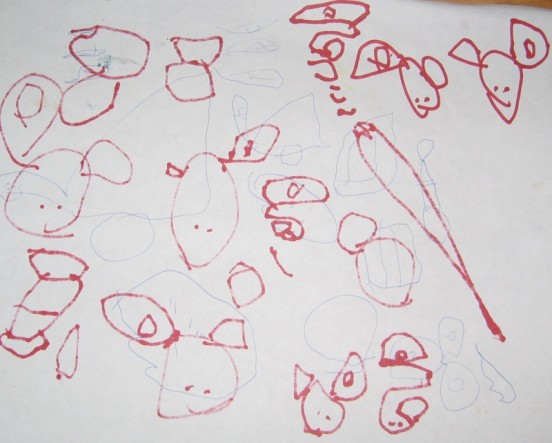
Pamela educated me about the connection between drawing and writing skills. When Blues Clues debuted in 1996, she became enamored with imitating Steve’s clues and taught herself to draw. As she began to fill pages and pages of clues, her coordination improved greatly. While she would have flatly refused to fill pages and pages of paper with letters, she found clues to be a joy! If a child has no interest in drawing, you might be able to entice them by teaching them to draw their favorite animated characters using simple shapes. I found very basic ideas in books by Ed Emberly and Usborne. I have no natural flair for art, and books like Draw Squad and Drawing with Children showed me how to move past the stick-figure stage! Thanks to her interest in Blues Clues her fine motor skills improved tremendously in just one year as you can see in the following pictures.


Homeschoolers often worry about documenting progress and providing paperwork for the state. During our sabbatical from writing, I discovered different ways to document knowledge without loads of writing:
  • Allow him to type (some find typing easier).
  • For stories, have her dictate to you or into a tape recorder; you or an older child can type or write by hand.
  • Develop worksheets in which he marks or points to the answers.
  • For math, have her tell you what to write.
  • Encourage him to draw.
  • For sequencing in math, science, history, etc., place the information on separate index cards and let her sort.
  • Let him set up the scene with blocks, toys, Legos, etc.
  • Let her dramatize alone, with stuffed animals, or with other children the plot of a story.
  • Take pictures of or film any of these if you must have documentation.

Wednesday, November 15, 2006

The Wonders of a Dry Erase Board!

While I find technology useful, low-tech helps are great too, especially ones that are inexpensive. One is our portable dry-erase board. Some autistic children struggle with the smell of the markers, but not Pamela. During their free time, both children enjoy drawing pictures on this board. I have used it in many ways:

  • Beginner writers find writing on a vertical plane much easier. I started my children with a dry erase board mounted on the refrigerators with magnets.
  • In Handwriting without Tears, a dry erase board worked better than a handheld slate, which broke! Some kids dislike the feeling of chalk dust, and they avoid fingernails scratching on a slate.
  • When we first introduced narration, I wrote keywords and character names to which the children might want to pay attention. As each child narrated a keyword, I recorded a brief summary to give Pamela visual reinforcement.
  • We recorded the schedule for the day on the dry erase board. If we were out and about, it was easier to carry and harder to lose than handwritten notes. If our plans changed, we updated it on the board.
  • When Pamela did not understand the need for whispering in a group setting, we would "talk" by writing on the dry erase board. She also quietly entertained herself with it.
  • Pamela has to copy questions and sentences in cursive for speech therapy (the association method). I write them on a dry erase board to avoid wasting paper.
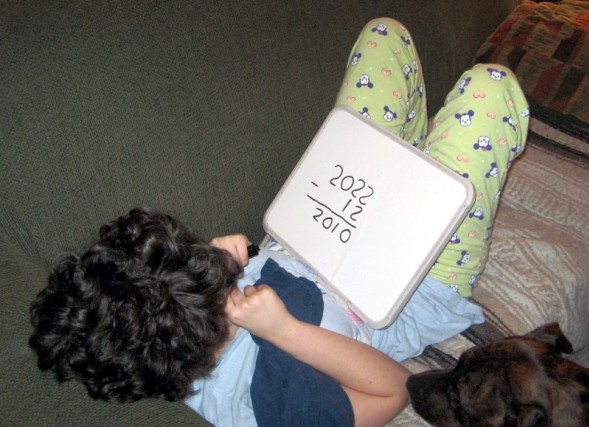
  • You can document any work done on a dry erase by taking photographs as I did in the following picture:

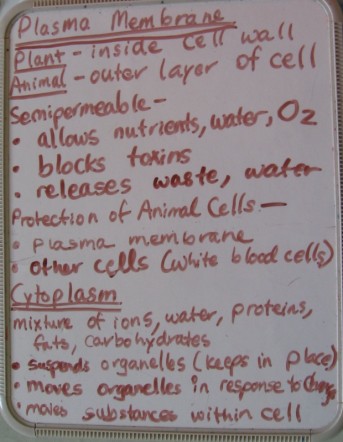
For my college-bound child, I have the dry erase board helpful in teaching him to take notes. As we read through his biology book, he tells me what notes to write. After we fill up a board with notes, he copies them down to simulate taking notes during class lectures. Pictured below are two boards of notes on the parts of the cell.


The most recent really cool, life-saving, self-help, low-tech tip came from my email list, Aut-2B-Home. One mother solved the problem of missing spots during tooth brushing by rinsing with Listerine Agent Cool Blue Mouthwash as directed. The rinse reveals the presence of plaque much like those pink, chewable tables did for me in school when I was a little girl. This visual cueing solved Pamela’s spotty tooth brushing habits overnight!

Sunday, November 12, 2006

Calendar Crazy

Pamela found a mistake in the church bulletin, which stated next Sunday, November 13. She muttered, "This is the worst day ever!" Then she marked out the twelve and changed it to thirteen. Steve and I chuckled because all of the offering envelopes in the pew where we normally sit are covered in figures like this picture:
Years and Starting Days

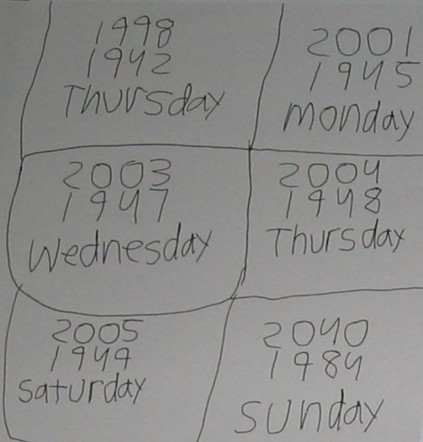
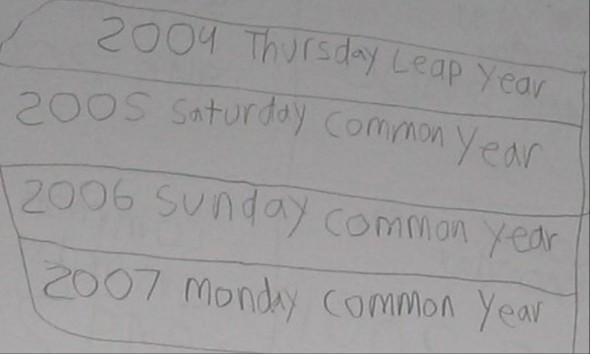
When Pamela was younger, she had no hints of ever developing savant skills. She did not seem to have a flair in math, music, art, or anything. When she was twelve, she became interested in calendars and began researching them on the Internet. She memorized all fourteen kinds of calendars: seven leap years (starting on Sunday, Monday, etc.) and common years (starting on Sunday, Monday, etc.). Then she learned what years go with each kind of calendar. For several years, Pamela has been writing notes like these:
Leap Year versus Common Year

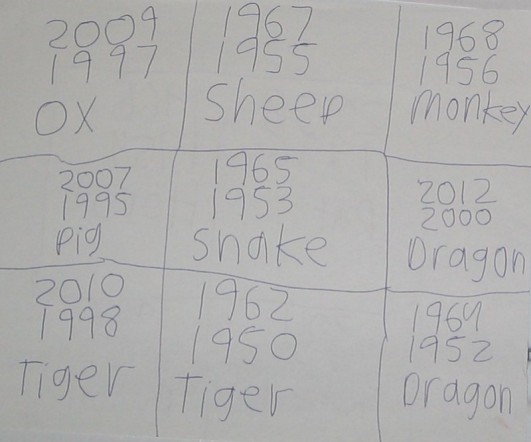
I have about three reams worth of calendar pages like the ones shown here. Pamela wrote all of the pages in today's blog entry last week. Eventually, Pamela branched into learning the Chinese astrological signs too.
Chinese Astrological Sign by Year

Friday, November 10, 2006

"Clever as Clever!"

Pamela proved to be "clever as clever" this week in language arts and math. I broke up her new poem, The End by A. A. Milne, into four segments. She aced every single studied dictation, including capitalization, tense, and punctuation! She almost has it memorized due to its repetitive language. While I suspect Pamela had very familiar with it because The End is one of her favorite poems, she deserves congratulations for doing such a fine job!
When I was one,
I had just begun.
When I was two,
I was nearly new.
When I was three,
I was hardly me.
When I was four,
I was not much more.
When I was five,
I was just alive.
But, now I am six,
I'm as clever as clever.
So I think I'll be six now,
Forever and ever.
One thing I love about living ideas is how they spill into other parts of our life. Today Pamela mastered her first lesson in multiplying fractions (Level 5 of Making Math Meaningful). She struggled with math when she was younger and highly concrete in thinking skills. Now that she is more able to handle abstract ideas and logic, she picks up new concepts more quickly. Pamela caught onto her introduction to mutliplication of fractions quickly. I recognized her efforts by saying she was "clever as clever." That cherished phrase brightened her face.

I have been wondering about why this poem attracts Pamela so much. When she was six-and-a-half years old, we started her gluten-free, casein-free diet. She blossomed that year and taught herself to speak spontaneously, pretend play, and imitate videos. She grew more at ease in social outings too. Pamela has always been "clever as clever," but six was the end of opioid-induced fog for her.

Pamela is not one of those brilliant little professors, and she struggles with every stride. Being clever isn't everything. If you doubt me, I dare you to watch this video.

Sunday, November 05, 2006

Pretty in Pink

Youth Group was wonderful tonight. When the kids sat on big comfy couches arranged in a square, Pamela looked around and asked, "Where's Amy?" The other students looked at Amy in surprise because Pamela does not usually acknowledge anyone. Amy smiled and bobbed her head gently with attitude because she knew to be singled out by Pamela was special.

Every week, the class warms up with an affirmation exercise. A student draws the name of a boy and a girl in the class. Then they must come up with positive adjectives that describe the person to form an acronym of their name. When they drew Pamela's name, a little knot tied up my stomach. Outside of Amy, Pamela does not really interact much with the other kids, even though she faithfully attends Youth Group every Sunday night. We have only lived here for a little over a year, and, to people who were born and raised in this town, Pamela is still the new kid on the block, especially because we homeschool. I knew she had two allies, Amy and a girl who works as a paid ABA therapist for some autistic twins. I worried that silence and awkward pauses would fill the room as kids struggled to find affirming things to say about Pamela.

I was pleased with their efforts for even some of the more reticent boys came up with kind words to describe Pamela:

P - Pretty in pink, positive
A - Awesome
M - Magnificent
E - Excitable, excited
L - Lovable, lovely
A - Adorable

The pastor usually rewrites the affirmations neatly and posts them in the window that week. I promise to snap a picture on Wednesday and post it.

Saturday, November 04, 2006

Baby Steps in Figurative Language

Autistic people tend to take words literally, so they need to learn how to discern meaning from figurative language. This is why I think Pamela can benefit from reciting poetry. Not only does she learn to improve her spelling and grammar, but she also sees how to interpret words in different ways.

Yesterday, she had her first lesson in personification with the poem, Daffodowndilly. I dictated the entire poem to her yesterday, and she wrote it perfectly. She recited the whole thing with a few, very minor glitches. Since she knew the poem so well, I decided to see if she had figured out the meaning behind the words. Here was our conversation:

Me: "Who is she?" (pointing to "She wore her yellow sun-bonnet")
Pamela: "A girl."
Me: "No, who is she?" (pointing to "She wore her greenest gown")
Pamela: "A woman."
Me: "No, look at the title. What is she?" (pointing to "Daffodowndilly")
Pamela: "A bird."
Me: "No, but you’re close! What does 'Daffodowndilly' sound like?"
Pamela: "A flower." (smiling)
Me: "Yes! Now, what kind of flower is it?"
Pamela: "A daffodil." (smiling brightly)
Me: "What season is it?"
Pamela: "Spring!" (without any hesitation)
Interpreting the season is a skill we have been practicing. Originally, she would take everything so literally that seeing the word "winter" automatically meant the poem was about the frosty, snowy season. Pamela knew the poem described spring without hesitation, showing how much she has honed her understanding of language.

While I think it important for autistic children to learn functional skills, I want more than a utilitarian education for Pamela. I aspire to balance learning to function in a neurotypical world with appreciating the finer aspects of life. Charlotte Mason, a Victorian/Edwardian era educator, makes a point that applies to children today:
We teach him those things that are proper for a person of wealth to know (as Locke said), OR we teach him enough art, reading, writing and arithmetic to prevent him from being illiterate. In both cases, the focus is on utilitarian education. The child is being indirectly educated to a profession rather than for personal growth. (page 156)
Schools should feed their students knowledge until they've created a healthy appetite in them. Then the students will go on satisfying their hunger for knowledge every day for the rest of their lives. We need to give up the farce of teaching students how to learn. That's just as ridiculous as teaching a child how to lift a fork to his mouth and chew without giving him any real food! They already know how to learn. Lessons given for the sole purpose of improving the mind shouldn't be a priority in the future. (page 348)
This begs the question. Does Pamela have a healthy appetite for poetry? When she finished her recitation of Daffodowndilly, she named the next three poems she plans to learn: The End by A.A. Milne, Cradle Song by Alfred Tennyson, and A Pirate Story by Robert Louis Stevenson.

Thursday, November 02, 2006

The Best and Cheapest Investment Ever!

The best and cheapest investment in homeschooling curricula I ever made was a 1992 Hammond Ambassador World Atlas. I bought it at a used library book sale in St. Cloud, Minnesota for two dollars. Only two dollars! We have traced many exciting journeys in our atlas and, because it cost me next to nothing, I boldly mark the maps as we go.

Pamela just started reading aloud The Endless Steppe by Esther Hautzig, a memoir about a Polish family herded into cattle cars and forced to work at a labor camp in Siberia during World War II. When I circled Esther’s hometown, Vilna, on our Russia page, we noticed she lived close to the hometown of another Jewish girl who fled her home in Berdichev, Ukraine in Letters from Rifka. Her family fled Russian persecution of the Jews after World War I. We had circled several cities to trace Rifka’s journey to Ellis Island: Warsaw and Antwerp.

Pamela enjoys finding geographical connections between books. When we learned that Ralph Moody was moving to Maine, she was thrilled because Rebecca of Sunnybrook Farm lived in the Pine Tree State too. Although the towns featured in this book are not in our atlas, we circled what might have been the model for Riverboro (Hollis, the town where the author spent her childhood). Not far from Hollis is a town called Windham, whose name bears a striking resemblance to Wareham from the book. It might be a coincidence, but we circled it anyway. After reading the first chapter of Fields of Home, we added two more circles to our Maine page, namely Bath, where Ralph’s ship arrived, and Lisbon Falls, where his grandfather lived.

Twenty-three pages of terrain maps of the ocean floors are a lifeline as we read The Sea around Us. Rachel Carson described continental shelves, which Pamela found colored light blue on our relief maps, and the deep ocean in dark blue. When the author named the Atlantic Ridge, Pamela traced it with her finger as well as other ridges outlining the continental plates of the world. When she read about various trenches, Pamela located them and traced quite a few. As her fingers traveled across the ocean, we are reminded of other nautical journeys in our present (Carry On, Mr. Bowditch and 20,000 Leagues under the Sea) and from our past (Kon-Tiki), all of which are marked in our atlas, which we are tranforming into a prized momento of our literary travels.

Wednesday, November 01, 2006

New Blogring and Happy Halloween

I wanted to join a blogring on the topic of homeschooling children in the autism spectrum and discovered none! Today, I launched a new blogring, Aut-2B-Home, to link together the blogs of families homeschooling spectrum children. You do not have to be part of the Aut-2B-Home email list, but are welcome to join. A link to the blogring is in the sidebar to the right after the topical index. If you wish to join, click here! If you need help joining the blogring, leave a comment and I will be glad to help you out.

Two Cool Cats

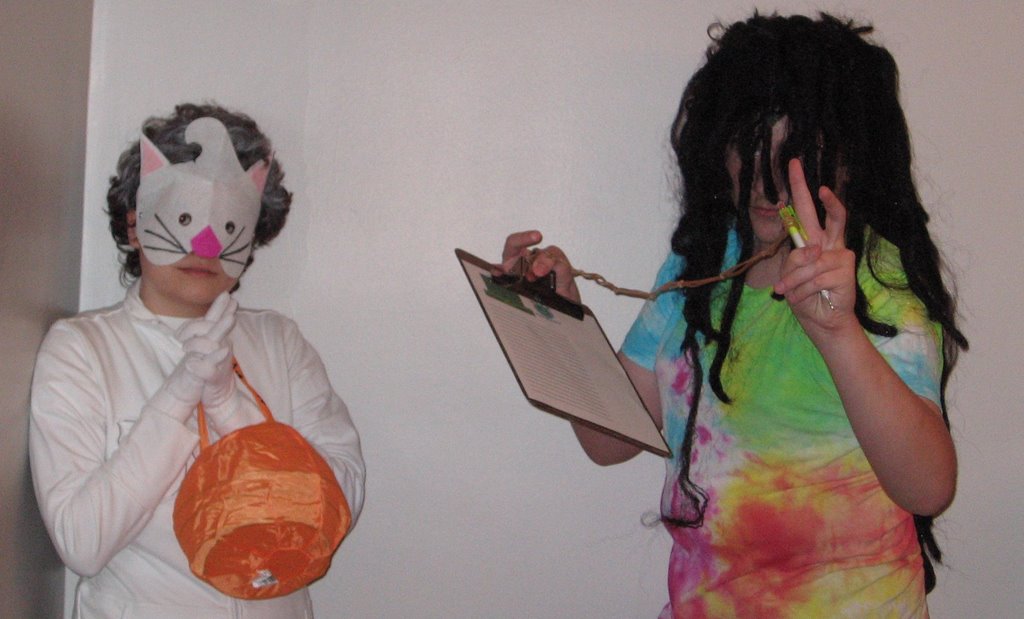
Yesterday was Halloween. My kids, Pamela (17) and David (14), are never too old to dress up and go trick-or-treating. Pamela dressed up as a cute, cuddly white cat, while David was a modern-day hippie, asking folks to sign a petition for "whirled peas" and "peas on earth." Many people got the joke and signed the petition. Others wanted nothing to do with it, and David casually replied, "That's cool, man." We saw many neat costumes and a live tarantula--yes, live!

It counted as P.E. because my "two cool cats" and I walked for an hour in a neighborhood with houses spread far apart. This neighborhood must be a favorite trick-or-treating haunt because cars and golf carts lined the streets. Walking was actually faster! It counted as art for David for he learned how to tie-dye a T-shirt yesterday (as did I).

Saturday, October 28, 2006

Narrations as a Form of Speech Therapy

Oral narrations are a wonderful way to do speech therapy. After we read a passage from a book, Pamela narrates what she read. This was and is very difficult for her, but she has improved over the years. After she does her narration, I open the book and ask her three "therapy" questions to practice the language structures she is learning that week.

Narrating books is much more interesting than canned speech therapy exercises. As we read from several books a day, Pamela has many opportunities to practice the art of speaking during the day. Some books are above her reading level, but she still finds ways to narrate. I remember reading biographies about autistic people who were bored silly in school because they were secretly reading, but still being taught their alphabet in class. I never want to underestimate Pamela, and I want her to tackle to our rich literary heritage. I would rather err on the side of going above her level, rather than dumbing down her material, and I assume that, if she understood nothing, she would balk and have meltdowns every time we open a book. As she continues to seem eager for reading, I hope I have found a proper balance between easy and challenging books.

We just finished reading Mary Emma and Company by Ralph Moody, the fourth in a series about Ralph's family. I believe this is right at Pamela's reading level. I asked Pamela to narrate what she remembered from the book and this is what she said:
Ralph has a new house. His father died. He is in heaven. Ralph said, "Goodbye, Colorado! Hello, Massachusetts!" He has a stove. It got burned. They can make a better stove. It is beautiful.

Mother has some laundry. She can wash some clothes. Grace is helpful. Mother can dry clothes. They can fold clothes. They can make money.

Ralph saw a fire. A bridge was broken. He saw a fire chief. A fire chief can chop wood. Ralph got bridge logs.

A May basket is for church. It has some flowers. Grace got a basket. A basket is beautiful. A note is for happy Mother's Day. Mother is happy.
Pamela's narration seems immature. When she was four-years old, her developmental pediatrician told us she might not ever speak, much less read or write. On top of having autism, she has syntactic aphasia, or "difficulties in using words in the correct order and/or forms for effective communication" (page 3 of Teaching Language Deficient Children). Pamela, like others with aphasia, drops little words such as prepositions, conjunctions and articles: years ago she might have said, "fire Ralph" for "Ralph saw a fire." Her brain is not wired to spot grammatical patterns and apply them. For example, three weeks ago, she could not string together these words: "does not have any." Up until this point, she could manage, "has no." Last week, I introduced the new phrase into her multi-sensory language activities through written stories, listening and repeating, oral and written narration, copywork, and dictation. Now, she can say the phrase smoothly, but it will take another week or two for it to become part of her daily speech patterns.

When put in perspective, Pamela’s oral narration of Mary Emma and Company is absolutely fabulous!

Friday, October 27, 2006

Teaching What They Need to Know When They Need to Know It

The beauty of a Charlotte Mason philosophy is teaching what my kids need to know when they need to know it. One does not have to work every single exercise in a grammar book or memorize spelling lists to become skilled in the mechanics of writing. For example, I have never formally taught spelling. When they make a spelling error in their studied dictation or writing, I develop a spelling lesson around that word (using either similar words or those that offer a contrast).

Yesterday’s studied dictation of the first four lines of Daffodowndilly illustrates this process. In her previous dictation, Pamela had confused “were” with “wore” and wrote, “She were her greenest gown.” This was the only mistake she made. I wrote a short lesson tailored to what she needed to know under the dictation:
wore = past tense for wear
were = past tense for are

She wore her yellow sun-bonnet.
Her sun-bonnets were pretty.

Her gowns __________ long.
She __________ her greenest gown.
Her jeans __________ blue.
She __________ her blue jeans.
She __________ red ribbons.
Her ribbons __________ curly.
She __________ new sneakers.
Her sneakers __________ bouncy.
Her earrings __________ dangling.
She __________ long earrings.
Her socks __________ short.
She __________ solid white socks.
Pamela spent about five minutes doing the lesson. Then she studied the first four lines of the poem, aced her dictation, and recited it nearly perfectly. She is ready for the entire poem. She has never memorized language for recitation so quickly, and, clearly, the multi-sensory way of learning is what she needs. She was so proud of her accomplishment: as soon as she put her pencil down, Pamela told me, "Congratulations!" for she knew she had written it perfectly. After her recitation, her face lit up with her bright smile. Because of her flat affect, a smile meant a strong emotion.

The neat thing is how connected learning becomes. In her speech therapy program, we have turned our focus to three aspects of sentence structure last week and this week: does not have any, his/her in the subject of a sentence, and is/are in a sentence with the structure, subject-is/are-adjective. The spelling lesson reinforced the structures she is mastering in the association method. It thrills me every time a moment of connectedness emerges.

Tuesday, October 24, 2006

A Tale of Two Doctors, or Why TV Does Not Cause Autism

Those who cannot remember the past are condemned to repeat it. ~ George Santayana

A gap in the treatment of disabled children worried a lone doctor in Vienna. Austrians rebuilding war-torn cities had no time for the retarded. The doctor lobbied local politicians. He opened the first clinic of its kind in Europe, and frustrated families flocked to it.

One day in 1954, the Austrian doctor glanced at two girls sitting in the waiting room. Both were washing their hands in dry air. He had seen repetitive movements before, but their actions caught his eye. Curious, he carefully examined them, compared their developmental history, and noticed a pattern.

The doctor uncovered six more patients like the girls at his clinic. He filmed them and scoured Europe for others fitting the profile. Twelve years later, he published his findings in a German medical journal that garnered no attention. His paper never even made it to the cutting room floor of the international press.

Another lone doctor traveled a parallel path in the city of Gothenburg. In 1960, he observed the same collection of unusual symptoms. He boxed up the records matching the pattern for safekeeping. His practice kept him busy, but the Swedish doctor intended to study the mystery some day.

Years passed. Both doctors in the two cities continued to document their girls and find new ones. Frustrated by the lack of interest in his research, the Austrian published a description of the disorder in English in 1977. It did nothing. More years passed.

Then a miracle happened. The two finally met at a conference in Canada. Imagine the joy of finding another professional with the same enthusiasm for these sweet girls. Inspired, the Swedish doctor collaborated with other on the first report of this syndrome published in English in a mainstream medical journal.

This report sparked interest in Rett Syndrome, named after the Austrian doctor. It took another quarter century to identify the primary gene that mutates and causes this syndrome. Now, they have a strain of female mice that show similar symptoms when this gene goes astray. They are well on their way to curing this developmental disorder.

What does the history of PKU and Rett Syndrome have to do with autism? Doctors once labeled these disorders as mental retardation. Seeing and investigating a pattern led to the prevention and treatment of PKU. Seeing another pattern revealed the gene and animal model for Rett Syndrome. Vast epidemiological studies did not produce these revelations. Large numbers cloak vital little patterns. By chipping away at unique profiles, researchers peeled back layers of retardation.

The lessons of the past imply that autism, like mental retardation, is a collection of syndromes. By sorting puzzle pieces by pattern, doctors might shorten the time needed to spot a new causation. Correlating the perceived increase in autism to one cause (television) is like assembling a jigsaw puzzle from a huge pile of pieces. Too many unrelated pieces blind the puzzle builder unless first sorted logically. The past tells us to conquer the puzzle by working in separate clusters.

Moral of the Story: Study the profile or your child. Try to identify therapies that seem most promising for an autistic child like yours.

Monday, October 23, 2006

Happily Ever After--For Some, or Why TV Does Not Cause Autism

Does television cause autism? If “yes”, watch this rerun!

Does correlation imply causation? If “yes”, watch this rerun!

Today’s episode of “Why Television Does Not Cause Autism” opens with a fable. . . Once in a rocky land of farms and snow, there lived a dentist named Harry. His wife Borgny cradled their darling girl named Liv. Her parents loved her and played with her, and nothing seemed amiss with their beautiful babe. Liv learned to walk in an odd fashion, but never started talking. Liv’s little brother Dag, born three years later, fared far worse: he seemed alert and normal for a few months, but never even learned to sit. He stayed infantile for the rest of his tragically short life.

One doctor after another diagnosed both children as hopelessly mentally retarded. Since all the fairy godmothers had gone into retirement, the faithful mother took them to a non-physician healer, an herbalist, and even a visionary, but her efforts came to nought. The parents had suspected the strong musky odor of their children’s urine to be a clue, but nobody had any ideas.

The parents persisted in their quest and, through some family connections, found a doctor wise in the ways of chemistry. He had no answers, but, as a consolation, offered to test their children’s urine. The kindly doctor ran routine tests that got routine results. Then something magical happened. In test for ketones, the urine turned dark green and faded away. The color startled him for it should have turned red-brown.

The doctor spent the next few months testing over twenty liters of urine and began to recognize the footprints left by the suspect. He tested people in institutions throughout the land, and some tested positive for these footprints. Doctors from far away tested the urine of other affected children, but less than two percent showed the trail left by the villain who had stolen their intelligence. Through analysis of family history, they found the thief had appeared in generation after generations of affected families.

Harry’s and Borgny’s children were never cured. Dag died at the age of six. Heartbroken, they never had another child. It took another twenty years for other dedicated families and doctors to develop a special diet and screening tests to prevent this one cause of mental retardation in very small minority of children. They died knowing that their efforts led to the screening of nearly all children worldwide to lock-up that particular villain and protect developing brains from harm.

The story you have just read is true. The names were not changed to recognize the heroes. On December 6, 1962, a ceremony was held at a special dinner in Washington, D.C. for the Joseph P. Kennedy Jr. Foundation. In a moment the results of that dinner . . .

The kindly doctor received a glass statue of the winged seraphim, Raphael, the angel of science, healing and love, for “opening a new era in the study of mental retardation with his discovery of the disease phenylketonuria, or PKU.”

Cast:
Harry, Borgny, Liv, Dag . . . The Egeland Family of Norway
The Kindly Doctor . . . Dr. Asjørn Følling
The Magical Test . . . Ketone Test
The Villain . . . Phenylketonuria
The Past . . . Untreated Cases of PKU

Contrast this fable, both fabulous and true, to a recent study by two Cornell business professors asking Does Television Cause Autism? Autism does not have a cause, but, like mental retardation, it has multiple causes. Finding one cause of many will most likely come from teamwork between parents, doctors, and dedicated people working together. Finding causes of autism will be like peeling away layers of an onion. Finding one cause will take years of research and experimental statistics, not broad epidemiological studies. Some forms of autism will eventually be discovered and given a new name. Some will be preventable or manageable, but others may never have an answer.

I conducted an informal, non-scientific poll of my email list, Aut-2B-Home, to find out how listmates could have helped those researchers:
  • Some suspected satire because the study’s title seemed like a rerun of the refrigerator mother theory.
  • Television may attract autistic children because of its very nature: highly visual and repetitive. Perhaps the question ought to be, “Does autism cause television addiction?”
  • The study neglected other underlying factors: (1) parents of autistic children tend to be engineers, possibly the first to purchase VCRs, who live in areas on the cutting edge of technology and (2) many autistic children have asthma and allergies, which lessen in dry climates.
  • Television might have enabled children, formally classified nonverbal retarded, to learn language, upgrading their diagnosis to autism.
  • Some children showed no interest in television at an early age because of difficulties in shifting attention.
  • A few parents have seen a connection between television and either seizures or extremely negative behaviors.
I close with a quote from one of my statistics books:
Statisticians are often stunned by the over-zealous use of some particular statistical tool or methodology on the part of an experimenter, and we offer the following caveat. Experimenters, when you are doing “statistics,” do not forget what you know about your subject-matter field! Statistical techniques are most effective when combined with appropriate subject-matter knowledge.
(Statistics for Experimenters, 1978: pg. 14-15).

Stay tuned for the next installment of Tammy Glaser's special coverage of the link between autism and television . . .

Saturday, October 21, 2006

She Turned Me into a Newt, or Why TV Does Not Cause Autism

Lisa Jo Rudy was absolutely right to compare the logic of Monty Python and the Holy Grail to a recent study by two Cornell business professors asking Does Television Cause Autism? A judge named Bedevere and some villagers try to convince themselves a young woman is a witch because witches and wood float as do ducks. If she weighs as much as a duck, she must be made of wood, which proves she is indeed a comely hag. After rigging the scales, the witch and duck balance perfectly, and the villagers haul her away to the stake. Bedevere says to King Arthur, the smartest of the bunch, "Who are you who are so wise in the ways of science?"

Before getting to the study, let me make you wise in the ways of statistics (I have a master’s degree in that field). If two variables have a correlation, one does not necessarily cause the other. A professor at a small college in Pennsylvania requires his students to analyze statistics on life expectancy from The World Almanac and Book of Facts 1993. The variables in this table include life expectancy at birth, the number of television sets per person, and the number of physicians per person. When calculated correctly, the statistics correlate the number of television sets per person and life expectancy. Aha! TV deprivation may cause early death and, to solve this problem, the United Nations ought to ship televisions into these deprived nations. Right? Wrong! In this case, an underlying factor (poverty) is driving both variables (television and life expectancy) making them appear to be related.

The professors studied many variables related to climate and television viewing by using a Bureau of Labor Statistics’ American Time Use Time Survey: precipitation, hours of daylight, ethnicity, military service, income, education, etc. Did you notice anything missing from this list? That is right! The actual survey did not include autism. Statistical number crunching correlates precipitation and television viewing.

Buried in Table 2 of the study and left out of the most media coverage of this issue are the other factors found to be statistically significantly correlated (the ones with three stars ***): hours of daylight, bachelor’s degree, and employment. Why does television trump these other variables? People who live in rainy places or have less daylight watch more television. People who work or have bachelor’s degrees watch less television. Imagine how foolish the headlines would look: “Does darkness cause autism?” “Can employment prevent autism?” “Can college prevent autism?”

Stay tuned for the next installment of Tammy Glaser's special coverage of the link between autism and television . . .

Friday, October 20, 2006

Daffodowndilly

Just when I think I have Pamela figured out, she amazes me again! Last Sunday, I mentioned Pamela's mastery of two verses from A.A. Milne's poem, Growing Up On Wednesday, she nailed the entire poem! I am stunned, speechless! This is truly a miracle. She has never memorized a verse of a poem in three months, much less three days!

For years and years, I have avoided recitation because trying to teach an aphasiac poetry was painful. Her tongue tripped over little words, her word order was all over the map, and she sputtered and stuttered. Memorization of anything except catchy phrases from television and radio was completely out of reach. Yes, I settled for "No payments until October 2006" and "I just saved a bunch of money on car insurance by switching to Geico" because it was better than nothing. After disastrous flirtations with recitation, I concluded Charlotte Mason was totally wrong about recitation when she said, "All children have it in them to recite; it is an imprisoned gift waiting to be delivered, like Ariel from the pine" (Volume 1, page 223). Being imprisoned in the pine with Ariel seemed more inviting that teaching Pamela poetry.

It only took ten years, but I have finally found a system for memorizing poetry that works for Pamela. When she recites "Growing Up," her face shines and she giggles. A.A. Milne poetry is now part of her repertoire of stim phrases, repeated for her personal enjoyment. If given the choice between stimming on advertising and poems, the latter wins!

Charlotte Mason recommended teaching poetry through auditory channels, Pamela's weak spot. I have known for years that she is a visual-kinesthetic learner, so other elements of Miss Mason's philosophy work better for memorization of poetry (copywork and studied dictation). Here are the steps:

First, I type up the poem in prose fashion and slightly alter the spelling and grammar to conform to standard Americanized English. Here is how Pamela's new poem, "Daffodowndilly" by Milne, usually appears:
She wore her yellow sun-bonnet,
She wore her greenest gown;
She turned to the south wind
And curtsied up and down.
She turned to the sunlight
And shook her yellow head,
And whispered to her neighbour:
"Winter is dead."
This is how the poem appears in Pamela's studied dictation sheet:
She wore her yellow sun-bonnet. She wore her greenest gown. She turned to the south wind and curtsied up and down. She turned to the sunlight and shook her yellow head, and whispered to her neighbor, "Winter is dead."

Second, I break up the poem into manageable pieces. For Pamela, four lines is the right length, and she focuses on four lines at a time.

Third, Pamela writes the first four lines of the poem from the studied dictation for her copywork (penmanship).

Fourth, she studies the typed version. When ready, I recite the poem to her, a few words at a time, and she writes what she hears on a clean sheet of paper. When finished, she compares what she wrote to the typed version to look for any mistakes.

Fifth, whenever she makes a mistake in her dictation, I turn it into a grammar lesson for the next day. Prior to the next studied dictation, we cover a short lesson that will help her avoid the error in future dictations. She repeats step four and cycle from grammar lesson to studying to dictation until she makes absolutely no mistakes.

Sixth, after a perfect dictation, I ask her to recite. Usually her recitation is nearly correct, but halting. Within a few days, she has perfected it!

Seventh, we go back to the third step, turning our focus to the first eight lines of the poem. I keep adding four lines at a time until she has mastered the entire poem as copywork and studied dictation. After all the visual and kinesthetic work, the recitation comes much more naturally!

I know this sounds dull and tedious, but it is not! Yesterday, when Pamela started "Daffodowndilly" she had already placed her next order for "The End" by Milne. For the first time ever, memorizing poetry is sheer joy.

Who Needs to S-P-E-L-L in Front of the K-I-D-S?

We never needed to spell in front of Pamela. We could get away with saying anything in her presence! She processed strings of words so poorly that she struggled to follow conversations, even with her bionic ears. Yes, we did try Berard Auditory Integration Training twice, and she lost many hypersensitivities. We tried Earobics, Ease disc, and auditory digit spans, and we still could say anything in front of Pamela. Fast Forword sounded like a possibility, but pricey. We accidentally discovered another way, cheaper and more fun, albeit more gradual!

Back in 1999, the Charlotte Mason philosophy of homeschooling grabbed my attention. A literary road to an education seemed tailor made for our family of bookworms. Because of Pamela's delayed reading and language skills, I began reading books aloud to Pamela. She sat by my side, eyes following my finger on the page, tracking left to right, top to bottom. We read together and enjoyed all the books in Year 1 of Ambleside Online. We laughed and sometimes cried our way through Year 2 for the books really touch the emotions.

About halfway through Year 3, we noticed Pamela tuning into and following conversations more. She was processing what we said and reacting! She was hearing family chitchat and asking questions! She was listening in on phone conversations. Like Sam Gamgee, she became adept at dropping eaves. Here is a classic example of Pamela's new and improved auditory processing:

Steve in a phone conversation with a coworker: "We need to sell the dogs!" (Sell inventory that is moving slowly.)

Pamela in an outraged voice: "You can't sell the dogs!" (We have two.)

During a visit last Christmas, Steve's family gathered around the dining room table and asked about Pamela's progress. She was watching television in the living room, part of a great room combined with the dining room. We told them about her new snooping skills. Steve said, "Watch this!" and he turned to me and said, "Tammy, do you think we should leave for home Wednesday?"

Without missing a beat, Pamela shot into the dining room and asked, "What are we doing Monday?" the day we were supposed to return home.

Who knew that cozying up with an autistic child and living books for hours and hours of reading pleasure was the key to improving listening skills? However, I will warn you of a downside: we have to leave the house to discuss any plans not already laid in concrete.

Tuesday, October 17, 2006

Techno-queen

Before we bought a digital camera, I lived with clip art for Pamela's speech therapy stories. Good clip art was hard too find because I never could find exactly what I wanted. That is why I love googling images. More often than not, I can find the perfect image for a story.

Take today for example. This week I am introducing the possessive pronouns, his, her, and its. I am also introducing patterns on clothing and other material: striped, plaid, flowery, solid, and print--try finding free clip art for that! Pamela loves Disney, so I googled "Minnie Mouse" for images. Of 24,500 images that hit, I found toys in which Mickey's gal wore three different outfits: polka dot print, flowery, and bridal. For each image, I right clicked the picture at the web site and pasted it into the personal description story.

Here is one of the three personal description stories about Minnie Mouse's clothing. The color-coding focuses Pamela on the new syntax for the week.
Polka Dot Print Story

Sunday, October 15, 2006

Who's Coming Out with Me?

We follow a Charlotte Mason philosophy of education. Pamela does copywork (for penmanship) and studied dictation (for grammar, spelling, capitalization, or punctuation). She has never been able to master recitation of poetry because she found it difficult to remember what little word went where. Over the summer, I had some revelations, and my new approach seems to be working! Yesterday, on the drive to see the movie One Night with the King, Pamela recited the first two verses of "Growing Up" by A.A. Milne, to her father, just for fun:
I’ve got shoes with grown up laces.
I’ve got knickers and a pair of braces.
I’m all ready to run some races.
Who’s coming out with me?

I’ve got a nice new pair of braces.
I’ve got shoes with new brown laces.
I know wonderful paddly places.
Who’s coming out with me?

Every morning my new grace is,
“Thank you, God, for my nice braces.
I can tie my new brown laces.”
Who’s coming out with me?
The answer came to me at a Charlotte Mason conference in Boiling Springs, North Carolina last June when three presentations and one of Pamela's abilities inspired the final solution. One presentation covered studied dictation and described a very simple, efficient way to do and document dictation, while another on recitation encouraged me to keep trying. The presentation about good instruction left me with a profound thought: information must have context and meaning and must be connected to previous knowledge for the mind to remember. Finally, I realized that Pamela had been reciting for years in the form of echolalia (television commercials and videos) and Mother Goose rhymes. She can memorize word patterns with enough exposure.

Since Pamela adores nursery rhymes, they must have meaning for her. Over the summer, she did studied dictation one rhyme at a time, which focused her mind on the context behind the little words she easily forgets. Because she has previous knowledge of these rhymes, dictation allowed her to focus upon little words. For every mistake made in a dictation, I wrote a short language arts lesson, providing both meaning and context behind the rules. Because it took a week or two of repeated dictations to get a perfect dictation, the process repeatedly exposed Pamela to a poem in a multi-sensory way (by seeing the poem while studying for a dictation, hearing me dictate it, and writing it for the dictation).

The big break through came after our first page of nursery rhymes. Pamela must have been bored for she handed me When We Were Very Young and she said, "I want 'Growing Up'"! She stunned me because that poem has twelve lines! Several sentences are very similar, and I would never have picked something I assumed to be so difficult. Going back to good instruction, this poem has meaning for Pamela. Having enjoyed the poem enough to ask for it, she clearly has previous knowledge of it. The proof is in the pudding for she has already mastered eight of twelve lines.

In the process of learning two verses, we have covered many topics in language arts: subjects and verbs, complete sentences, using uppercase versus lowercase letters in sentences, contractions for is, adding the suffix ful, adding y to words with e at the end, and using articles with singular versus plural nouns. Studied dictation is such an elegant way to teach children what they need to know when they need to know!

Friday, October 13, 2006

Snoopy Dancing in Carolina!

Pamela amazed me today! This morning, she rifled through my drawer, looking at wrapping paper. She folded a small piece around an extra copy of the book Stuart Little and announced her intention to give a present to Amy, one of my algebra students. What a sweet gesture! Amy, a fellow E.B. White fan, beamed when Pamela handed her the present when we met for algebra.

After algebra, my goal was to practice the A-Q/A-Q way of conversing. Before the speech session, I wrote the title "What's your favorite. . ." on a piece of paper and placed the words "year?" "color?" "food?" "month?" "season?" "book?" in a column. I instructed Amy to repeat back whatever questions Pamela asked, and I recorded their replies.

Pamela easily answered Amy's questions, but needed some help keeping the conversation going. I prompted her to continue with the next question in the column until we reached seasons. Amy replied, "My favorite season is winter because I like to ski in West Virginia." Suddenly, Pamela began asking very appropriate questions about that state, "Where's West Virginia?" followed by "Who's in West Virginia?" Amy does not know anyone in the mountain state, so I prompted Pamela to ask, "What's in West Virginia?" and Amy supplied the name of her favorite ski resort. When we reached the end of the list, Pamela smiled and said, "Goodbye!" for she was ready to head home. Ending the week on such a promising note tickled me to death!

My Name is Tammy, and I am a Techno-holic!

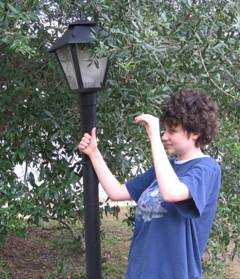
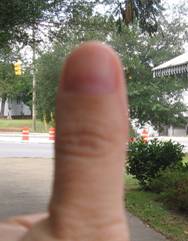
Objects TogetherI love technology, especially digital cameras which are so handy in teaching children with autism. Yesterday my digicam helped me illustrate a difficult passage in a book. Pamela was reading the introduction of the second lesson of our science book. The third and fourth paragraphs discuss how distance affects how big or small an object appears. The lesson tells the child to look at an object outside that is far away and cover it up with their thumb. Since a sign of autism is difficulty looking at things pointed out or tracking moving objects, I was unsure how well Pamela processed those two paragraphs. So, we headed outside and took the following pictures. Pamela narrated, I wrote down what she said in correct English, and she typed what she understood about the pictures:
A lamppost is big. A thumb is small. They are together. The size looks right.
The lamppost is far away. The thumb is close. They are apart. The thumb is small, but it looks big. The lamppost is big, but it looks small. This is an optical illusion. It can trick the eyes. Something closer can look big. Something farther can look small.
Lamppost Far AwayThumb Close

Then I rewrote the material from the third and fourth paragraphs of the book with syntax Pamela can easily understand and added it to Pamela's typed narration. It extended what Pamela observed to the earth, the sun, and other stars:
The sun is big. It is far away. It looks small because it is far away. The earth is small. The earth looks bigger than the sun. It is not! This is another optical illusion because one million earths can fit in the sun.
The sun is a star. The sun looks bigger than a star. They sun is far away. Stars are very, very far away. They look very, very small. This is another optical illusion because some stars are bigger then the sun.
How digital cameras help me homeschool both children:
  • Portray ideas concretely
  • Set-up schedule or communication board
  • Depict steps in a task
  • Show when a bedroom looks clean
  • Illustrate Social Stories
  • Document field trips
  • Display big projects in a portfolio
  • “Scan” textbook pictures to study for a test
  • Record steps in an experiment
  • Transfer drawings digitally
  • Magnify nature specimens
  • Reveal the environment of nature specimens
What I did before I bought one:
  • Order a CD when getting film developed
  • Search for Google images
  • Borrow one
Between my love affair with Excel and digital cameras, I can neither confirm nor deny the fact that I am a techno-holic!